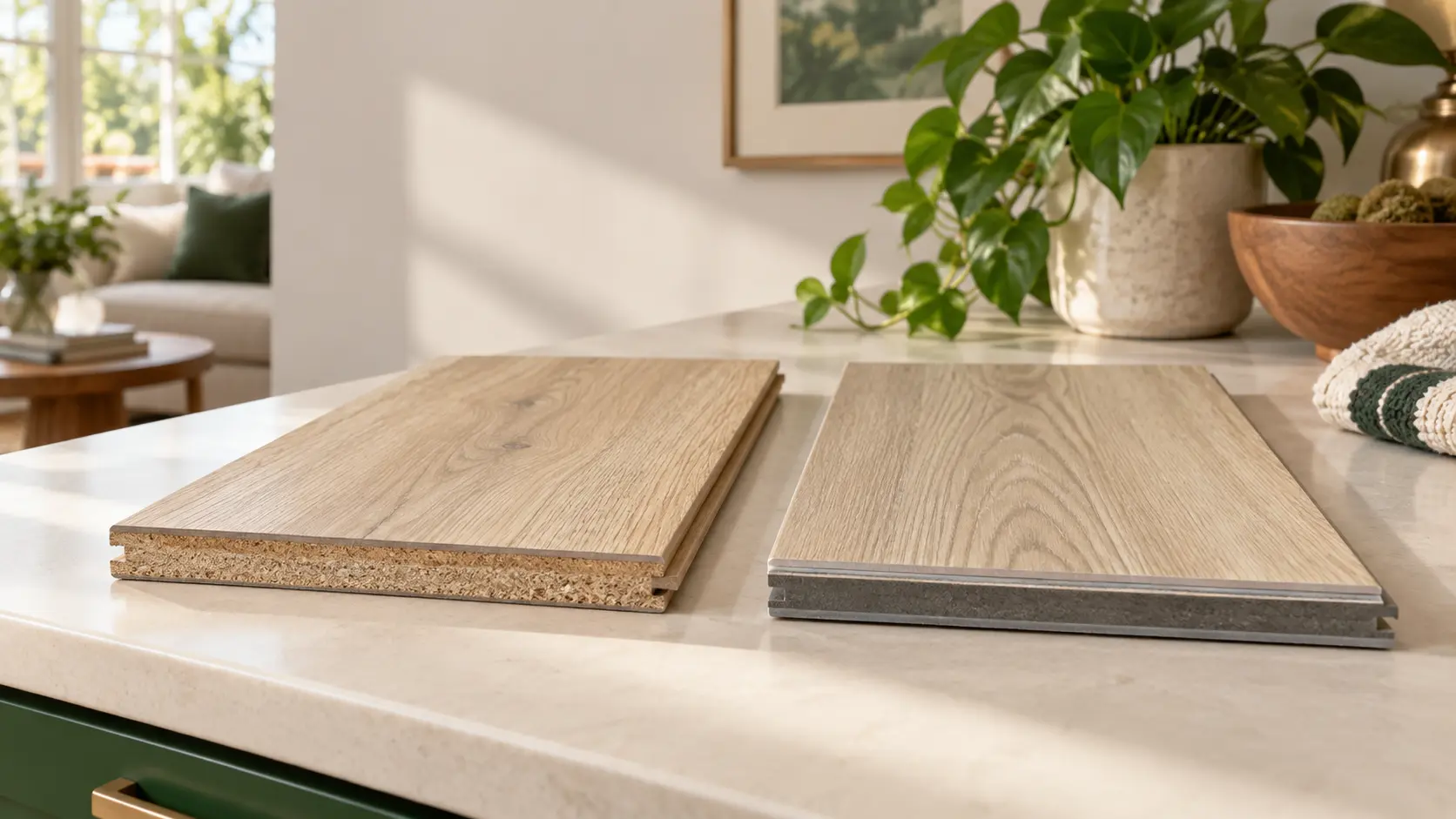
Flooring decision guide
Laminate vs LVP is easier to decide when you compare the exact floor, the room and the written water terms—not just the two material names.
Quick answer
Laminate vs LVP: which should you choose?
Start with LVP when frequent spills are your main concern; shortlist both for a dry living space. A particular laminate can still be suitable for an approved wet-prone room if its manufacturer specifies that use. Neither material wins everywhere. Compare each product’s approved rooms, water warranty, wear performance, subfloor requirements and total installed cost before buying.
Two sample boards can look identical in a store, yet behave differently around seams, furniture and daily cleaning. The real question is: Which specific floor suits this room and this household? Here is a practical comparison of laminate and luxury vinyl plank (LVP), followed by a checklist you can use with two real product labels.
Laminate vs LVP at a glance
Laminate generally combines a decorative image and protective wear surface over a wood-fiber-based core. Luxury vinyl plank (LVP) uses vinyl-based layers; construction and core vary by collection. Sheet vinyl and luxury vinyl tile are different formats, so claims about them do not automatically apply to every plank.
| Question | Laminate | LVP |
|---|---|---|
| Everyday spills | Check the exact product’s water claim, cleanup rules and installation requirements. | Many planks are marketed as waterproof; still check the installed-floor and warranty limits. |
| Water beneath the floor | Investigate the source before installation. | A waterproof plank does not fix a damp subfloor or hidden leak. |
| Scratches and dents | Performance varies by wear surface and product. | Performance varies by wear surface and product. |
| Sound and feel | Test a supported sample with its approved underlayment. | Test a supported sample with its approved pad or underlayment. |
| Cost | Compare the full installed quote. | Compare the full installed quote. |
This is a screening tool, not a material-wide warranty. NALFA’s laminate guidance ties use in excessively moist areas to the manufacturer’s waterproof specification. A named laminate collection such as Pergo TimberCraft is marketed as waterproof; that does not extend its claim to all laminate floors.
What does “waterproof” mean for the installed floor?
Water on the surface
A spilled glass and an appliance leak are different exposures. Check whether the water claim applies to the plank, the installed system or particular everyday spills, and what installation details are required at joints, edges and fixtures. Some laminate collections are sold with waterproof claims; others have narrower terms. LVP warranties also vary by product.
Water below the planks
If a slab is damp or a pipe leaks, changing plank material alone does not remove the moisture. Pause the project, identify the source and ask the installer about required subfloor testing and preparation. NALFA stresses suitable subfloor preparation for laminate; the chosen LVP product needs its own installation check.
For seams, perimeter installation and product warranty language, read our laminate waterproofing guide.
The three-question floor decision
Which floor fits each room?
These are starting points. The exact collection’s approved rooms and instructions decide what you can install.
Living room or bedroom
Consider either. Compare appearance, underfoot feel and sound. In a dry room, do not decide solely on a large waterproof label.
Kitchen or dining area
Start with spill handling. LVP may be convenient; an appropriately approved waterproof laminate may also qualify. Read joint and cleanup terms.
Bathroom or laundry room
Check room approval first. Kitchen-spill approval does not necessarily cover a full bathroom or appliance leak. NALFA cautions against laminate in excessively moist rooms unless specified as waterproof.
Basement
Check moisture first. Neither material repairs a wet slab. Confirm below-grade approval and required subfloor preparation.
Pets, scratches, dents and comfort
Neither category is automatically the scratch winner. Surface finishes, construction and use differ across collections. A thicker-looking plank by itself does not establish scratch resistance. Ask for applicable performance information, and inspect full-size samples in your home’s daylight and evening light.
Try walking on a properly supported display installation if possible. Ask what the manufacturer permits under chairs, rolling furniture and rugs, and whether replacement planks will be available later. Sound and comfort depend on the full assembly: plank, approved pad or underlayment, subfloor and installation. Do not add cushioning that the product instructions do not permit.
Which costs less once installed?
A cheaper carton can become a more expensive project. Request two itemized quotes for the same room and scope. Include old-floor removal, subfloor inspection and preparation, flooring quantity and waste, approved underlayment, transitions, trim, labor and taxes.
Compare the finished totals and the exact manufacturer, collection and product number. Neither click-lock LVP nor laminate should be assumed suitable over an uneven or persistently damp base simply because installation looks straightforward.
Cleaning and long-term care
For either floor, remove loose grit with a suitable soft attachment or broom, clean spills promptly and follow the product’s approved cleaner and moisture instructions. A waterproof label is not a reason to leave puddles in place. Do not assume steam, abrasives or a strong cleaner are safe without checking the maker’s care sheet.
Use our LVP cleaning guide for a practical routine. For swelling, seams or a laminate water claim, use the laminate warranty guide. Your floor’s current instructions take precedence over general advice.
Compare two real products before you buy
Write the two product names side by side. Then complete these six checks for both before accepting a display-card claim.
Identify the exact product
Record brand, collection, product number and current document version.
Confirm your room is approved
Look for the actual kitchen, bathroom, laundry or below-grade permission you need.
Read the water terms
Check covered exposures and exclusions at seams, perimeter, fixtures and below the floor.
Check the installation sheet
Confirm subfloor preparation, moisture requirements, pad and perimeter details.
Check daily care
Compare approved cleaning methods, furniture protection and replacement options.
Compare equivalent installed quotes
Include preparation, accessories, removal and labor—not just carton price.
Laminate vs LVP: FAQs
Is LVP always better than laminate?
Is every laminate floor damaged by water?
Can water get under waterproof LVP?
Which is better for a bathroom?
Is laminate or LVP cheaper?
The practical verdict
For a dry room, shortlist both. For regular splashes, compare products explicitly approved for the room and read their water terms. For a damp subfloor or active leak, resolve the moisture problem before installing either. The better floor is the one whose documented limits fit your room, daily use and complete project budget.
NALFA laminate flooring FAQs · Pergo TimberCraft collection · COREtec product overview. Manufacturer collection marketing is not a substitute for the current warranty and installation documents for the exact product you choose.

