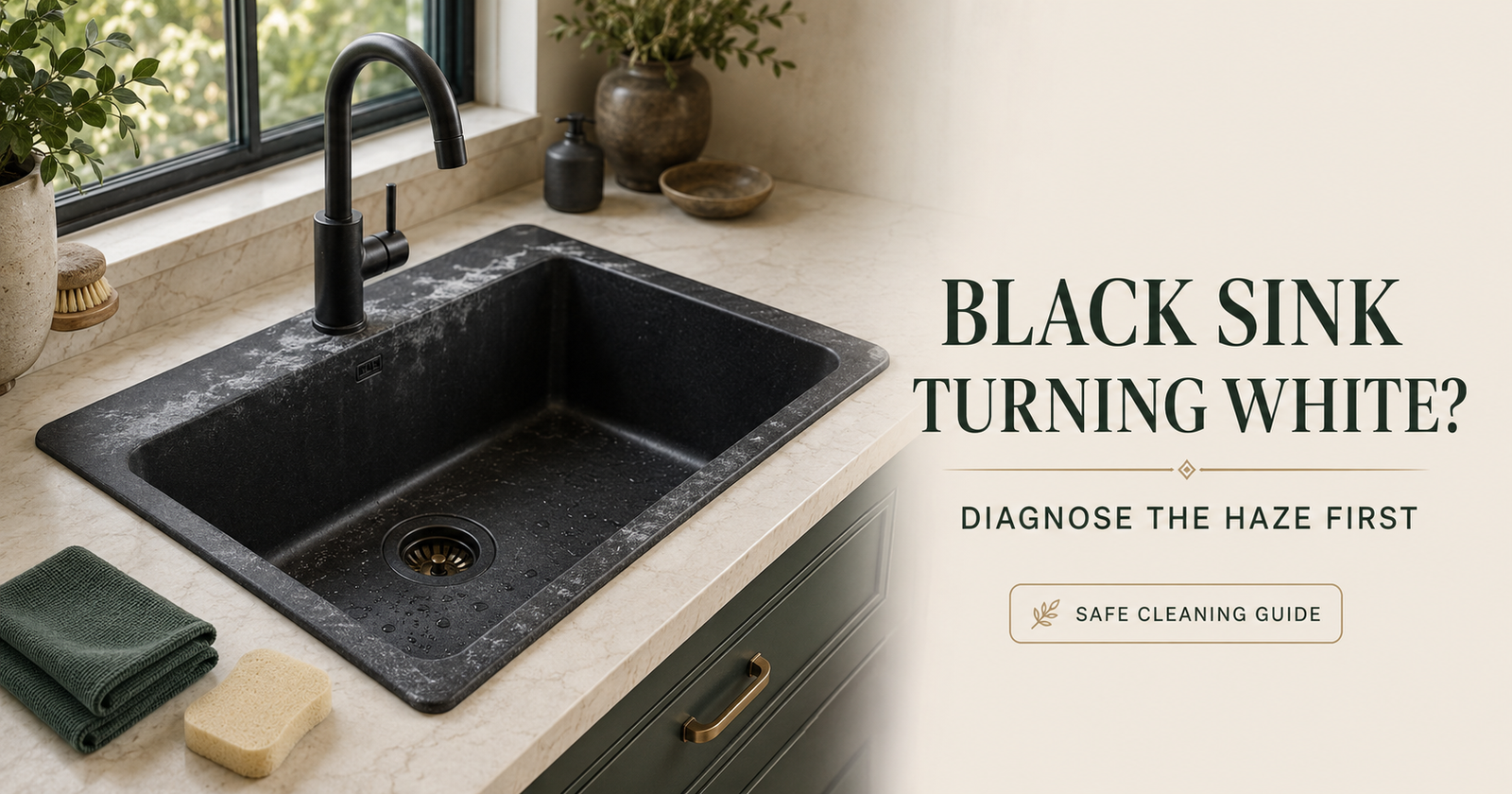
Start with residue removal—not restoration products
A black composite sink turning white is often showing mineral scale or cleaner residue on the dark surface, but a pale area can also be abrasion or other permanent surface change. Start with the least-aggressive cleaning method approved for your sink and reassess before escalating.
- Start: mild dish detergent, the soft side of a non-scratching sponge, clean water and a microfiber cloth.
- Check: whether the haze becomes lighter after cleaning and thorough drying.
- Avoid guessing: do not automatically reach for vinegar, abrasive powder, bleach, a scouring pad or a “restoring” oil.
- Escalate by brand: use a descaling method only after checking the care instructions for your exact sink.
- Stop: if the surface becomes rougher, scratched, patchy, lighter or otherwise changes rather than simply getting cleaner.
1Why Is a Black Composite Sink Turning White?
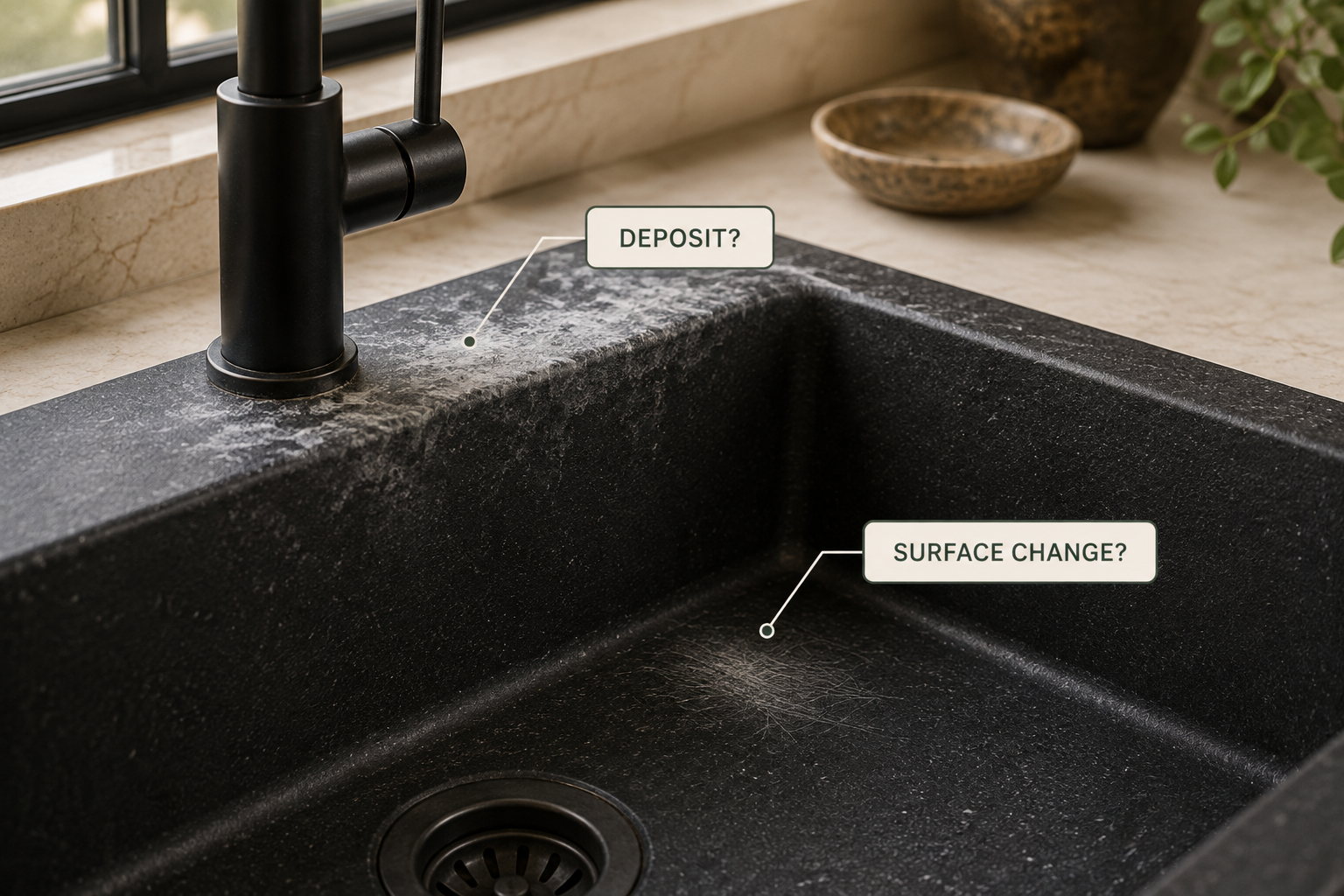
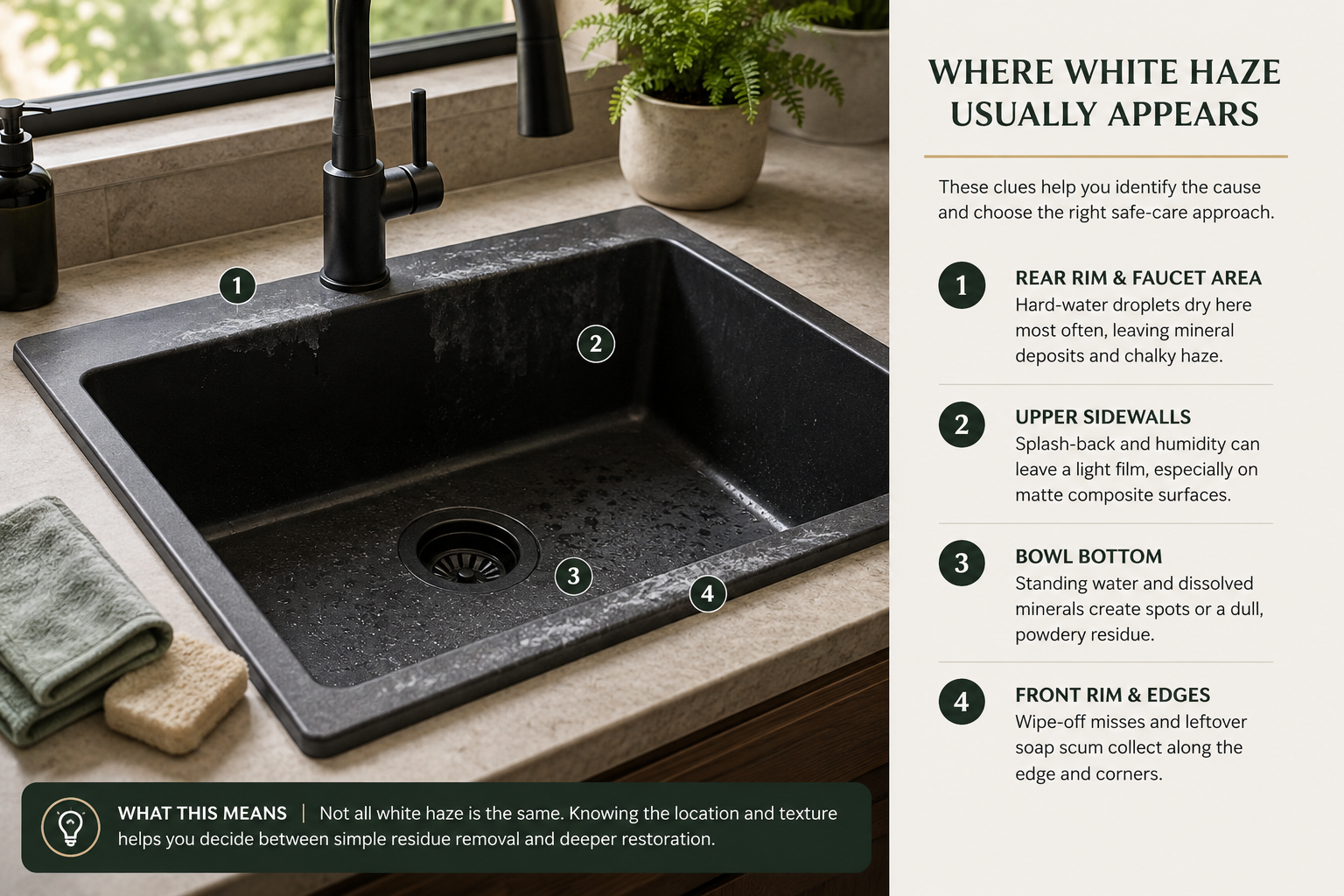
Against a black sink, even a thin pale deposit is easy to see. Hard-water minerals are a common reason: water evaporates but leaves dissolved minerals behind. Repeated droplets can gradually create a chalky or cloudy film, particularly around the faucet, drain, ledges and areas where water regularly dries.
Soap and cleaner residue can create a similar-looking film. In other cases, the problem is not sitting on the surface at all. Repeated abrasive cleaning, an incompatible chemical or physical wear may alter how the surface reflects light, producing a pale or dull patch that ordinary cleaning cannot remove.
That distinction matters. If the problem is a deposit, cleaning may remove it. If the surface itself has changed, progressively stronger cleaning can make the damage worse.
2Diagnose the White Haze Before You Scrub
| What you see | More consistent with | What to do next |
|---|---|---|
| Chalky film near the faucet, drain or drying areas | Mineral or limescale buildup | Begin with routine cleaning, then use only a manufacturer-compatible descaling method if needed. |
| Cloudy or smeary film after dish soap or cleaner dries | Cleaner or soap residue | Rinse thoroughly and dry before deciding that stronger treatment is needed. |
| Sink looks darker while wet but pale again when dry | Possible surface deposit or altered surface appearance | Do not treat the wet appearance as proof that oil will repair the sink. Clean and diagnose first. |
| Localized pale patch with visible scratch marks or roughness | Abrasion or surface change | Stop aggressive cleaning and check the manufacturer’s repair or support guidance. |
| White patch does not change after appropriate cleaning | Possible non-removable surface change | Do not keep increasing abrasiveness simply because the mark remains. |
3Identify the Sink Before Choosing a Stronger Cleaner
Look underneath the sink, in your purchase paperwork, on the manufacturer’s website or in the installation/care documents for the brand and model. Terms such as granite composite, quartz composite and proprietary material names may look similar in a kitchen but do not create one universal care standard.
This is especially important before using an acid-based descaler, abrasive pad, solvent, chlorine-containing cleaner or restoration product.
4Safest First Cleaning for White Haze
The purpose of the first pass is not to attack stubborn scale. It is to remove loose grime and cleaner residue with minimal mechanical or chemical stress, then see what remains.
Clear and rinse the sink
Remove dishes and debris. Rinse the bowl so loose particles are not dragged across the surface during cleaning.
Use mild dish detergent
Apply a small amount to the soft side of a clean, non-scratching sponge or soft cloth. Do not add abrasive powder “for extra power.”
Clean gently and evenly
Work across the affected area without heavy pressure. Cleaning the surrounding surface as well makes the result easier to judge.
Rinse completely
Remove detergent rather than allowing a new soap film to dry on the sink.
Dry with microfiber
Dry the surface completely. A dark sink can look temporarily different when wet, so judge the result after drying.
5Result Checkpoint: What Changed?
If the haze improved significantly
The problem was likely at least partly removable residue. Repeat only the same gentle method if necessary rather than immediately moving to something harsher.
If a chalky deposit remains
Mineral scale becomes more likely, especially in hard-water areas or around places where droplets repeatedly evaporate. Now check the care instructions for the exact brand and material before descaling.
6If It Is Limescale, Escalate by Manufacturer—not by Internet Recipe
This is where generic cleaning advice becomes risky. Manufacturers do not all publish the same instructions for composite sinks.
For example, BLANCO’s official SILGRANIT sink care guidance recognizes limescale as a cause of visible discoloration on dark sinks and provides SILGRANIT-specific descaling guidance. Its routine US care instructions start with dish soap, a soft sponge, rinsing and microfiber drying, while its dedicated cleaning products target limescale and soap film.
SCHOCK’s official quartz-composite sink care guidance likewise recommends mild detergent and a soft cloth or sponge for routine care and warns against highly abrasive cleaners, chlorine-based cleaners, drain cleaners, alkalis and other solvents. Its product-specific care systems differ by quartz-composite finish.
SCHOCK likewise recommends mild detergent and a soft cloth or sponge for routine care and warns against highly abrasive cleaners, chlorine-based cleaners, drain cleaners, alkalis and other solvents. Its product-specific care systems differ by quartz-composite finish.
Other manufacturers can publish materially different instructions. Some granite-composite manuals allow vinegar solutions or specific abrasive procedures under defined conditions. That is why this article does not give one universal vinegar ratio or one universal scrub-pad recommendation for every black composite sink.
7Why Mineral Oil Can Make the Sink Look “Fixed” Without Proving It Is Fixed
A common online tip is to wipe a faded-looking black composite sink with mineral oil or another oil. Darkening the surface can make pale areas look less obvious, but appearance alone does not tell you whether mineral scale or cleaner residue was actually removed.
This creates an important difference between removing the cause and masking its appearance. If an oil is not part of your sink manufacturer’s care instructions, do not use it as a substitute for diagnosing and removing a deposit.
There is another reason not to generalize: some manufacturers prescribe oils for very specific tasks. BLANCO, for example, describes an oil-and-water technique for metal abrasion on SILGRANIT and then instructs the user to remove the oil with dish soap and warm water. That does not establish oil as a universal treatment for white haze on every composite sink.
8What Not to Use Until You Know the Brand
| Cleaner or method | Why caution is needed | Safer decision |
|---|---|---|
| Scouring powder or aggressive abrasive | May alter the surface appearance or leave abrasion depending on the product and sink. | Use only a tool specifically allowed by the exact manufacturer. |
| Steel wool | Can scratch or damage composite surfaces. | Do not substitute it for a soft sponge. |
| Bleach or chlorine cleaner | Brand instructions differ; some explicitly prohibit chlorine-based products. | Check the care manual before use. |
| Drain cleaner on the sink surface | Strong chemistry may damage the material or finish. | Avoid surface exposure and follow both sink and drain-product instructions. |
| Vinegar or acidic descaler | Useful in some manufacturer-approved limescale procedures but not automatically approved for every composite sink. | Use only when your exact manufacturer’s guidance supports it. |
| Melamine “magic” eraser | Its suitability depends on the sink and manufacturer instructions. | Do not assume “non-chemical” means non-abrasive or universally safe. |
| Oil as a color restorer | May change appearance without removing the underlying deposit. | Diagnose and clean first; use care products only as directed. |
9If You Already Used the Wrong Cleaner
Do not immediately add another chemical to “neutralize” the first one. Mixing household cleaners can create additional hazards and may make the surface problem harder to diagnose.
Stop the questionable product
Do not keep repeating a treatment that appears to be making the area lighter, rougher or more uneven.
Rinse when appropriate
If the product label and sink instructions permit normal water rinsing, remove residue thoroughly. Never mix cleaners in an attempt to reverse a reaction.
Dry and inspect
Compare the treated area with the surrounding surface under ordinary light once everything is dry.
Contact the manufacturer when appearance changed
Record the cleaner name, how it was used and what changed. That information is more useful than repeatedly trying new internet remedies.
10When Cleaning Cannot Remove the White Area
Cleaning removes material that is on the surface. It cannot necessarily reverse material that has been physically abraded, chemically altered or otherwise damaged.
Suspect a non-cleaning problem when:
- the pale area has visible scratches;
- the texture feels different from the surrounding sink;
- the mark began directly after aggressive scrubbing or a strong chemical;
- manufacturer-approved cleaning produces no meaningful change;
- the area continues to look patchy after the sink is fully rinsed and dried; or
- the surface is chipped, cracked or structurally damaged.
At that point, the useful question changes from “What stronger cleaner should I try?” to “Does this material have a manufacturer-approved restoration or repair procedure?”
11How to Prevent White Haze From Coming Back
If the problem was mineral or soap buildup, prevention is mostly about preventing residues from being left behind repeatedly.
- Rinse away soap and food residue after routine use.
- Do not leave household cleaner to dry on the bowl unless its instructions specifically require a contact period.
- Dry high-visibility black surfaces with a soft microfiber cloth when practical.
- Pay particular attention to the faucet base, drain area and flat ledges where droplets evaporate.
- Follow the manufacturer’s periodic limescale-care schedule if your water leaves mineral deposits.
- Keep abrasive pads and strong chemicals out of the routine-cleaning workflow unless specifically approved.
For a recurring hard-water problem, a consistent low-aggression routine is usually preferable to letting deposits become heavy and then repeatedly attacking them with stronger treatments.
12Frequently Asked Questions
Why is my black composite sink turning white?
Mineral deposits and cleaner residue are common explanations, especially when the haze is most visible after the sink dries. Abrasion or another surface change can also look pale, so do not assume every white mark is removable scale.
Why does my black sink look normal when wet but cloudy when dry?
Water changes how light reflects from the surface and can temporarily make pale deposits or altered areas less visible. The wet appearance is a useful clue, but it does not prove the cause or prove that oil will restore the material.
Can I use vinegar on a black composite sink?
Do not treat vinegar as universally safe or universally unsafe for the entire composite-sink category. Some manufacturers publish acid-based or vinegar procedures for specific materials and conditions; others provide different care systems. Check the current instructions for your exact sink first.
Is a Magic Eraser safe on a composite sink?
That depends on the exact surface and manufacturer guidance. A melamine foam behaves as a mild abrasive, so “no harsh chemical” does not automatically mean “no surface risk.” Use it only when compatible with your sink’s care instructions.
Does mineral oil restore a faded black composite sink?
Oil may deepen the appearance of a dark surface, but that does not prove it removed mineral scale or repaired damage. Treat oiling and actual deposit removal as separate questions and follow your manufacturer’s care instructions.
How do I know whether the white haze is permanent?
If appropriate routine cleaning and the manufacturer’s approved limescale procedure do not change it, or if the area is scratched, rough or visibly altered, stop escalating blindly. Contact the manufacturer or installer for material-specific guidance.
Final Safe Recommendation
If you are dealing with a black composite sink turning white, begin by assuming you need a diagnosis—not a stronger cleaner. Wash gently with mild detergent and a soft sponge, rinse thoroughly, dry, and inspect the result.
If chalky residue remains, identify the exact brand and follow its current limescale procedure. Do not transfer vinegar ratios, scrub pads, bleach rules or restoration products from one composite-sink brand to another.
The stopping rule is simple: when a treatment starts changing the surface instead of removing material from it, stop cleaning and move to manufacturer or professional guidance.

