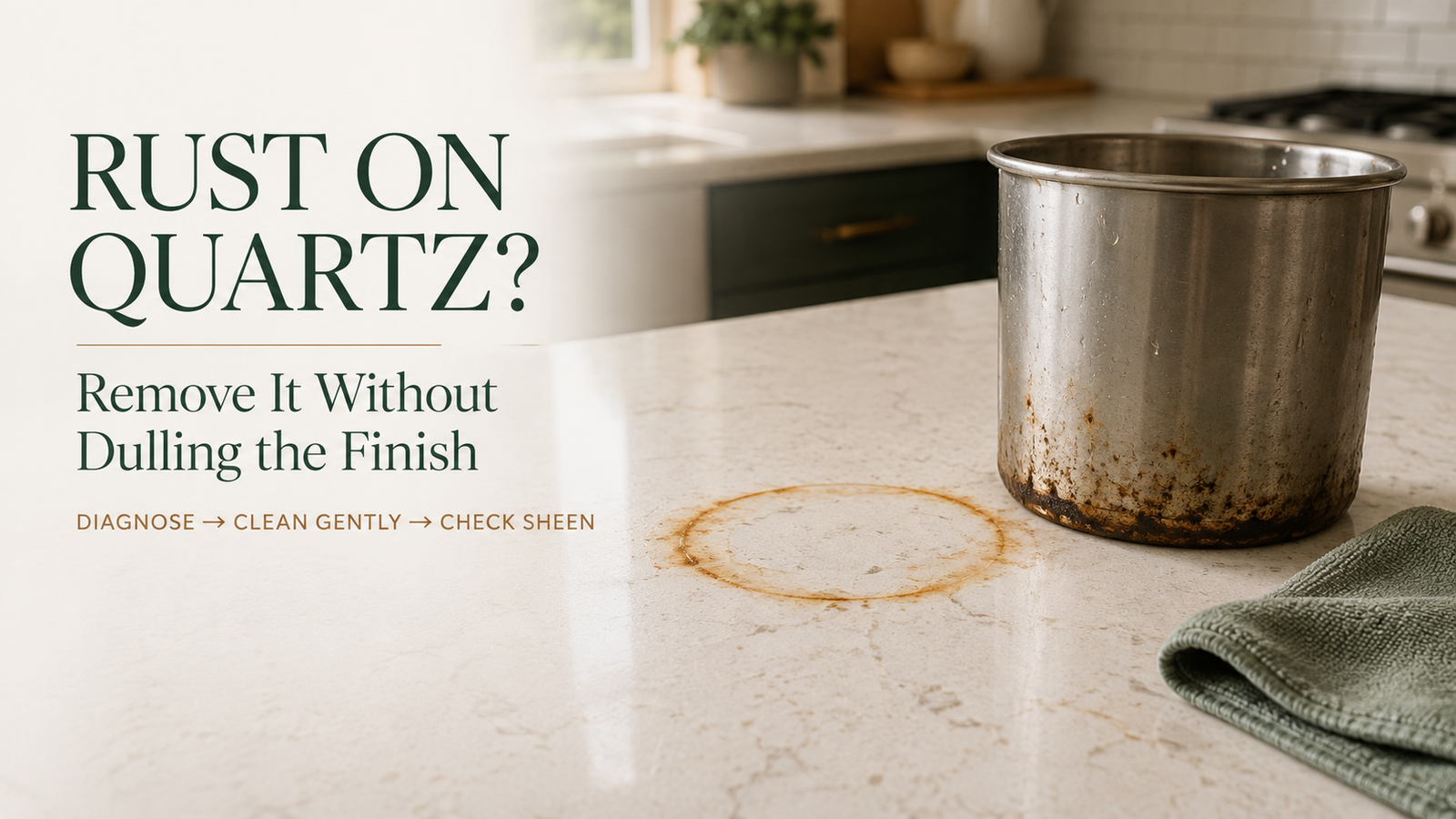
A rust ring on quartz is often removable—but don’t start with a random rust remover
- Start gently: wash away ordinary soil with warm water, mild dish soap, and a soft cloth before treating the orange mark.
- Confirm the surface: engineered quartz, quartzite, marble, and granite are different materials and should not share one cleaning recipe.
- Check the brand: rust-treatment guidance varies. Caesarstone, for example, publishes a specific spot-treatment method for rust and metal marks.
- Avoid blind escalation: do not reach automatically for CLR, strong acids, abrasive pads, steel wool, sanding, or aggressive scrubbing.
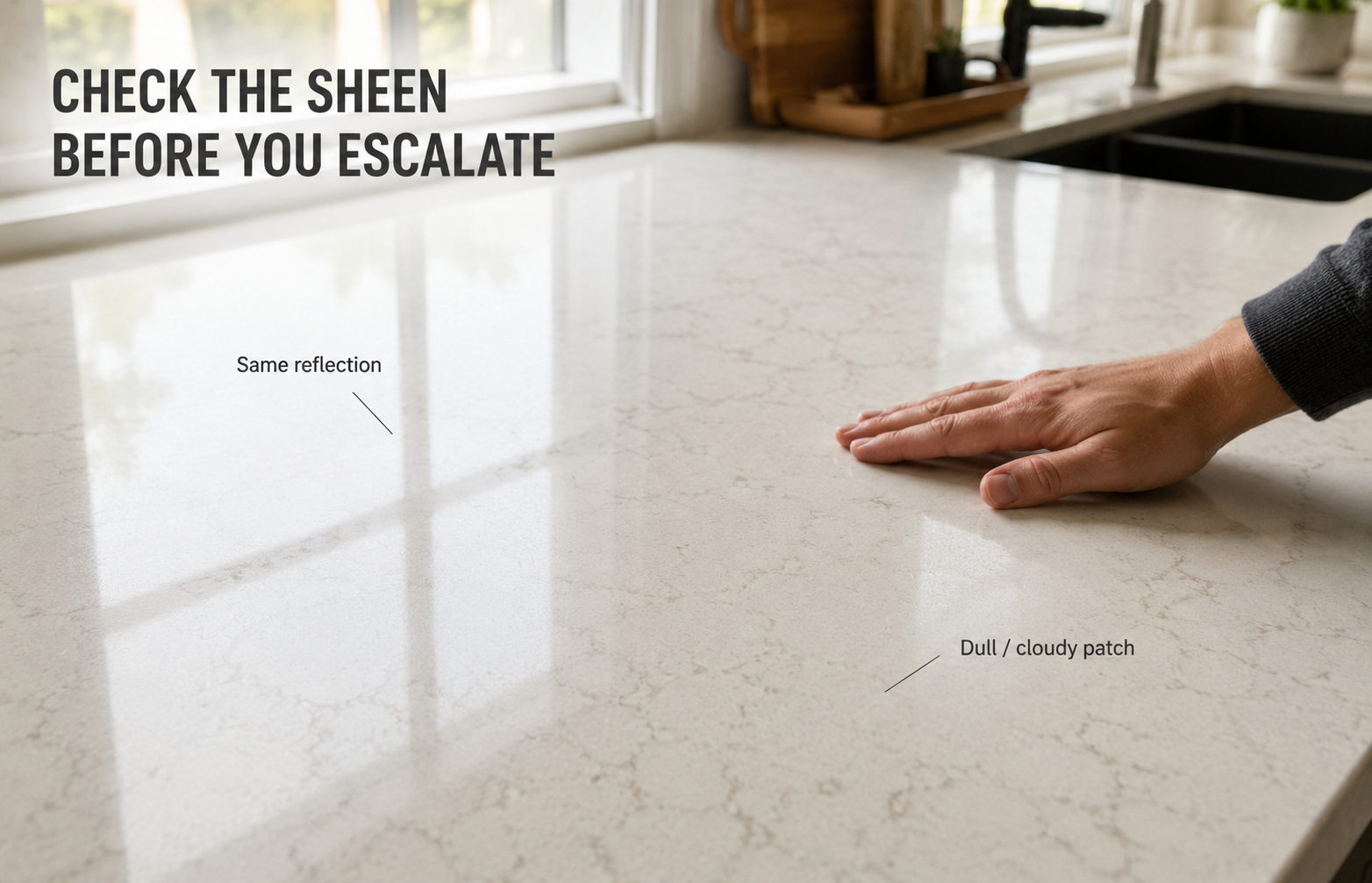
- Stop immediately if the treated area becomes duller, rougher, lighter, or different in sheen from the surrounding countertop.
Trying to remove rust stain from quartz countertop surfaces can become risky when the orange ring looks stubborn. The stain may have come from a wet cast-iron pan, metal can, soap dispenser, appliance foot, or decorative object—but the correct next step depends on the countertop material, finish, and manufacturer.
The safest approach is not to attack the mark harder. First identify what you are looking at, clean the surface gently, then escalate only to a method supported for your exact quartz product. That matters because engineered surfaces contain binders and finishes that can lose sheen or develop a visibly altered patch after overly aggressive cleaning.
Is It Really Rust—or a Different Quartz Problem?
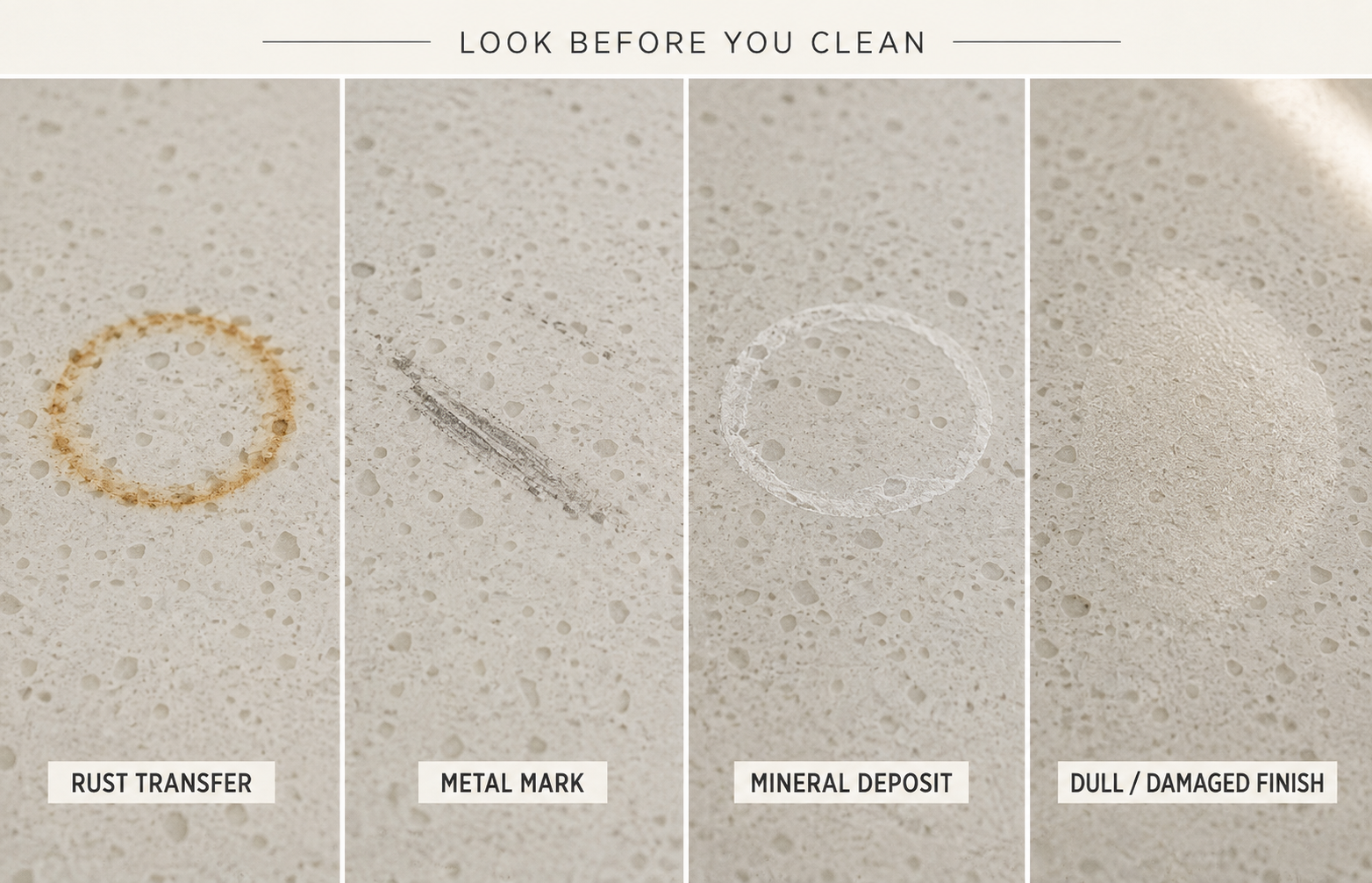
A brown or orange ring directly underneath a wet metal object strongly suggests transferred rust. But color alone is not enough to diagnose the problem. Mineral deposits, metal transfer, residue, or surface damage can look surprisingly similar from above.
| What you see | More likely explanation | What to do first |
|---|---|---|
| Orange-brown ring exactly where wet metal sat | Transferred rust | Confirm quartz brand, then start with mild cleaning |
| Gray or dark streak that looks rubbed onto the surface | Metal transfer mark | Use the manufacturer’s metal-mark guidance |
| White or chalky ring near a faucet or wet container | Mineral scale rather than rust | Treat as hard-water buildup, not as rust |
| Cloudy or matte patch that remains after the color is gone | Cleaner residue, abrasion, or surface alteration | Stop chemical escalation and inspect the sheen |
| Orange/brown color appears to sit within the slab rather than on top | Possible material inclusion or internal discoloration | Contact the fabricator or manufacturer before repeated cleaning |
Confirm That You Have Engineered Quartz Before Cleaning
“Quartz countertop” is often used casually for several different surfaces. Engineered quartz or modern mineral surfaces are manufactured products; quartzite, marble, granite, porcelain, and solid-surface counters are different materials. A cleaner appropriate for one can be a poor choice for another.
Look at your installation paperwork, invoice, leftover sample, underside label, fabricator record, or manufacturer color name. If you know the brand—such as Caesarstone or Silestone—use that manufacturer’s current care page for the exact product and finish.
Remove Rust Stain From Quartz Countertop: Start With the Least-Aggressive Clean
Before using a rust-specific product, remove grease, food film, and ordinary surface soil. Sometimes a light orange mark is partly sitting in residue rather than directly on the countertop.
Remove the metal source
Move the pan, can, dispenser, or other object away from the counter. Dry its base so it cannot transfer more rust back to the surface.
Use warm water and mild soap
Dampen a clean, soft cloth with warm water and a small amount of mild dish soap. Wipe the stained area without heavy pressure.
Rinse away the soap film
Use a second clean cloth dampened with plain water. Do not leave detergent residue behind, because film can make the area look cloudy.
Dry completely
Dry with a soft towel and inspect the mark once the surface is no longer wet. Water can temporarily disguise a change in sheen.
If the orange color has disappeared, stop. There is no benefit in moving to a stronger cleaner after the problem is already solved.
Check the Result Before You Escalate
Move your head or a nearby light so illumination travels across the countertop at a low angle. Compare the treated spot with the surrounding surface instead of judging only the stain color from directly above.
If Rust Remains, Follow Your Quartz Manufacturer—not a Generic Hack
Brand-specific guidance is the most important escalation step. Manufacturers do not always publish identical cleaning instructions, and recommendations can differ by product generation, finish, market, and stain type.
Caesarstone: published rust and metal-mark guidance
Caesarstone’s current U.S. care guidance has a dedicated Rust & Metal Marks procedure. It instructs owners to place a small amount of Bar Keepers Friend Cleanser powder or oxalic acid on a damp cloth, wipe very gently in a circular motion, then rinse thoroughly with warm water and dry with a soft cloth or paper towel. It specifically warns against using an abrasive scourer.
Check Caesarstone’s current quartz and mineral-surface care instructions before using that method, especially if you have a dark, honed, concrete, or rough finish.
Caesarstone’s FAQ also describes its Bar Keepers Friend treatment as spot cleaning and emphasizes very light pressure and thorough rinsing rather than forceful scrubbing.
See Caesarstone’s current FAQ for metal and rust marks.
Silestone/Cosentino: verify the current product guidance first
Current Cosentino material emphasizes routine cleaning with water and mild soap and warns against abrasive or harsh products in general-use guidance. Older and regional Silestone documents contain different stain-specific instructions, which is a good reason not to apply one archived recipe automatically to every Silestone installation.
Use Cosentino’s current Silestone product information to identify your surface, then follow the care instructions linked for your market or contact Cosentino if the stain-specific method is unclear.
What Not to Use Blindly on a Quartz Rust Stain
A stubborn orange ring tempts people to escalate quickly. The danger is that a stronger treatment can remove the color while leaving a larger dull or chemically altered patch.
| Method or product | Why caution is needed | Safer decision |
|---|---|---|
| Steel wool or metal scouring pads | Can scratch the surface and may create additional metal transfer | Avoid |
| Aggressive abrasive pads | Can change sheen even when the stain fades | Use only a tool your exact manufacturer approves |
| Magic Eraser / melamine foam | Its mild abrasive action can alter some finishes; Caesarstone professional guidance warns against it on its surfaces | Do not assume it is harmless |
| CLR or another strong descaler/rust remover | Formulations and manufacturer compatibility vary | Use only with explicit product/manufacturer support |
| Strong acids or alkalis | Can attack binders, alter appearance, or violate care restrictions | Avoid unless your exact manufacturer specifically instructs otherwise |
| Sanding or DIY polishing | Can permanently create a different sheen or texture | Leave surface refinishing to an appropriate professional |
Already Tried Vinegar, Bleach, CLR, Bar Keepers Friend, or Heavy Scrubbing?
First stop adding products. Combining cleaners or repeatedly alternating methods makes it harder to tell whether you are looking at remaining rust, cleaner residue, abrasion, or chemical alteration.
If the surface looks normal after rinsing and only the rust color remains, return to your manufacturer’s stain guidance. If the rust is gone but a cloudy, light, matte, or rough patch remains, more rust remover is unlikely to solve that new problem.
Rust Is Gone but the Quartz Looks Dull—What Now?
A dull patch after stain removal can have several causes. Soap or cleaner film may temporarily scatter light. Repeated rubbing can also alter the way a finish reflects light, and unsuitable chemicals may cause a more persistent visual change.
Start with a plain-water rinse and thorough drying. If the appearance returns to normal, residue was the more likely explanation. If a clean, dry patch remains visibly different from every angle, stop DIY polishing and contact the surface manufacturer or fabricator.
Do not try to “blend” the patch by scrubbing a larger area. Enlarging a damaged zone does not restore the original factory finish.
When Cleaning Probably Cannot Fix the Orange Mark
Repeated cleaning is the wrong path when the discoloration appears to be inside the material, is associated with a crack or seam, has no plausible external metal source, or remains unchanged after the manufacturer’s approved cleaning sequence.
Also stop if you notice:
- a persistent change in gloss or texture;
- a pale or bleached-looking patch around the former stain;
- visible scratches created during treatment;
- a mark that appears beneath the surface rather than on it;
- cracking, resin damage, edge damage, or a failing seam; or
- a stain that requires stronger chemicals than the manufacturer approves.
At that point, photograph the area in normal and side lighting and contact the manufacturer, installer, or fabricator. Include the brand, color/product name, finish, approximate installation date, what caused the mark, and every cleaner already used.
How to Prevent Rust Rings on Quartz
The easiest rust stain to remove is the one that never transfers. Keep wet ferrous metal from sitting directly on the counter for long periods.
- Dry the bottoms of cast-iron pans before setting them down.
- Do not leave steel cans on a wet counter.
- Check metal soap dispensers, utensil holders, plant containers, scales, and small appliances for hidden corrosion underneath.
- Use a clean, non-staining tray or protective barrier under objects that remain beside a sink.
- Wipe standing water instead of allowing it to remain trapped below metal.
- Clean newly forming orange transfer early rather than waiting for a heavy ring to develop.
Frequently Asked Questions
Can a rust stain permanently damage a quartz countertop?
Surface rust transfer may be removable, but the treatment used to remove it can create a different problem if it changes the countertop’s sheen or texture. An orange mark that appears to be inside the slab may also require manufacturer or fabricator assessment rather than more cleaning.
Is Bar Keepers Friend safe for quartz countertops?
Not as a universal rule. Caesarstone currently publishes a specific spot-treatment procedure using a small amount of Bar Keepers Friend Cleanser powder for rust and metal marks. That permission applies to Caesarstone’s published guidance and should not automatically be generalized to every quartz brand.
Can I use CLR to remove rust from quartz?
Do not assume CLR or another rust/descaling product is compatible with your countertop. Check both the cleaner label and the current care instructions for your exact surface brand and finish before use.
Will vinegar remove rust from quartz?
Vinegar appears in some manufacturer guidance for specific cleaning problems, while other current surface guidance cautions against acidic products. Because formulations and recommendations vary, vinegar should not be treated as a universal quartz-rust solution.
Why did my quartz look dull after I removed the rust?
First rule out cleaner or soap residue by rinsing with plain water and drying thoroughly. If the clean, dry area still reflects light differently from the surrounding countertop, stop scrubbing or polishing and contact the manufacturer or fabricator.
Can a Magic Eraser damage quartz?
Melamine foam has abrasive action. Caesarstone professional guidance specifically warns that Magic Eraser can damage the finish or sheen of its surfaces. Use only cleaning tools supported by the manufacturer of your exact countertop.
How do I know whether the orange mark is rust or part of the slab?
A ring matching the base of a wet metal object is consistent with transferred rust. A mark with no external metal source, or one that appears to sit below the surface, deserves manufacturer or fabricator assessment before repeated chemical treatment.
Should I polish quartz after removing a rust stain?
Do not use DIY sanding or polishing simply because a treated spot looks dull. Factory finishes are difficult to reproduce locally, and aggressive polishing can make the visual mismatch larger.
Final Safe Recommendation
To remove rust stain from quartz countertop surfaces safely, begin with mild soap, water, a soft cloth, and a full rinse-and-dry checkpoint. If rust remains, identify the exact brand and follow its current stain guidance rather than escalating from a generic internet recipe.
For Caesarstone, current U.S. guidance specifically provides a gentle Bar Keepers Friend powder/oxalic-acid spot-treatment method for rust and metal marks. For another brand, use that brand’s instructions instead. Stop cleaning if the sheen, color, or texture changes.

