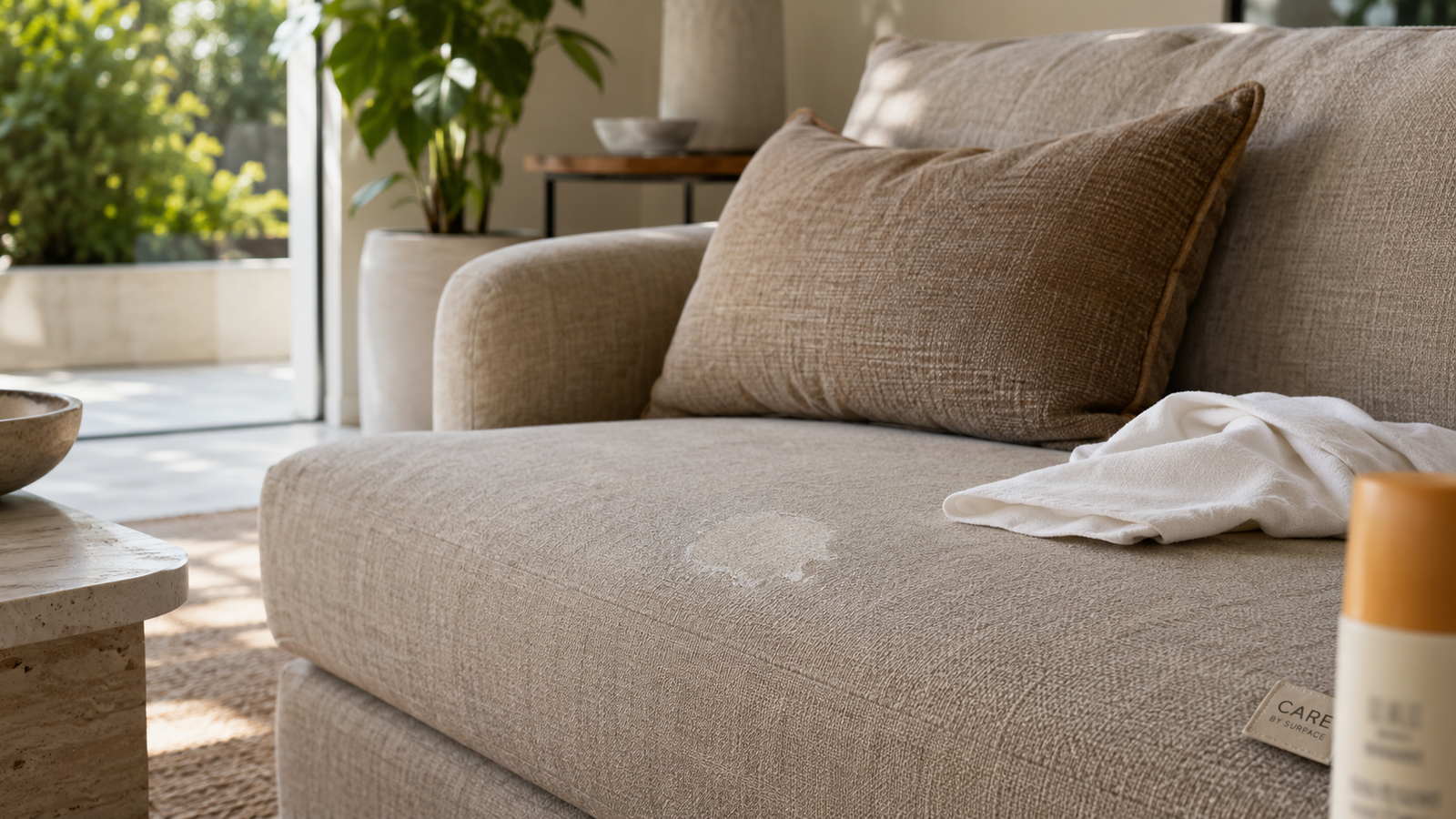
Treat the fabric label and brand as the safety limit
A sunscreen stain on performance fabric couch upholstery should not be treated with a universal cleaner. Blot fresh transfer first, identify the upholstery brand or cleaning code, and use the least-aggressive method that the fabric manufacturer allows.
- Do now: blot or lift excess sunscreen without grinding it into the weave.
- Check next: furniture care label, fabric brand and W/S/WS/X instructions where provided.
- Avoid: random bleach, alcohol, vinegar, dry-cleaning solvent or aggressive scrubbing unless the exact fabric guidance permits it.
- Prevent a second problem: control moisture and rinse cleaner residue thoroughly.
- Stop: if color transfers, pile changes, the ring expands or the manufacturer’s instructions prohibit the next treatment.
1Identify the Fabric Before You Clean the Sunscreen
“Performance fabric” describes a performance goal, not one universal fiber or cleaning chemistry. Two sofas marketed as stain-resistant may have very different instructions. That matters because a method that is explicitly allowed for one branded fabric can be discouraged on another.
Start with the furniture tag, manufacturer documentation or the fabric name supplied with the sofa. If the upholstery is branded Sunbrella, Crypton or Revolution, follow that brand’s care instructions rather than assuming all three are interchangeable.
What W, S, WS and X usually tell you
| Code | General meaning | What it means for this stain |
|---|---|---|
| W | Water-based upholstery cleaning is generally permitted. | Use only a fabric-compatible water-based treatment and avoid oversaturation. |
| S | Solvent cleaning is specified instead of water. | Do not introduce water simply because another sofa guide recommends it. |
| WS | Water- or solvent-based treatment may be allowed. | Manufacturer instructions still determine which chemistry and technique are appropriate. |
| X | Vacuuming or professional methods are typically required; consumer wet cleaning is not the default. | Do not experiment with DIY liquid spot cleaners. |
The code is a starting point, not permission to use every product in that category. Brand-specific guidance and the furniture maker’s warranty instructions take priority.
2What Does the Sunscreen Mark Actually Look Like?
Before adding cleaner, look at the stain in good light. Sunscreen can leave several different-looking problems, and a failed cleaning attempt can create an additional mark that was not part of the original spill.
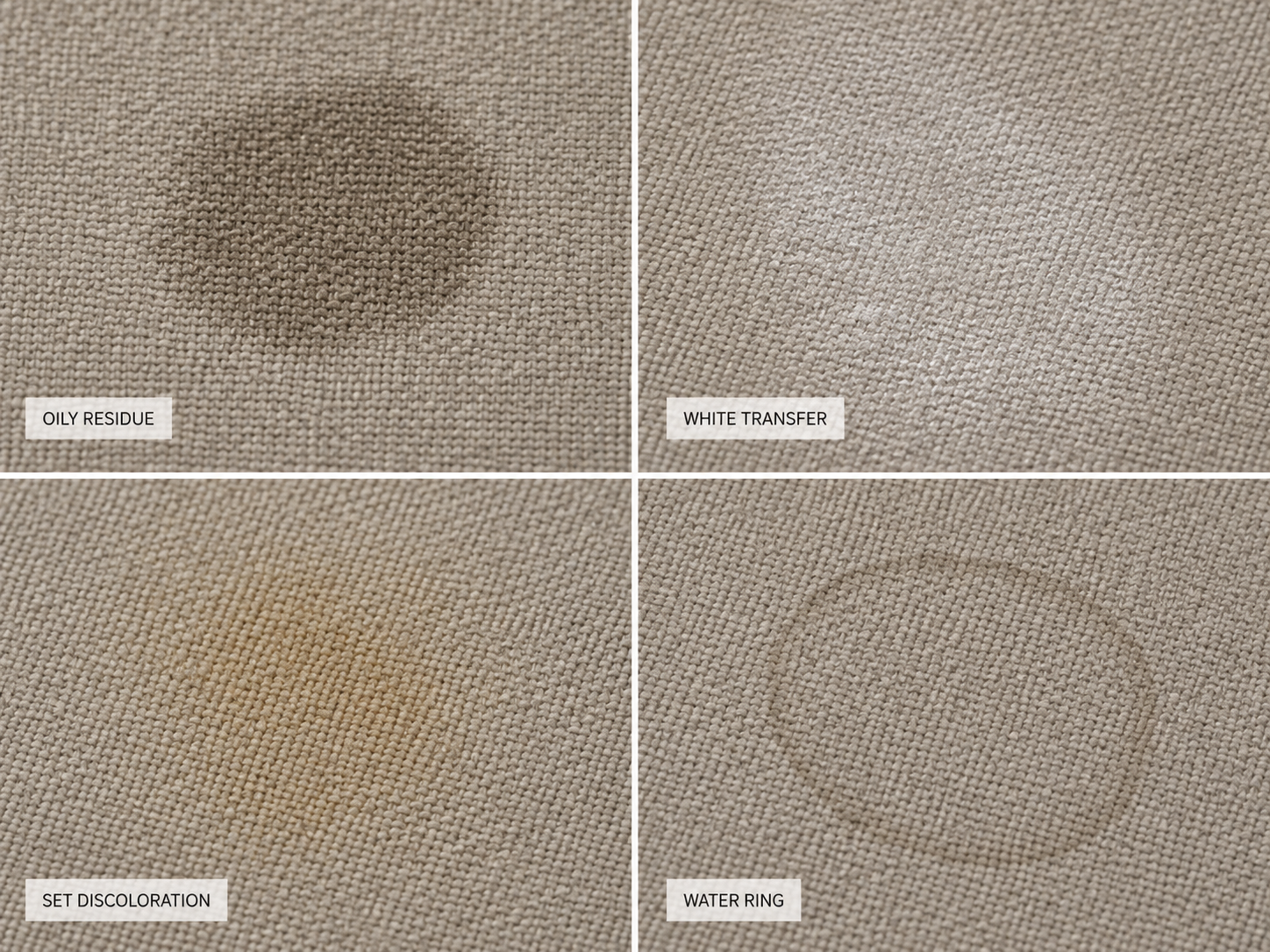
| Appearance | Likely issue | First priority |
|---|---|---|
| Greasy or darker patch | Oil/wax-rich sunscreen residue | Blot/lift residue, then follow the brand’s oil-stain route. |
| White or chalky transfer | Visible sunscreen solids or dried product residue | Remove loose residue gently before wetting. |
| Yellow or orange discoloration | Set stain, ingredient interaction or altered residue | Do not escalate blindly; confirm manufacturer-approved stain treatment. |
| Pale ring surrounding the cleaned area | Water/cleaner migration or leftover detergent | Stop repeated spot soaking and follow the brand’s full-area/rinse guidance. |
| Fuzzy, flattened or lighter texture | Possible abrasion, pile distortion or color change | Stop scrubbing; more chemistry may not repair physical damage. |
3Fresh Sunscreen: What to Do First
If the transfer is fresh, the safest immediate goal is removal of excess product—not aggressive stain treatment.
- Lift excess product. If there is a blob of lotion on the surface, lift it carefully with a dull straight edge or clean spoon rather than pushing it deeper into the weave.
- Blot, don’t grind. Use a clean white absorbent cloth and work with light pressure. Replace the cloth area as sunscreen transfers onto it.
- Check the label and fabric brand. Do this before introducing detergent, bleach, solvent, alcohol or another household cleaner.
- Test any approved treatment discreetly. Use an inconspicuous area if the manufacturer recommends spot testing.
- Control moisture. Upholstery may contain foam, batting, adhesives or nearby materials that do not share the face fabric’s chemical resistance.
4Sunbrella vs Crypton vs Revolution: Follow the Brand, Not the Word “Performance”
The most important safety distinction in this guide is that the three brands below publish materially different care directions.
| Fabric | Published starting direction | Critical caution |
|---|---|---|
| Sunbrella upholstery | Blot spills, use its soap-and-water guidance, rinse thoroughly and air dry. Its stain guide places sunscreen with oil-based stains and provides additional oil-stain treatment options. | Clean the upholstery appropriately and rinse residue; Sunbrella notes that seam-to-seam cleaning may be needed to avoid water rings. |
| Crypton | Crypton recommends blotting, plain water first for routine spot treatment, then a mild detergent solution when needed, with careful rinsing. | Its published spot-cleaning guidance says not to oversaturate and does not recommend bleach or solvents as a standard treatment. |
| Revolution Performance Fabrics | For oil stains including sunblock, Revolution specifically suggests trying a baby wipe first, followed if necessary by its mild dish-detergent-and-water procedure. | Revolution publishes separate bleach-cleanable guidance for its fabrics but discourages solvent-based products. Do not transfer this permission to other brands. |
For current instructions, check the official Sunbrella Cleaning Guide, Crypton spot-cleaning instructions, or Revolution cleaning instructions for the exact fabric you own.
5If the Sofa Is Sunbrella
Sunbrella’s current upholstery instructions begin with removing loose dirt, blotting spills and cleaning with a mild soap-and-water solution. The company emphasizes thorough rinsing and air drying. Its stain-specific guide lists sunscreen among oil-based stains and recommends an absorbent treatment for fresh oil, followed by its soap solution and, for persistent oil residue, an appropriate oil-stain treatment.
- Blot fresh sunscreen and remove excess without rubbing it across the fabric.
- Follow the exact dilution in the current Sunbrella guide rather than guessing a stronger soap concentration.
- Work gently with the tool Sunbrella permits for the fabric.
- Rinse thoroughly so detergent and loosened sunscreen do not dry back into the upholstery.
- Allow the upholstery to air dry and judge the result only after it is dry.
If a persistent oil-based mark remains, use Sunbrella’s current oil-stain guidance rather than improvising with a household solvent. When spot cleaning creates visible rings, Sunbrella specifically notes that cleaning the entire fabric area from seam to seam may be needed.
6If the Sofa Is Crypton
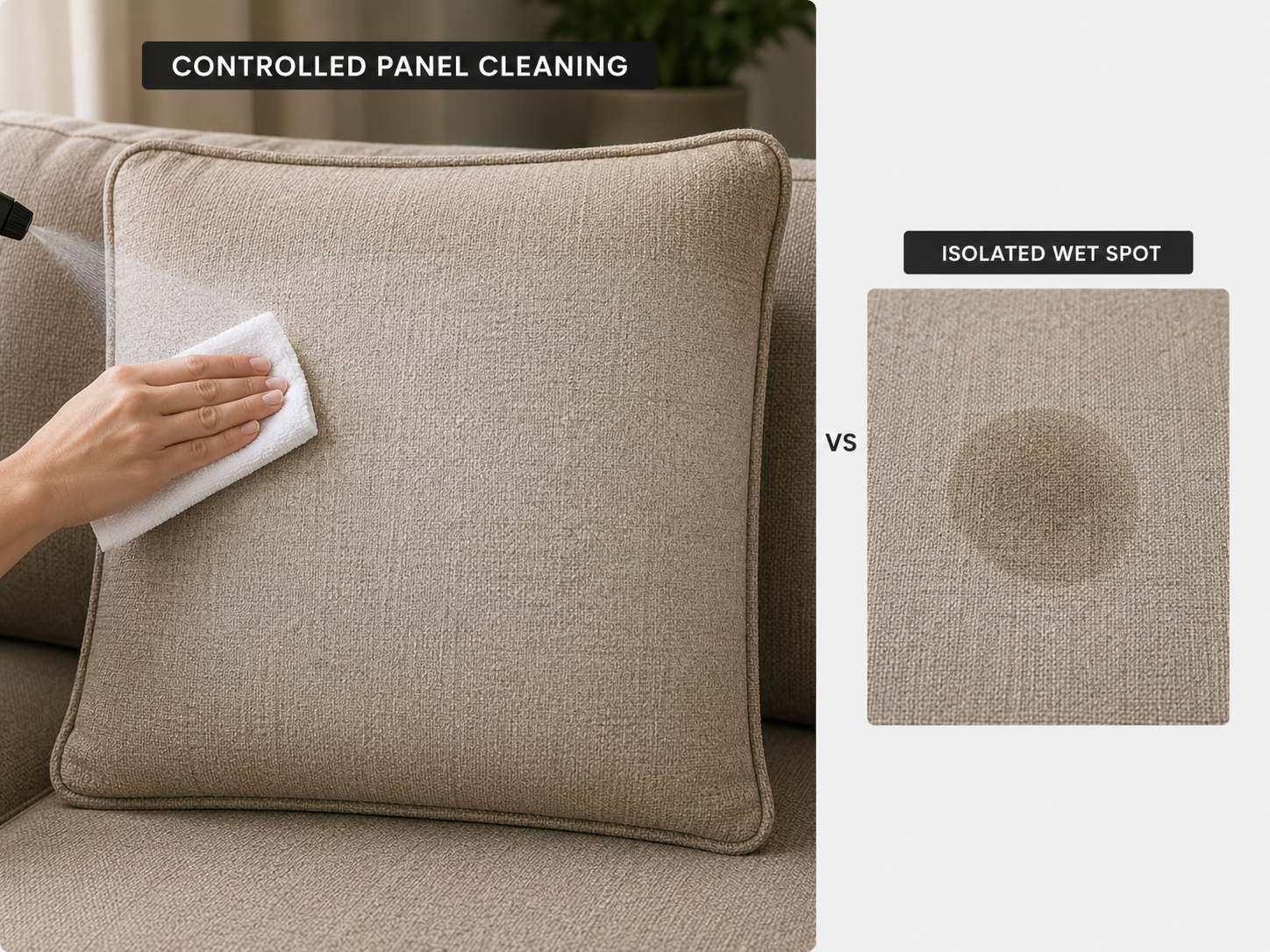
Crypton’s published spot-cleaning method is deliberately controlled. It starts with blotting loose or liquid soil and trying plain water. For persistent stains, Crypton specifies a mild detergent solution, mist application, light agitation and thorough rinsing.
The key mistake to avoid is saturation. Crypton warns against oversaturating its upholstery during spot cleaning, and its instructions emphasize removing soap residue because residue attracts dirt.
- Blot the sunscreen transfer with a clean, soft towel.
- Try the manufacturer’s plain-water step where appropriate.
- If needed, prepare only the mild detergent concentration specified by Crypton.
- Mist rather than flood the stain.
- Work lightly from the outside toward the center so the stain does not spread.
- Rinse according to the manufacturer’s instructions and blot excess moisture.
- Air dry before deciding whether another treatment is justified.
7If the Sofa Uses Revolution Performance Fabric
Revolution gives unusually specific guidance for an oil stain such as sunblock. Its current cleaning instructions say to try a baby wipe first. If that does not remove the mark, Revolution specifies a mild dish-detergent solution made with 2 ounces of detergent in 30 ounces of water.
The manufacturer then instructs users to wet the relevant cover area, rub/blot the stained area, remove excess moisture, rinse with clean water—sometimes more than once—and allow the fabric to dry.
Revolution also publishes bleach-cleanable guidance for its performance fabrics, while telling owners not to use flammable or solvent-based cleaners. For sunscreen, however, start with the manufacturer’s oil-stain instructions rather than jumping directly to a stronger treatment.
8Result Checkpoint: Clean Again, Rinse, or Stop?
Do not judge wet upholstery as though it were dry. Water temporarily changes fabric color and can hide residue. Let the treated section reach the drying stage specified by the manufacturer before deciding what happened.
9If Cleaning Created a Water Ring
A ring after spot cleaning does not automatically mean the original sunscreen became permanent. It may be a boundary where moisture, detergent or suspended soil migrated outward while the spot dried.
Do not keep pouring cleaner onto the center. First check the fabric manufacturer’s instructions. Sunbrella, for example, advises that cleaning the entire upholstery surface from seam to seam may be required to prevent rings and residue. That should not be generalized to a fabric whose care code does not permit water.
If the cushion is visibly saturated, the ring is spreading, the backing remains wet or the fabric code is unclear, professional upholstery cleaning is safer than repeated home spot treatments.
10What Not to Use Without Exact Fabric Approval
| Method/product | Why it can be a problem | When it may be legitimate |
|---|---|---|
| Bleach | Can damage dyes, yarns, backing or nearby materials when the textile is not designed for it. | Only where the exact manufacturer explicitly permits the concentration and procedure. |
| Rubbing alcohol / solvent cleaner | May affect color, coating, backing or adhesives. | Only where the exact textile care instructions allow that solvent. |
| Vinegar | Generic DIY advice does not establish compatibility with the sofa’s fiber, finish or backing. | Only when supported by the manufacturer for the exact application. |
| Hard brushing | Can fuzz, mat or distort the surface and leave a visibly different patch. | Use only the brush type and pressure allowed by the fabric maker. |
| Steam | Heat and moisture compatibility vary by fabric and construction. | Only where the manufacturer specifically allows steam or hot-water extraction. |
| After-market stain protector | Can alter appearance/performance and may affect warranty coverage. | Only with explicit fabric/furniture manufacturer approval. |
11When Cleaning Is No Longer the Right Fix
Repeated cleaning cannot reliably repair every visible change. Stop DIY escalation if you see:
- fabric dye transferring to your cleaning cloth;
- fuzzing, flattening or pile distortion;
- a patch becoming lighter than the surrounding upholstery;
- backing or cushion foam remaining saturated;
- a water ring expanding after each attempt;
- a cleaning code that conflicts with the method you were about to use;
- a persistent stain after the manufacturer’s permitted repetitions; or
- instructions directing you to professional extraction or specialist cleaning.
At that point, contact the sofa manufacturer, fabric brand or a professional upholstery cleaner and tell them exactly what was applied already. That history matters when diagnosing residue, dye change or overwetting.
12How to Prevent the Next Sunscreen Mark
- Allow sunscreen to absorb or dry before leaning bare arms, shoulders or legs against upholstered furniture.
- Keep a washable throw on frequently used seating during heavy sunscreen use.
- Blot fresh transfer promptly instead of letting oily residue sit and collect soil.
- Keep the sofa’s exact fabric name and care instructions with your household records.
- Do not add an aftermarket fabric protector unless the manufacturer confirms compatibility.
- After wet cleaning, rinse as directed so detergent residue does not become the next visible mark.
13Frequently Asked Questions
Can I use Dawn dish soap to remove sunscreen from a performance-fabric couch?
Only if the exact upholstery instructions permit a mild dish detergent. Sunbrella, Crypton and Revolution all publish detergent-based procedures in certain contexts, but the specified concentration and method differ. Follow your manufacturer’s recipe instead of mixing a stronger solution.
Can sunscreen permanently stain a couch?
It can leave persistent oily, white, yellow or orange discoloration, especially after the residue has set or after an incompatible cleaner is used. However, a visible mark is not automatically permanent. Diagnose the fabric and follow its approved cleaning path before deciding that replacement or professional treatment is necessary.
Why did my couch get a ring after I cleaned the sunscreen?
The ring may come from uneven wetting, cleaner residue or soil moving toward the edge of the damp area. Some manufacturers recommend treating a larger seam-to-seam area to avoid rings, but only use that approach when water cleaning is permitted for the exact upholstery.
Can I use bleach on performance fabric?
Not as a category-wide rule. Revolution publishes bleach-cleanable instructions for its performance fabrics, while Crypton’s standard spot-cleaning guidance says bleach is not recommended. Sunbrella has its own bleach procedures for specific cleaning situations. Always follow the exact brand and furniture instructions.
Should I scrub a dried sunscreen stain?
Aggressive scrubbing can distort the surface or spread residue. Remove loose material first and use only the agitation method allowed by the fabric maker—typically blotting, a soft cloth or an approved soft brush.
What if I cannot find the couch cleaning code?
Look for the furniture manufacturer’s care page, the fabric brand or the original product documentation. If the material still cannot be identified, avoid strong cleaners and contact the manufacturer or an upholstery professional before wetting or solvent-cleaning the fabric.
How do I remove an orange sunscreen stain from upholstery?
Treat orange or yellow discoloration as a set stain rather than simply adding stronger cleaner. Follow the stain-removal sequence allowed for the exact fabric. If approved treatment does not improve it—or if color or texture changes—stop and seek manufacturer or professional guidance.
Final Safe Recommendation
For a sunscreen stain on performance fabric couch upholstery, start by removing excess sunscreen, identify the fabric brand or cleaning code, then use the least-aggressive method that the manufacturer actually approves. Rinse residue as directed, let the upholstery dry before judging the result, and stop if you see spreading rings, color transfer, pile distortion or a conflict with the care instructions.

