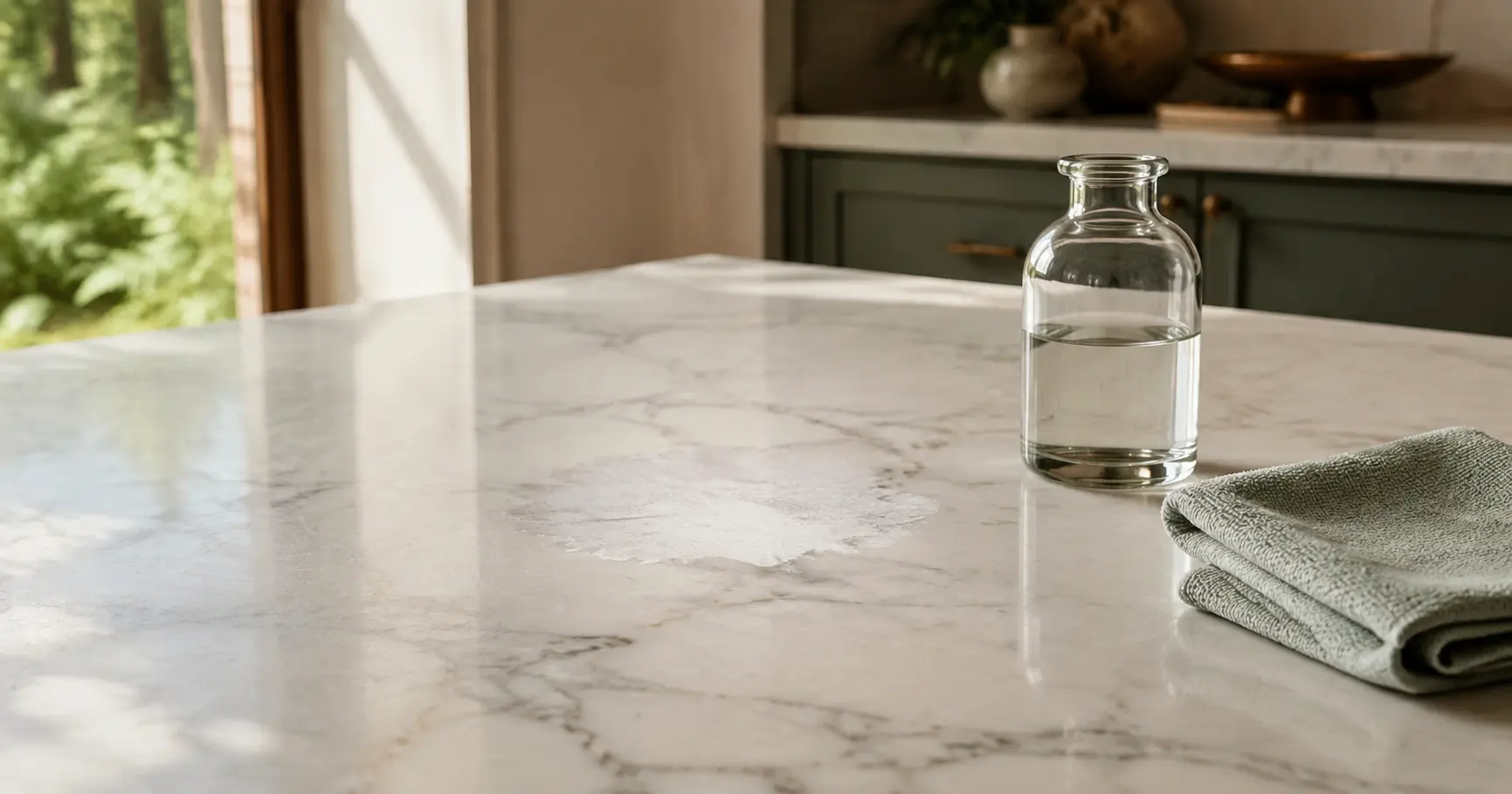
A vinegar etch mark on marble is damage, not dirt
If you see a vinegar etch mark on marble, put the vinegar and other cleaners away. Blot any liquid that is still present, use the stone maker’s approved gentle rinse, dry the area, and inspect it under angled light. A dull patch that remains after the surface is clean and dry may need polishing or honing—not stronger cleaning.
- Do now: blot a fresh spill; do not wipe it across a wider area.
- Safest baseline: follow the marble supplier’s care guide, then rinse and dry as directed.
- Avoid: baking-soda scrubs, steel wool, Magic Eraser, generic polish and power-tool experiments.
- Check: compare the fully dry area from several angles in soft side light.
- Stop: if the mark is rough, deep, widespread, on textured stone or the finish is unknown.
That pale ring or cloudy splash can be alarming, especially when it appeared right after cleaning. The first impulse is often to scrub again. Resist it. Vinegar can react with the calcium-bearing minerals in marble and change the finish itself. Once that happens, a cleaner has nothing left to “lift.”
The immediate job is smaller and safer: remove any remaining product, let the marble dry, and work out whether you are looking at residue, absorbed discoloration or a true etch. Only then does it make sense to discuss repair.
Vinegar Still Wet? Do This First
The Natural Stone Institute advises blotting spills instead of wiping them, then flushing the area with water and mild soap, rinsing and drying with a soft cloth. Your stone supplier’s current instructions take priority if they differ.
- Lift the bottle, soaked cloth or other source away from the marble.
- Blot standing liquid with a clean white cloth or plain paper towel. Turn to a fresh section as it absorbs the spill.
- Use the approved rinse or cleaning baseline for that marble. Do not improvise a second chemical reaction.
- Rinse away cleaner film when the care instructions call for it.
- Pat dry with a separate soft cloth and leave the area uncovered until it is fully dry.
Vinegar Etch Mark on Marble: 7 Safe Steps Before Repair
Stop the cleaning experiment
Set aside the vinegar mixture and write down everything it contained. Do not chase the mark with stronger cleaners, abrasives or polish.
Remove what is still on the surface
For a fresh spill, follow the blot-rinse-dry sequence above. If the area is already dry, do not re-soak it merely to test a theory.
Let the marble dry completely
Moisture changes color and reflection. Keep mats, bottles and appliances off the spot, then assess it only after the temporary darkening has cleared.
Confirm the material
Check the purchase record or ask the fabricator. Natural marble, dolomitic stone, cultured marble and marble-look quartz may resemble one another but cannot share a repair recipe.
Identify the finish
Record whether it is polished, honed, textured or coated. A treatment that restores gloss to polished stone can leave an obvious shiny island on a honed surface.
Inspect and photograph the dry mark
Take one straight-on photo and another in soft, low-angle light. Note the size, texture, color, exposure time and whether the outline follows a splash, ring or wipe pattern.
Choose the repair boundary
Use a marble-specific product only when its label covers your exact material and finish. For rough, deep, widespread, textured or uncertain damage, stop and contact the fabricator or a qualified stone-restoration professional.
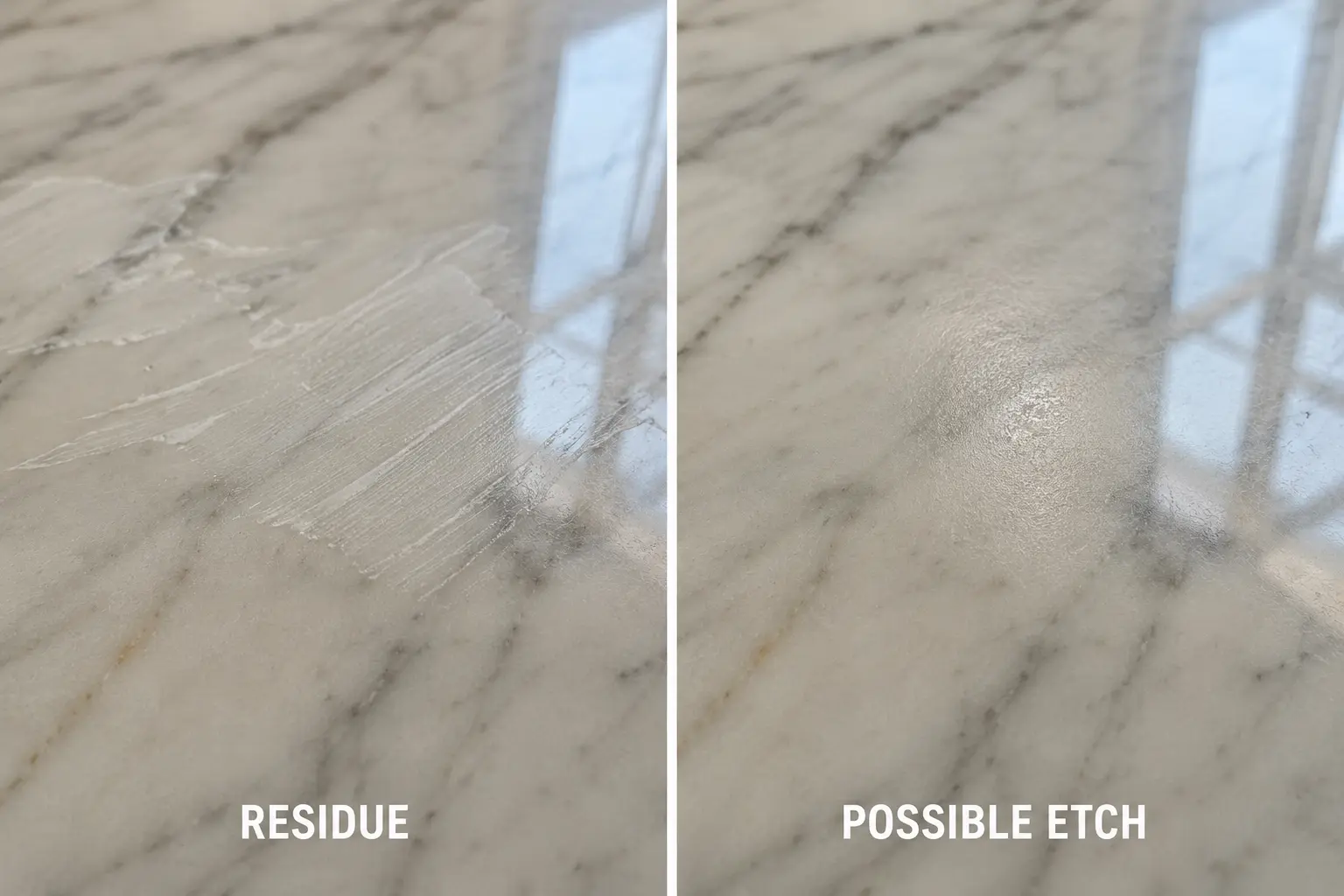
Is It Residue, a Stain or an Etch?
Do not diagnose from color alone. Look at reflectivity, texture, the spill history and what happens after an approved gentle rinse and full drying.
| Dry-surface clue | More consistent with | What to do next |
|---|---|---|
| Smeary film changes after the approved rinse | Cleaner or soap residue | Continue only the approved rinse-and-dry method; do not polish yet. |
| Darker area with normal-looking sheen | Moisture or absorbed material | Allow more drying time; identify the spilled ingredients before stain treatment. |
| Dull or pale patch visible mainly in side light | Likely surface etching | Stop cleaning; assess finish and repair suitability. |
| Rough, pitted or slightly sunken area | More significant etching or mixed damage | Professional assessment; avoid local aggressive polishing. |
| Both dullness and darker discoloration | Etch plus stain or moisture | The stain and finish change may require different treatments in the right order. |
Why Vinegar Leaves a Dull Mark on Marble
Vinegar contains acetic acid. Marble commonly contains calcite or other acid-sensitive carbonate minerals. When acid meets that surface, a small amount of mineral can dissolve, leaving microscopic roughness that scatters light instead of reflecting it evenly. On polished marble, the result often looks like a cloudy splash, pale ring or “water spot.”
This is why an etch cannot be washed away like grease. Restoring the appearance may require the affected finish to be re-honed or re-polished until it blends with the surrounding stone.
Polished, Honed and Textured Marble Need Different Decisions
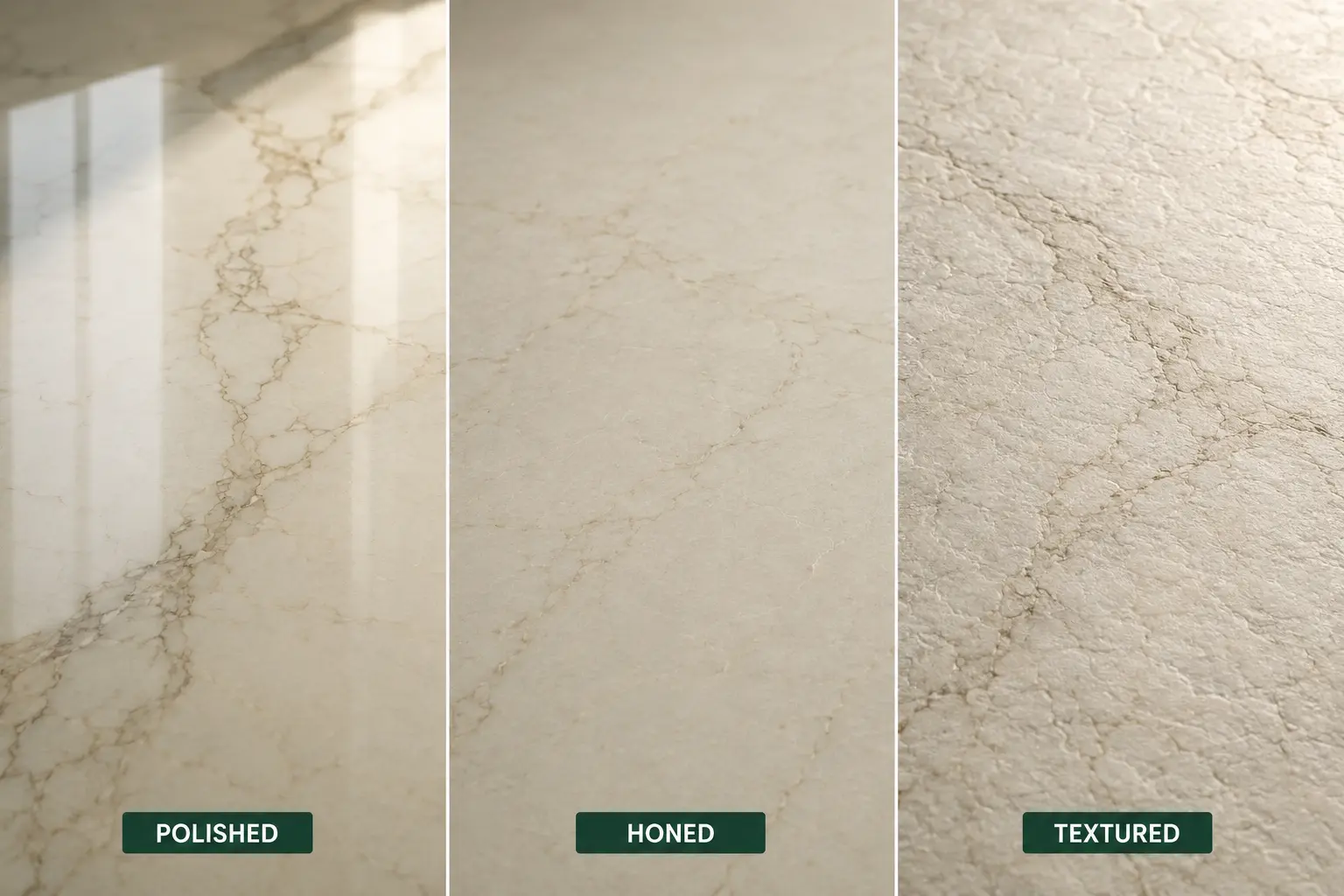
| Finish | How etching may appear | Repair concern |
|---|---|---|
| Polished | Dull ring or splash that catches side light | A spot repair may leave a different gloss or visible halo. |
| Honed | Paler or uneven matte patch | Polishing can create an unwanted shiny spot. |
| Textured/tumbled | Color or texture seems uneven across raised and recessed areas | Uniform local refinishing is difficult; professional assessment is safer. |
| Cultured/coated marble | Dull or damaged coating rather than etched natural stone | Natural-stone powders and abrasives may damage the gel coat. |
MSI’s marble guidance warns against vinegar and abrasive scrubbing pads. Its maintenance guidance sends scratching or etching to a restoration professional. That conservative boundary is especially appropriate when the finish is unknown, the area is large or the surface is textured. See MSI marble care and maintenance.
Can You Repair a Light Marble Etch Yourself?
Possibly—but only after the material and finish are confirmed. The Natural Stone Institute describes marble polishing powder as one option for etch marks, while manufacturer and restoration guidance is more cautious about finish matching. These positions are not really contradictory: a product may be capable of polishing marble, yet still produce a poor result when the stone, sheen, tool or technique is wrong.
| Situation | DIY status | Reason |
|---|---|---|
| Small, light etch on confirmed polished natural marble | LABEL-DEPENDENT | A marble-specific product may be suitable if its label covers the stone and finish. |
| Honed marble | ASK FIRST | Polishing can create a conspicuous glossy patch. |
| Deep, rough, pitted or widespread etching | PROFESSIONAL | The area may need controlled honing, polishing and blending. |
| Textured, tumbled, mosaic, coated or unknown material | STOP | A natural-marble spot treatment may alter texture, coating or color unevenly. |
If you do use an approved product, follow its label exactly. Do not substitute a drill, change the pad, increase dwell time or keep polishing because the area looks different while wet. Stop if the patch grows, the color changes, grit scratches appear or the sheen becomes more uneven.
Why Sealer, Poultice and More Cleaning May Not Fix It
- Sealer: primarily helps slow liquid absorption. It does not rebuild a polished surface that acid has altered.
- Poultice: may draw certain absorbed stains from stone, but it does not restore lost reflectivity by itself.
- Neutral cleaner: can remove compatible soil and film; it cannot reverse an etch.
- Polish: a generic countertop shine product may coat or smear the surface without matching the marble finish.
- Hard scrubbing: can widen the dull zone and introduce scratches.
This distinction—removable residue versus changed material—also matters on other surfaces. The CareBySurface guide to a black composite sink that develops white haze shows why diagnosis should come before stronger cleaning. Do not transfer that sink treatment to marble.
The CareBySurface Marble Etch Decision
The same boundary applies to specialty coatings. The CareBySurface guide to a PVD faucet finish damaged after cleaning explains why the finish maker—not a generic household hack—must control the recovery path.
When to Stop Cleaning and Get Professional Help
Stop experimenting and ask the fabricator or a stone-restoration professional when:
- the etch feels rough, pitted or sunken;
- the damaged area is larger than a small isolated spot or crosses an edge, seam or sink cutout;
- the surface is honed, textured, tumbled, mosaic, coated or cultured marble;
- staining and etching seem to be present together;
- a previous repair left a shiny dot, halo, swirl marks or wider dullness;
- the installation is valuable, antique, under warranty or commercially maintained;
- you cannot confirm the stone or finish; or
- the product label does not clearly cover your exact surface.
How to Prevent Another Marble Etch
- Keep vinegar, descaler and bathroom spray away from the marble-care bottle.
- Label homemade mixtures with every ingredient.
- Use cutting boards, trays and coasters around citrus, wine, soda and vinegar-based foods.
- Blot acidic spills promptly instead of wiping them outward.
- Use only a cleaner approved for natural marble and its finish.
- Keep the slab name, finish and sealer information with your home records.
- Remember that an impregnating sealer helps with staining resistance, not acid immunity.
Frequently Asked Questions
Is vinegar damage on marble permanent?
The surface change will not wash away, but many etches can be improved through finish-matched honing or polishing. The repair method and likely result depend on the stone, finish, depth, size and location.
Can I clean away a vinegar etch mark on marble?
No. Cleaning can remove remaining product or film, but an etch is a change in the marble finish. If the dry dull patch remains, the next decision is restoration—not stronger cleaning.
Should I put baking soda on marble after vinegar?
Do not make a baking-soda scrub the automatic response. It can leave film, and rubbing an abrasive paste can change a polished finish. Follow the stone supplier’s spill instructions; the Natural Stone Institute’s baseline is blotting, mild soap and water, rinsing and thorough drying.
Will resealing marble hide an etch?
Usually not. Impregnating sealers are intended to reduce absorption and staining; they do not recreate the sheen removed by acid. Repair the finish first if a professional or product manufacturer recommends it.
Why does the mark look better when the marble is wet?
Water can temporarily alter how the roughened area reflects light. The effect can help reveal a finish problem, but it does not measure depth or prove that a DIY repair will blend correctly.
Can marble polishing powder remove a light etch?
Some marble-specific polishing products are intended for light etching on compatible polished stone. Use one only when its current label covers your exact material and finish. Honed, textured, coated or uncertain surfaces need a more cautious assessment.
How do I tell an etch from a stain?
An etch usually changes reflectivity or texture and often looks duller in side light. A stain more often changes color because material entered the stone. The two can occur together, so the spill history and fully dry appearance matter.
Is honed marble easier to repair than polished marble?
Etches may be less obvious on a honed finish, but that does not make spot repair simple. A polishing product can create a glossy patch that is more noticeable than the original mark. Ask how the surrounding honed finish will be matched.
When should I call a marble-restoration professional?
Get an assessment for deep, rough, widespread or repeated etching; textured or mosaic marble; damage near seams and cutouts; mixed staining and etching; or any surface whose material and finish you cannot confirm.
Final Safe Recommendation
For a fresh spill, blot rather than spread it, use the marble maker’s approved gentle rinse and dry the area. For an existing dull mark, confirm the material and finish before buying a repair product. A small, light etch on known polished natural marble may have a label-approved spot-treatment path; deep, rough, widespread, honed, textured, coated or uncertain damage belongs with the fabricator or a stone-restoration professional.
Most importantly, stop treating the mark as stubborn dirt. Once vinegar has changed the marble’s finish, more cleaning will not restore the missing reflection.

