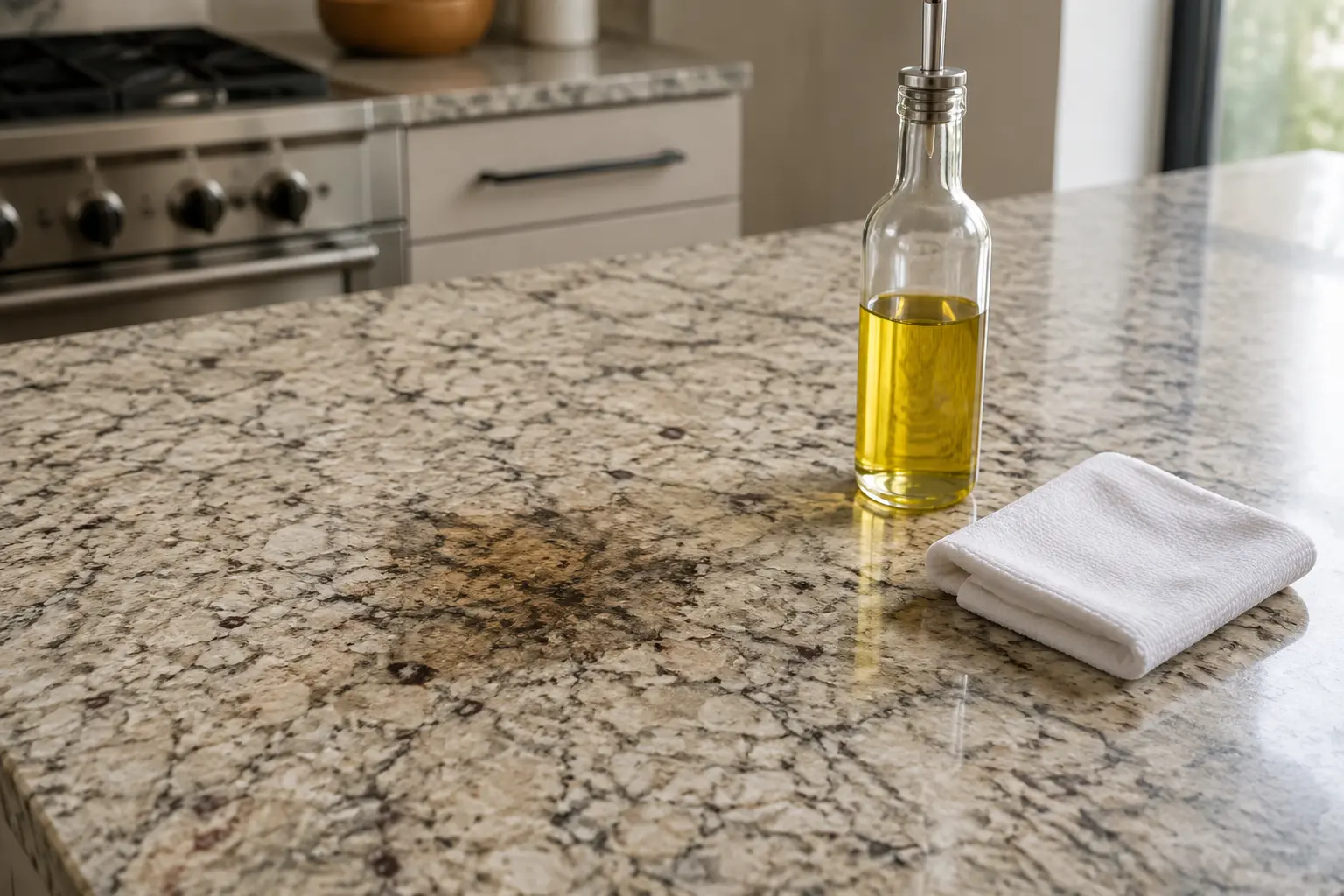
A dark oil spot on natural granite usually needs more than surface wiping—but it does not call for random solvents or aggressive scrubbing. Confirm the material, remove surface grease gently, let the stone dry, and use a stain-specific poultice only when the dark area remains.
Quick Verdict
For an oil stain on granite, blot a fresh spill instead of spreading it, then clean the surface film with the care method approved for your stone and sealer. Inspect only after the granite is completely dry. If a dark, absorbed-looking patch remains, the Natural Stone Institute identifies a poultice as the usual escalation for a deep oil-based stain.
Do not transfer this method to engineered quartz, cultured marble, solid surface or granite-composite sinks. Do not mix cleaners. Stop and contact the fabricator or a stone professional if the material is uncertain, the stain crosses a seam, or the finish changes.
First, Make Sure the Countertop Is Natural Granite
Before treating an oil stain on granite, confirm that the counter is natural stone. A poultice works by holding an appropriate cleaning liquid against an absorbent material so contamination can move out of natural stone. That logic is not universal across every counter sold with “stone” in its name.
Check your purchase paperwork, installer invoice, leftover slab label or fabricator record. Natural granite normally has irregular mineral variation that continues through the slab. Engineered quartz uses mineral particles bound with resin and follows its brand’s care instructions. For example, Cambria describes its quartz as nonabsorbent and directs owners to use warm water, a soft cloth and mild soap for residue—not a natural-stone poultice.
Material uncertainty changes the decision
If you cannot confirm natural granite, stop before applying a poultice, solvent, sealer or stain remover. Ask the fabricator or manufacturer to identify the surface.
What Can Create an Oil-Based Granite Stain?
Cooking oil is only one possible source of an oil stain on granite. The Natural Stone Institute groups grease, tar, milk, cosmetics and plumber’s putty with oil-based stains because they can leave a darker area in absorbent stone. Location is often the best clue: a ring beneath an oil bottle points in a different direction from darkening along a sink cutout or around a soap dispenser.
| Likely source | Typical pattern | Important complication |
|---|---|---|
| Cooking oil or greasy food | Irregular dark splash, drip or container ring | Wiping can spread the affected area |
| Lotion, hair product or cosmetics | Small dark patch near a bathroom vanity item | Pigment or fragrance may create a mixed stain |
| Plumber’s putty or installation material | Dark halo around a faucet, drain control or fixture | May involve the underside, caulk or fixture removal |
| Oil-based cleaner, polish or sealer | Broad smear, streak or uneven dark field | Could be topical residue rather than a simple absorbed spill |
| Unknown dark mark | No reliable spill history | Do not choose poultice chemistry by color alone |
Evidence boundary: community photographs can show that the problem recurs, but they cannot establish the correct chemical for your slab. Stain type, surface identity and installation details control the escalation.
Is It Oil, Moisture or a Surface Change?
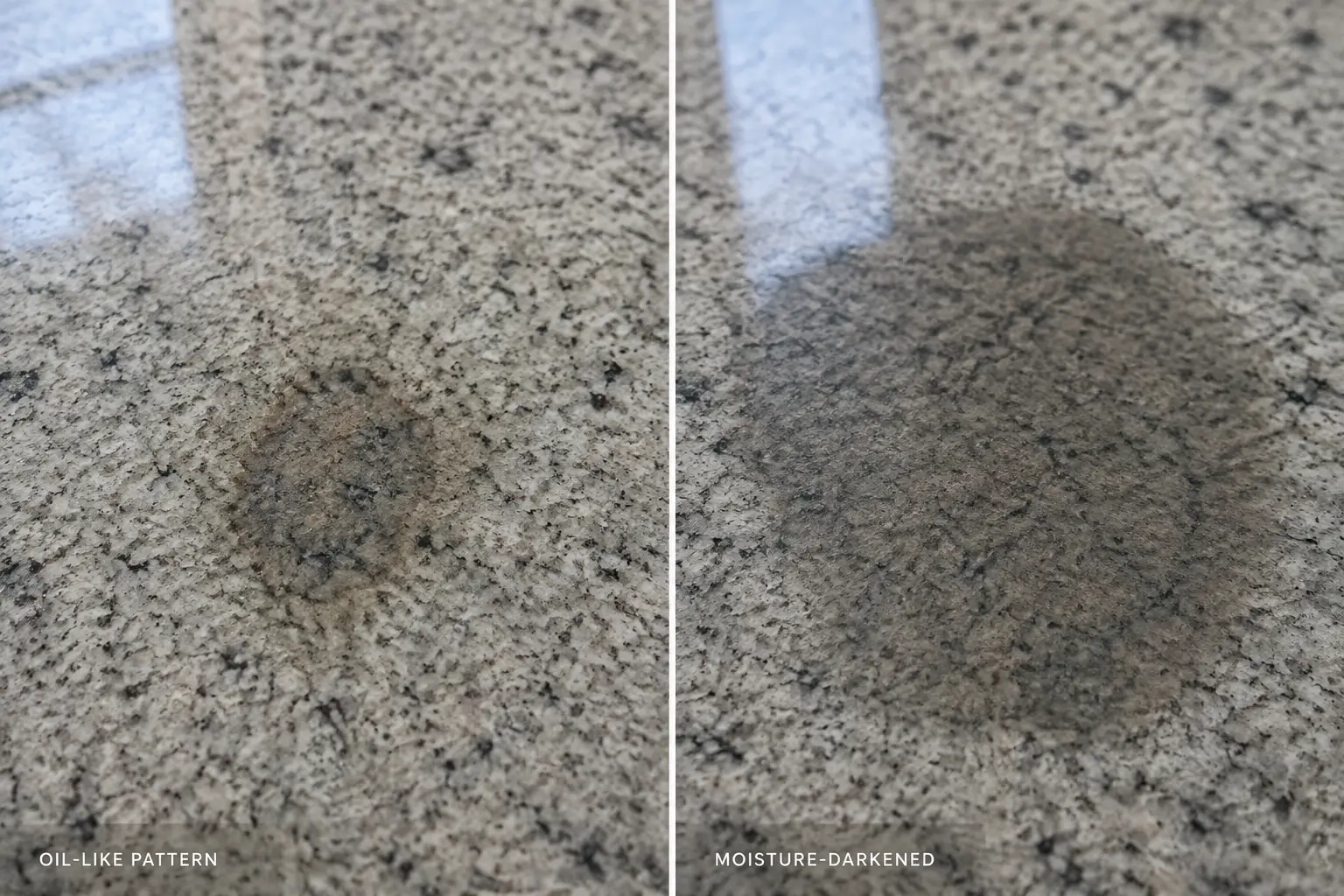
An oil-based stain commonly darkens natural stone. Appearance alone does not prove that a dark patch is an oil stain on granite, so use the spill history, location, outline and dry result together.
| What you see | More consistent with | Next decision |
|---|---|---|
| Dark patch matching a cooking-oil bottle, greasy food, lotion or plumber’s putty | Oil-based contamination | Remove surface residue, dry fully, then consider an oil-stain poultice |
| Even darkening immediately after washing or a wet treatment | Moisture in the stone or poultice area | Allow complete air-drying before judging |
| Dull or rough patch that changes reflection rather than color | Finish damage, abrasion or residue | Stop scrubbing; ask a stone professional to inspect it |
| Dark line following a seam, faucet hole or sink cutout | Oil or moisture involving resin, caulk or the underside | Do not flood the area; contact the fabricator |
| Orange-brown mark shaped like a metal object | Rust or metal stain | Use a metal-stain diagnosis, not an oil poultice |
If the Oil Spill Is Still Fresh
Lift the source
Remove the leaking bottle, greasy package or food without dragging it across the countertop.
Blot—do not wipe outward
Press clean white absorbent material onto the spill. Replace it as it becomes oily. Wiping can enlarge the affected area.
Remove the surface film gently
Use the routine cleaner approved by the countertop fabricator or sealer maker. If those instructions permit mild dish detergent, use only a small amount with a soft cloth, then remove the detergent completely with clean water.
Dry and wait
Pat the surface dry and leave it uncovered. Do not diagnose the remaining color while the stone is still wet.
Dry-result checkpoint
If the mark disappears after cleaning and drying, you removed surface oil or temporary moisture. If a darker patch remains in the stone, escalation may be appropriate. If the surface becomes dull, pale, rough or scratched, stop treating it as an oil stain.
Baseline Cleaning Before You Use a Poultice
The goal of the baseline pass is to remove grease sitting on top of an oil stain on granite, not to force a strong chemical into the slab. Use a soft white cloth and the mild routine cleaner allowed by the exact stone, sealer and fabricator. Rinse away the cleaner when its instructions require it, dry the area, and reassess.
Do not use vinegar or lemon juice as degreasers. Acidic household cleaners can be unsuitable for natural stone and its finish; see our guide on whether white vinegar is safe for marble, granite and wood.
Safe starting path
- Confirm natural granite
- Check fabricator and sealer instructions
- Use a soft white cloth
- Remove cleaner residue
- Judge only when fully dry
Do not improvise
- No vinegar or lemon juice
- No steel wool or abrasive pad
- No cleaner mixtures
- No heat gun, hair dryer or iron
- No resealing over a stain
When a Poultice Is Right for an Oil Stain on Granite
The Natural Stone Institute’s stain guide classifies cooking oil, grease, milk, cosmetics and similar materials as oil-based stains. It explains that these stains darken stone and may need to be dissolved and drawn into an absorbent poultice. Some deep stains require repeated treatment, and some may not come out completely.
Use the exact procedure published by your stone professional, fabricator, sealer manufacturer or the chosen commercial stone-poultice label. Those directions control the compatible liquid, protective equipment, ventilation, coverage, contact period, removal and rinsing. Do not substitute a stronger solvent simply because the first pass was slow.
Lowest-complexity NSI option
For an identified oil-based stain on natural stone, the Natural Stone Institute lists a baking-soda-and-water poultice as one option. It separately lists powdered poultice materials used with mineral spirits. Because solvent use adds ventilation, flammability, exposure and compatibility concerns, this homeowner pathway starts with the water-based option only when the fabricator or sealer guidance does not prohibit it. Solvent escalation belongs under the exact product label or professional direction.
Protect the work area
Keep food, children and pets away. Follow the product’s ventilation and protective-equipment directions. Eliminate ignition sources if the label identifies a flammable ingredient.
Test the complete system
Test the poultice material and its cleaning liquid in a discreet area when the fabricator or label recommends it. A spot test reduces uncertainty but cannot guarantee identical behavior everywhere.
Treat the stain without flooding edges
Apply and cover the poultice only as directed. Keep uncontrolled liquid away from seams, caulk, resin repairs, appliance gaps and sink cutouts.
Remove it without metal scraping
Follow the directions for uncovering, drying and removal. Use only a permitted nonmetal tool and avoid scratching the finish.
Remove residue and let the stone dry
Complete the specified rinse or residue-removal step, then allow the granite to air-dry fully before comparing it with the surrounding stone.
Verified Natural Stone Institute application framework
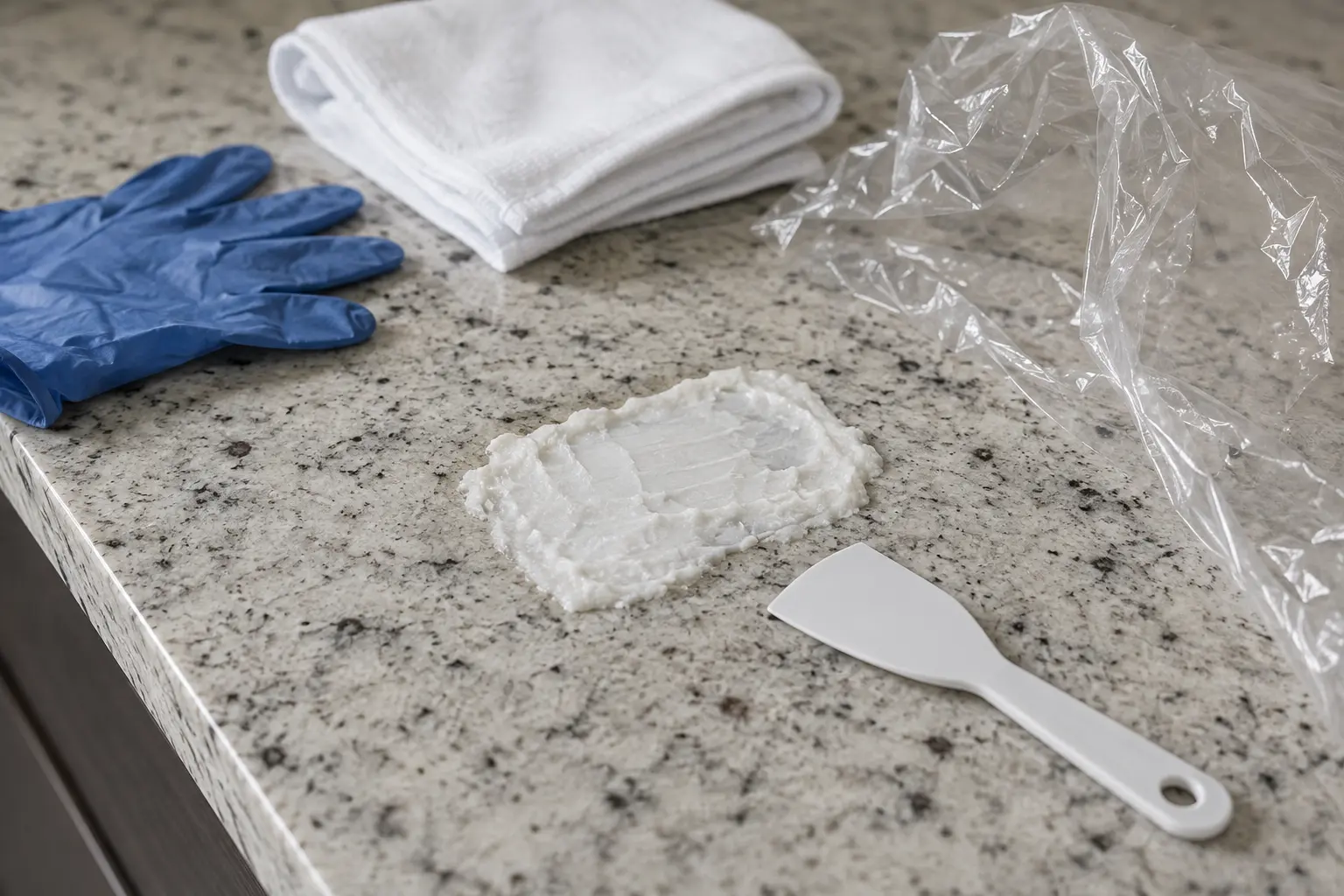
When the selected material and cleaning liquid are confirmed compatible, NSI guidance describes the following framework: prepare a thick paste; wet the stained area with distilled water; spread the poultice about 1/4 to 1/2 inch thick and roughly one inch beyond the visible stain using a wood or plastic tool; cover it with plastic and tape the edges; allow the specified working period; then uncover it, let it dry thoroughly, remove it with a wood or plastic scraper, rinse and dry.
NSI’s published working period is 24 to 48 hours. Follow a commercial product label when it differs, and do not invent a shorter or longer dwell time. The guide notes that a poultice may need to be repeated and that some stains may never be completely removed.
Do not confuse the wet treatment footprint with failure
The poultice introduces moisture. Compare the treated area only after it has returned to a stable dry appearance. An immediately darker footprint is not proof that the stain spread or the stone was permanently damaged.
Why this article does not invent one universal solvent recipe
Natural Stone Institute guidance lists more than one possible agent for oil-based stains. The correct choice also has to be compatible with the sealer, finish, nearby resins and product safety label. That makes identification and label-specific use safer than transferring one internet recipe to every granite counter.
The Poultice Came Off, but the Granite Still Looks Dark
Do not immediately apply another chemical when an oil stain on granite still appears dark after treatment. Moisture from the poultice can temporarily darken natural stone. Leave the area uncovered and allow it to reach a stable, fully dry appearance.
Repeat, escalate or stop?
- Repeat the same verified procedure: only if the stain is clearly lighter after drying and the product or professional guidance permits another application.
- Escalate to the fabricator: if the mark has not changed, involves an unknown topical coating, or sits beside a seam, cutout or resin repair.
- Stop: if the finish turns dull, pale, rough, scratched or uneven; fumes or irritation occur; or the product affects caulk or resin.
Why Common Attempts Fail
| What happened | Likely explanation | Better next action |
|---|---|---|
| Dish soap removed greasiness but left a dark mark | Surface oil lifted, but absorbed material remains | Dry fully, then assess a compatible oil-stain poultice |
| The first poultice helped only a little | The stain may be deeper than one application can reach | Repeat only if the verified procedure permits and the dry result improved |
| The entire poultice footprint looks dark | Treatment moisture may still be present | Wait for complete air-drying before deciding |
| The mark did not change at all | Wrong stain identification, incompatible poultice chemistry or non-stain damage | Stop repeating and consult the fabricator or stone professional |
| The patch is lighter but now dull | Residue, abrasion, coating change or finish damage | Do not polish blindly; obtain finish-specific advice |
| The dark halo returns around a fixture | Continuing source below or around the fixture | Have the installation source inspected before more surface treatment |
Methods to Avoid
| Method | Why it is a poor default | Safer decision |
|---|---|---|
| Vinegar or lemon juice | Acid is not a universal natural-stone or sealer-safe degreaser | Use verified stone-care guidance |
| Steel wool, scouring powder or aggressive pad | May scratch or change a polished or honed finish | Use soft materials and label-approved tools |
| Mixing bleach, ammonia, acids or solvents | Can create toxic exposure or unpredictable surface damage | Use one verified system exactly as directed |
| Heat to “pull out” oil | Can spread contamination and affect stone, sealer or nearby resins | Use an evidence-supported poultice or professional service |
| Applying sealer over the mark | Sealer does not extract existing oil and may complicate removal | Resolve the stain before evaluating resealing |
When to Call a Stone Professional
- You cannot confirm that the surface is natural granite.
- The stain crosses a seam, resin fill, backsplash joint, sink cutout or appliance opening.
- The oil may have reached the underside of the slab.
- A correctly chosen poultice produces no improvement after the permitted attempts.
- The surface is honed, leathered, antiqued or treated with an unknown topical coating.
- The area becomes pale, rough, dull or scratched.
- You would need a solvent you are not equipped to use safely.
Prevent the Next Oil Mark
Prevent another oil stain on granite by keeping cooking oils, lotions and oily bottles on a washable tray. Blot spills promptly. Use the fabricator-approved routine cleaner and avoid leaving degreaser residue on the stone.
After the stain is resolved and the granite is fully dry, ask the fabricator whether the surface needs resealing. Sealer can slow absorption; it cannot make granite stain-proof or remove oil already inside the stone.
Resealing may be worth evaluating when
- The fabricator confirms the stone and existing sealer
- The stain has been removed or professionally assessed
- The slab is completely dry
- The approved absorption test indicates reduced protection
Do not reseal yet when
- A dark patch still remains
- The countertop material is uncertain
- A poultice footprint is still damp
- The mark involves resin, caulk or a seam
- An unknown topical coating is present
Frequently Asked Questions
Will an oil stain on granite disappear on its own?
Surface oil may clean away, and temporary moisture darkening can fade as the stone dries. An absorbed oil-based stain often needs stain-specific treatment. Do not assume that every dark patch will disappear or that stronger cleaning will help.
How can I tell oil from water darkening the granite?
Use the spill history and full-dry result. Oil commonly leaves a persistent dark patch associated with a greasy source. Water or poultice moisture should change as the stone dries. If the cause remains uncertain, avoid solvent treatment and ask the fabricator.
Can baking soda remove an oil stain from granite?
Natural Stone Institute guidance includes baking soda and water as one possible poultice for oil-based stains. That does not override your fabricator, finish, sealer or commercial-product instructions. Avoid abrasive scrubbing with the powder.
Can I use acetone or mineral spirits?
The Natural Stone Institute lists these among possible agents for some oil-based stone stains, but they carry product-safety, ventilation, flammability and compatibility considerations. Use them only when the exact stone-care procedure and product label support the application and you can follow every precaution; otherwise use a commercial stone poultice or a professional.
Why is the area darker after removing the poultice?
The treatment may leave temporary moisture in the stone. Let it air-dry completely before judging. If the area remains dark, does not improve, or changes texture or sheen, contact the fabricator rather than immediately adding another chemical.
Should I reseal the granite after removing the stain?
Evaluate sealing only after the stain is resolved and the slab is fully dry. Follow the fabricator or sealer manufacturer’s test and application guidance. Never apply sealer as a way to hide or trap an existing oil stain.
Can the same poultice remove every kind of granite stain?
No. Oil, organic material, rust, ink and biological growth call for different identification and may require different agents. Selecting chemistry only because every mark is called a “stain” can waste time or damage the surface.
Does a hidden-area test prove the method is safe?
No. It can reveal an immediate color, sheen or coating reaction in that spot, but it cannot prove identical behavior across different minerals, resin fills, edges or previously treated areas.

