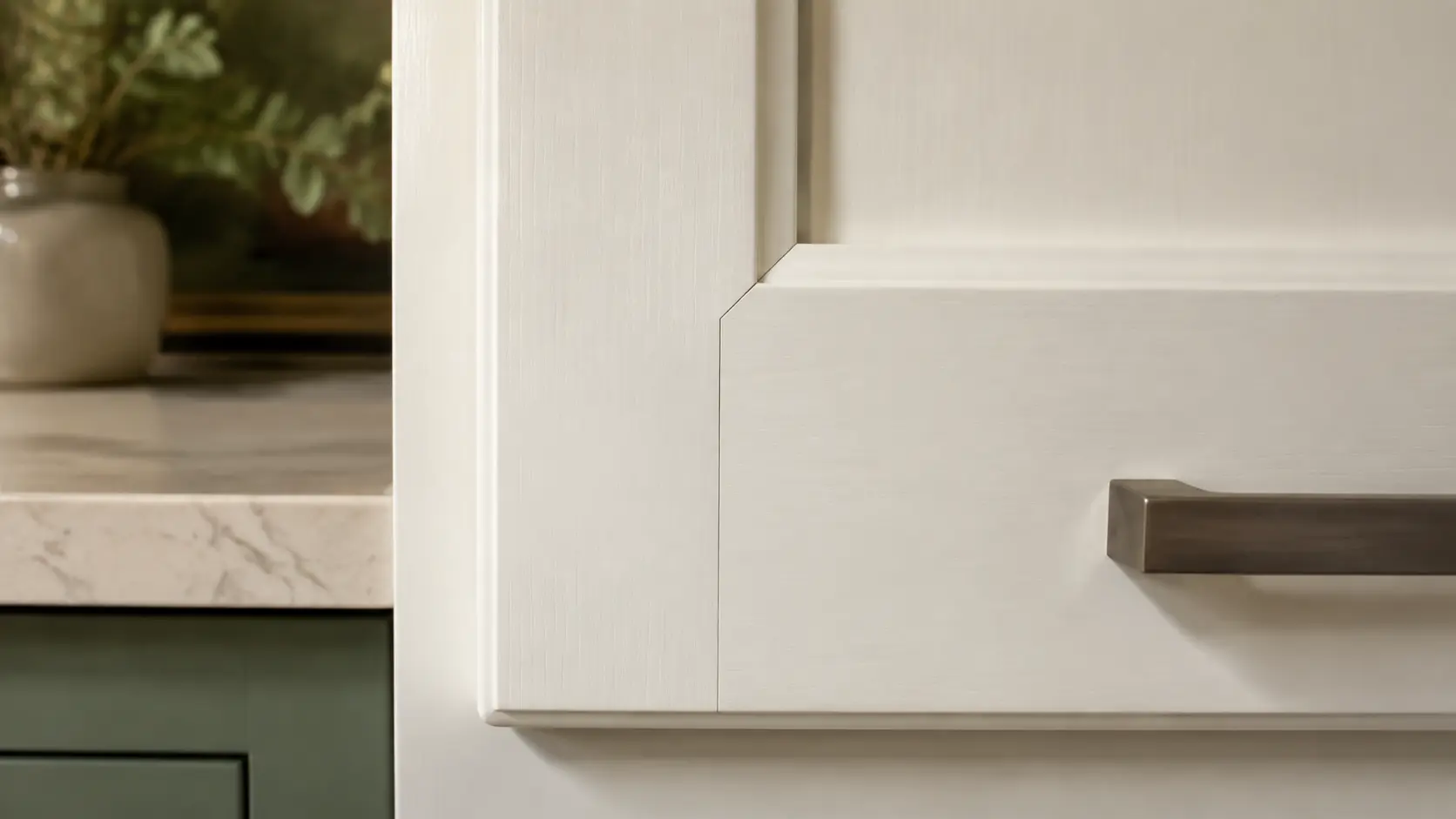
White painted cabinets cracking does not always mean the entire finish has failed. A fine line at a door joint can come from normal wood movement, while peeling, widespread checking, swelling or soft paint points to a different problem that needs a different response.
Quick verdict
Do not sand, caulk or repaint the crack immediately. First identify the cabinet material, locate the crack and photograph it. A narrow line exactly where two solid-wood door components meet may reflect seasonal movement. Cracks across a flat area, peeling near water or heat, swollen substrate, or widespread paint checking are more consistent with coating or material damage.
If the cabinets are new or under warranty, contact the manufacturer or dealer before altering the finish.
Why are white painted cabinets cracking?
Painted cabinet doors can develop visible lines when the wood beneath the paint expands and contracts as indoor humidity changes. These lines often appear at stile-and-rail joints because separate pieces of wood move slightly differently.
Cracking can also come from moisture, steam, impact, poor coating adhesion, an incompatible repainting system or movement in an MDF or engineered-wood substrate. The pattern and location matter more than the color of the paint.
What to do before attempting a repair
-
Photograph the crack
Take one full-door photograph and several close-ups in neutral daylight. Include a ruler or another scale reference without pressing it against the finish. Record the date and whether the crack recently changed.
-
Find the cabinet brand and construction
Check purchase records, hinge labels, drawer-box markings or the dealer invoice. Determine whether the door is solid wood, MDF, wood-frame with a floating panel, veneer, laminate or thermofoil. These surfaces do not share one repair method.
-
Locate the crack precisely
Note whether it follows a corner joint, surrounds the center panel, crosses a flat section, begins at a screw or impact point, or appears beside a sink, dishwasher, range or self-cleaning oven.
-
Check the surrounding finish
Without picking at it, look for lifting edges, bubbles, tackiness, discoloration, swelling, softness or exposed substrate. Those signs make ordinary touch-up less appropriate.
-
Record indoor conditions
Use a reliable hygrometer to note relative humidity over several days. Compare the readings with the range in your cabinet manufacturer’s current care or warranty documentation rather than applying one universal number.
Initial checkpoint
If the crack is confined to one construction joint, the door remains flat and solid, and no coating is peeling, document and monitor before modifying it. If the paint or substrate is lifting, soft, swollen or breaking away, stop treating it as a cosmetic joint line.
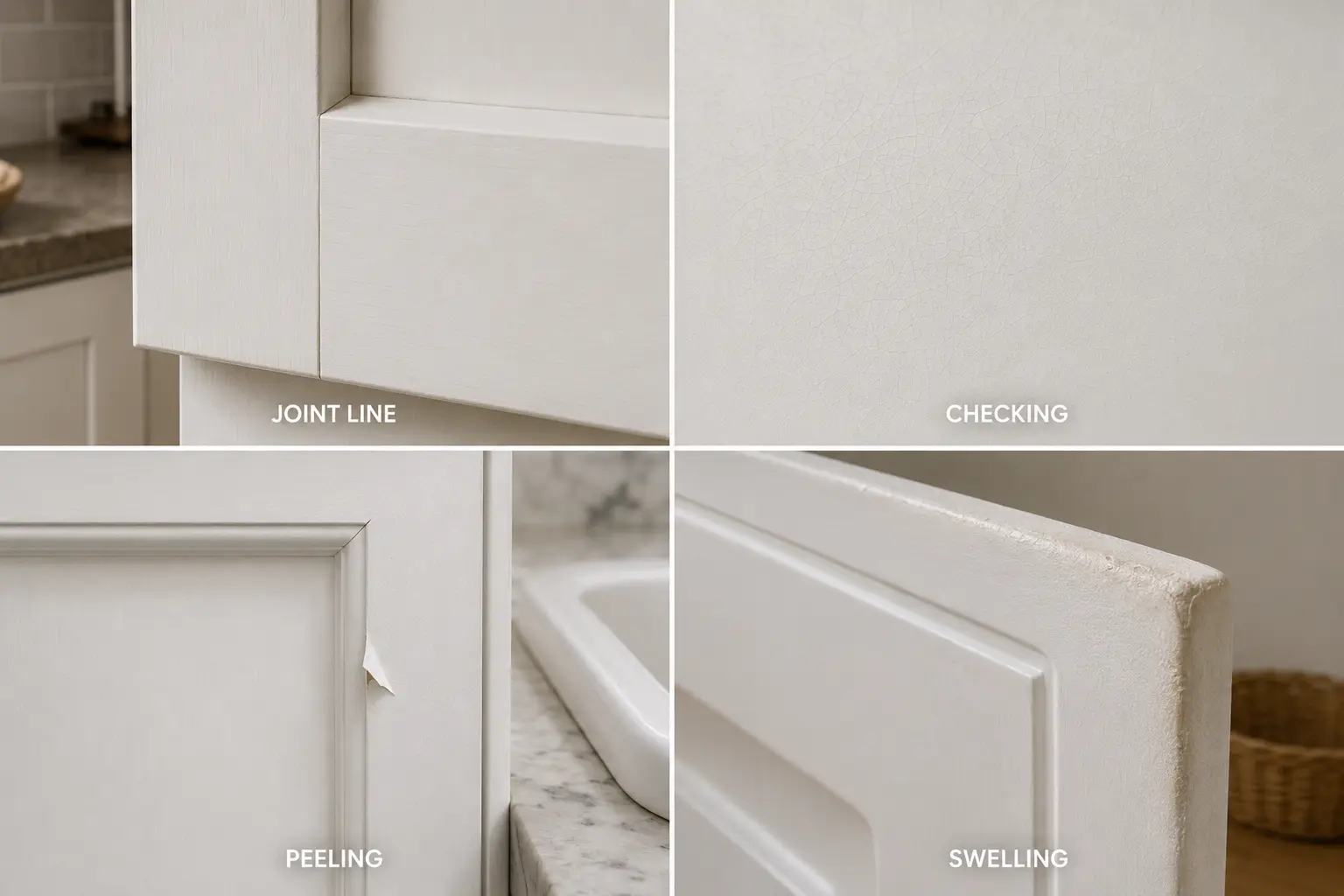
Diagnose the crack by its pattern
| What you see | More consistent with | Safest next step |
|---|---|---|
| Fine straight line exactly at a stile-and-rail joint | Normal wood movement or joint telegraphing through paint | Photograph, check humidity and review manufacturer guidance before touch-up |
| Line around the edge of a floating center panel | Seasonal panel shrinkage exposing a previously hidden edge | Monitor across a humidity cycle; do not glue or caulk a panel designed to move |
| Network of fine cracks across a broad painted area | Paint checking, incompatible coating layers or application failure | Contact the manufacturer, painter or qualified refinisher |
| Peeling, bubbles or discoloration near a sink or dishwasher | Water, steam or cleaning-product damage | Stop moisture exposure, dry the area and obtain finish-specific guidance |
| Crack beginning at a dent, handle or impact point | Mechanical damage | Inspect for loose material; use only an approved repair system |
| Swollen edge, crumbling MDF or separated veneer | Substrate damage or delamination | Stop cosmetic cleaning and seek repair or replacement advice |
What should you do with the cabinet crack?
Document the condition first, then separate a joint-related paint line from checking, peeling or moisture-related substrate damage.
Yes — it follows a joint
- Check recent indoor humidity changes.
- Review the cabinet manufacturer’s warranty and care guidance.
- Watch for widening, movement or door misalignment.
If the line remains fine and stable, monitor it or use only the manufacturer-approved touch-up method.
No — it crosses a flat area
- Look for paint checking, lifting or peeling.
- Check edges for softness, swelling or moisture exposure.
- Determine whether the coating or underlying material has changed.
Stop cosmetic touch-up if the finish is lifting or the substrate is swollen. Seek manufacturer or qualified repair guidance first.
Why painted door joints reveal movement
Many traditional cabinet doors are assembled from separate rails and stiles surrounding a center panel. Wood continually exchanges moisture with indoor air. As conditions change, components can expand or contract by small amounts. An opaque paint finish makes a hairline joint change easier to see than a stained finish would.
MasterBrand explains that humidity fluctuations can cause contraction, expansion and joint separation, with open or closed joints appearing more prominently on painted cabinetry. Showplace likewise states that changing humidity can make wood move and paint crack at door joints. These manufacturer statements support a key distinction: a visible joint line is not automatically evidence that the whole cabinet was painted incorrectly.
Manufacturer-specific rule
“Normal” does not mean every crack should be ignored. Your cabinet brand, door construction, age, warranty and local conditions control the decision. A crack that is widening, loose, wet, swollen or spreading across the finish needs further evaluation.
A center-panel line may be shrinkage, not a broken door
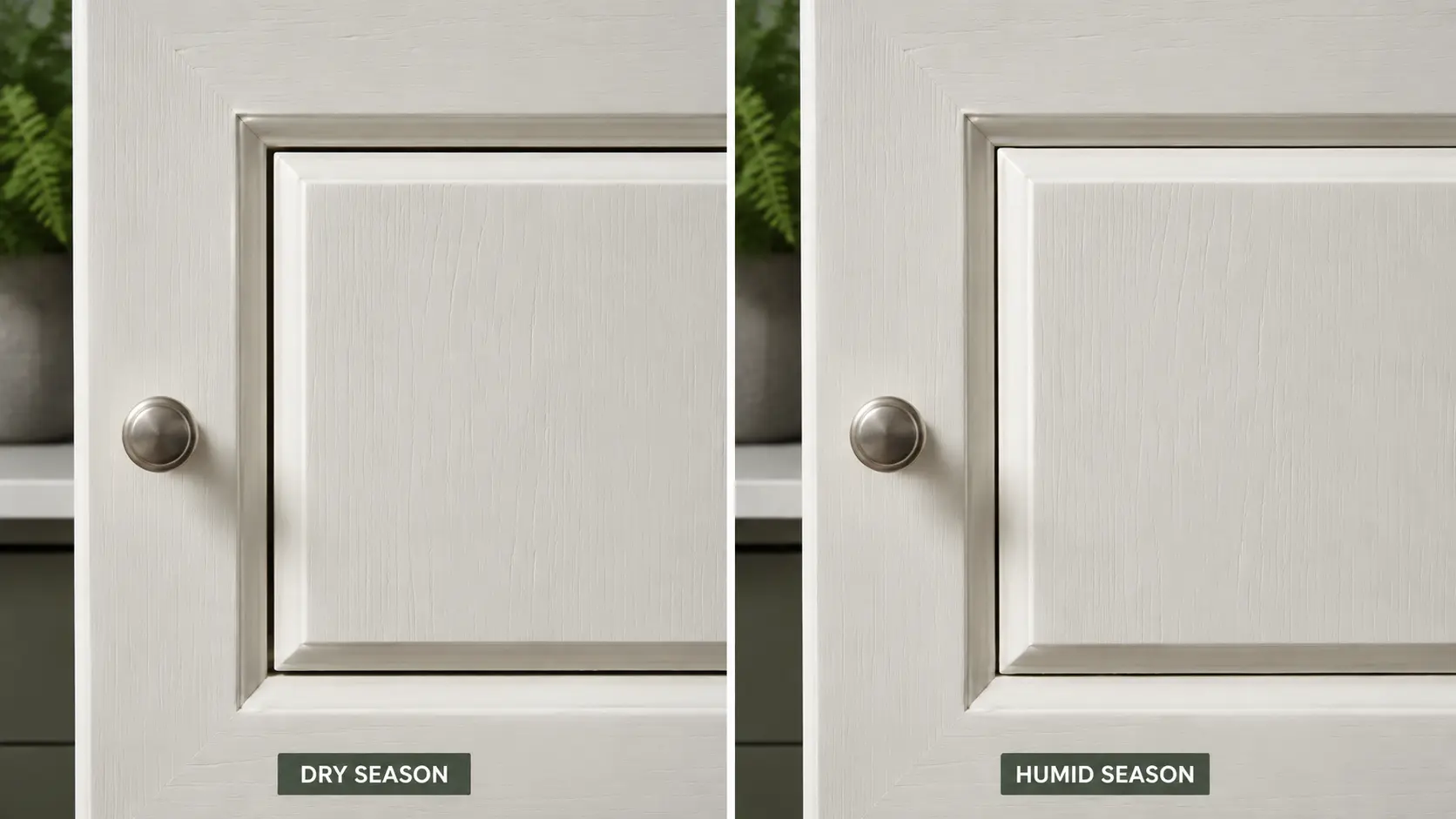
Frame-and-panel doors often use a center panel that is allowed to move within the surrounding frame. During a dry season, that panel can contract enough to expose an edge or finish line that was previously hidden. It may become less noticeable when indoor humidity returns to the manufacturer’s acceptable range.
Do not glue, fill or caulk a floating panel simply because a line appears. Preventing intended movement can transfer stress elsewhere. If you cannot identify the construction, ask the cabinet dealer or manufacturer before altering it.
When cracking is more likely to be finish failure
Widespread checking
A network of fine cracks across flat surfaces is different from one joint line. It may involve coating thickness, curing, preparation or incompatible layers.
Peeling or lifting
If an edge can lift or the coating separates from the substrate, adding touch-up paint over it will not restore adhesion underneath.
Swelling or softness
Raised fibers, swollen MDF and softened edges suggest moisture reached the substrate. Cosmetic paint cannot reverse that dimensional damage.
Heat or steam pattern
Damage concentrated beside an oven, dishwasher, coffee maker or sink may require correcting the exposure before any repair can last.
Could cleaning products cause the problem?
A cleaner is less likely to create a single precise line at a wood joint, but incompatible products can weaken, discolor, soften or dull a cabinet finish. Repeated wetting can also enter seams and exposed edges.
MasterBrand advises against harsh detergents, abrasive cleaners, scouring products, steel wool, solvent-based products, ammonia, bleach and silicone-based polishes on its cabinetry. That list is manufacturer-specific, but it illustrates why generic “degreasing hacks” should not be used on an unknown painted finish.
If cracking began immediately after cleaning, save the product container and record:
- the product name and formulation;
- how it was diluted;
- how long it remained on the finish;
- the applicator or scrubber used;
- whether the area changed color, sheen or texture; and
- whether water entered a seam or raw edge.
Do not attempt chemical reversal
Do not add vinegar, baking soda, bleach, ammonia, alcohol or solvent to “neutralize” a previous cleaner. Remove residue only as the cabinet and cleaner instructions permit, dry the area, and contact the finish manufacturer when appearance or texture has changed.
Check the warranty before touching up
If the cabinets are new, professionally refinished or still within a warranty period, avoid sanding, filling or repainting before requesting guidance. An unauthorized repair can remove useful evidence and may complicate a claim.
- Find the receipt, order number, door style, finish name and installation date.
- Photograph the entire cabinet run and the affected doors.
- Record room temperature and relative humidity.
- Note nearby moisture, heat, ventilation and cleaning history.
- Contact the original dealer, manufacturer or refinisher with the documentation.
Warranty treatment varies. Some manufacturers expressly describe visible joint cracking as a natural characteristic of painted wood, while widespread coating failure or defective workmanship may be evaluated differently. Use the warranty for your exact product—not another company’s policy.
When a touch-up may be appropriate
A manufacturer-matched touch-up product may be appropriate for a stable, minor cosmetic line or chip when the cabinet maker approves it. Color, gloss and aging matter: generic white paint can look markedly different beside a factory finish even when the color appears close in the container.
Before proceeding:
- confirm that warranty documentation is complete;
- confirm the substrate is dry, stable and not swollen;
- obtain the manufacturer’s current touch-up kit and instructions;
- test in an inconspicuous location if permitted;
- use the smallest possible application; and
- judge the result only after it has fully dried and cured as instructed.
Dry-result checkpoint
Inspect from normal standing distance and under ordinary daylight after the instructed drying period. Stop if the repair remains tacky, changes sheen, bridges a moving joint, highlights the crack or begins lifting at the edges.
Repairs to avoid before diagnosis
Filling every joint with caulk
A flexible filler may hide a line temporarily but can smear the factory finish, collect dirt or fail when components continue moving.
Sanding through a factory coating
Spot sanding can create a visible depression and a sheen mismatch that is harder to repair than the original hairline.
Using random white paint
Factory whites vary in undertone and gloss. Existing finishes also change with age and light exposure.
Painting over loose material
Touch-up paint cannot secure a peeling coating or rebuild swollen MDF, veneer or damaged joints.
Manage humidity without chasing one universal number
Stable indoor conditions can reduce dimensional swings in wood cabinetry. MasterBrand identifies a particular humidity range in its homeowner documentation, while other manufacturers may state their own limits. Follow the current requirements for your cabinet brand and climate.
Useful steps include:
- monitoring conditions with a reliable hygrometer;
- running heating, cooling, humidification or dehumidification consistently;
- using kitchen exhaust when producing steam;
- drying splashes promptly, particularly around sinks and dishwashers;
- avoiding damp towels draped over cabinet doors; and
- preventing concentrated heat or steam from repeatedly striking one door edge.
Do not force the room rapidly toward a target in an attempt to close a crack overnight. Sudden swings can create additional movement, and a humidifier used incorrectly can cause condensation or other building problems.
When to contact a professional
Contact the cabinet manufacturer, dealer or qualified refinisher when:
- the crack is widening or appears through the wood itself;
- the door is loose, warped or no longer closes correctly;
- paint is checking across multiple doors;
- the finish is peeling, bubbling or soft;
- MDF, veneer or another substrate is swollen or separating;
- water damage extends inside the cabinet box;
- the crack follows a recent installation or professional repainting job;
- the finish identity is unknown; or
- a minor touch-up would not produce an acceptable visual match.
How to reduce future cracking and finish damage
- Maintain the temperature and humidity range stated by the cabinet manufacturer.
- Use ventilation during cooking and dishwasher cycles.
- Wipe water and cooking splatter promptly with an approved method.
- Keep abrasive pads, harsh degreasers and solvent cleaners away from painted finishes unless explicitly permitted.
- Do not hang damp towels over painted doors.
- Keep the cabinet brand, finish name and touch-up kit information with your home records.
- Photograph small changes early so later movement can be compared objectively.
Frequently asked questions
Are cracks at painted cabinet-door joints normal?
Some manufacturers describe fine joint lines as a natural result of solid wood expanding and contracting. That does not make every crack normal. Widespread checking, peeling, swelling, loose joints or structural cracks require further evaluation.
Will cabinet cracks close when humidity changes?
A seasonal joint or panel line may become less visible as wood acclimates, but that outcome is not guaranteed. Document and monitor it while keeping conditions within the cabinet manufacturer’s stated range.
Should I caulk cracks in painted cabinets?
Not before identifying the construction and obtaining manufacturer guidance. Caulk can bridge a joint that needs to move, create a sheen mismatch or complicate warranty evaluation.
Can I use leftover wall paint for cabinet touch-up?
Usually that is a poor match for a factory cabinet coating. Color, resin, hardness and sheen can differ. Use the exact manufacturer-approved touch-up system when available.
Why is the paint cracking beside my dishwasher or sink?
Repeated water or steam exposure may damage the finish or substrate. Correct the moisture source, dry the area and inspect for swelling, softness or peeling before considering cosmetic repair.
Are white painted cabinets cracking because of poor preparation?
Poor preparation or incompatible coatings can cause failure, particularly when cracking is widespread. A precise line at a wood joint can instead reflect normal dimensional movement. Pattern, construction and history are needed to distinguish them.
Can cleaning products make cabinet paint crack?
An incompatible cleaner can soften, dull, discolor or weaken a finish, especially with repeated exposure. It is less likely to explain a single straight joint line unless moisture or cleaner repeatedly entered that seam.
Bottom line
When you find white painted cabinets cracking, begin with location, construction and history—not filler or stronger cleaner. Document the line, check the cabinet maker’s humidity and warranty guidance, and distinguish a stable joint from peeling, swelling or widespread coating failure. Touch up only when the exact finish system and repair boundary are known.

