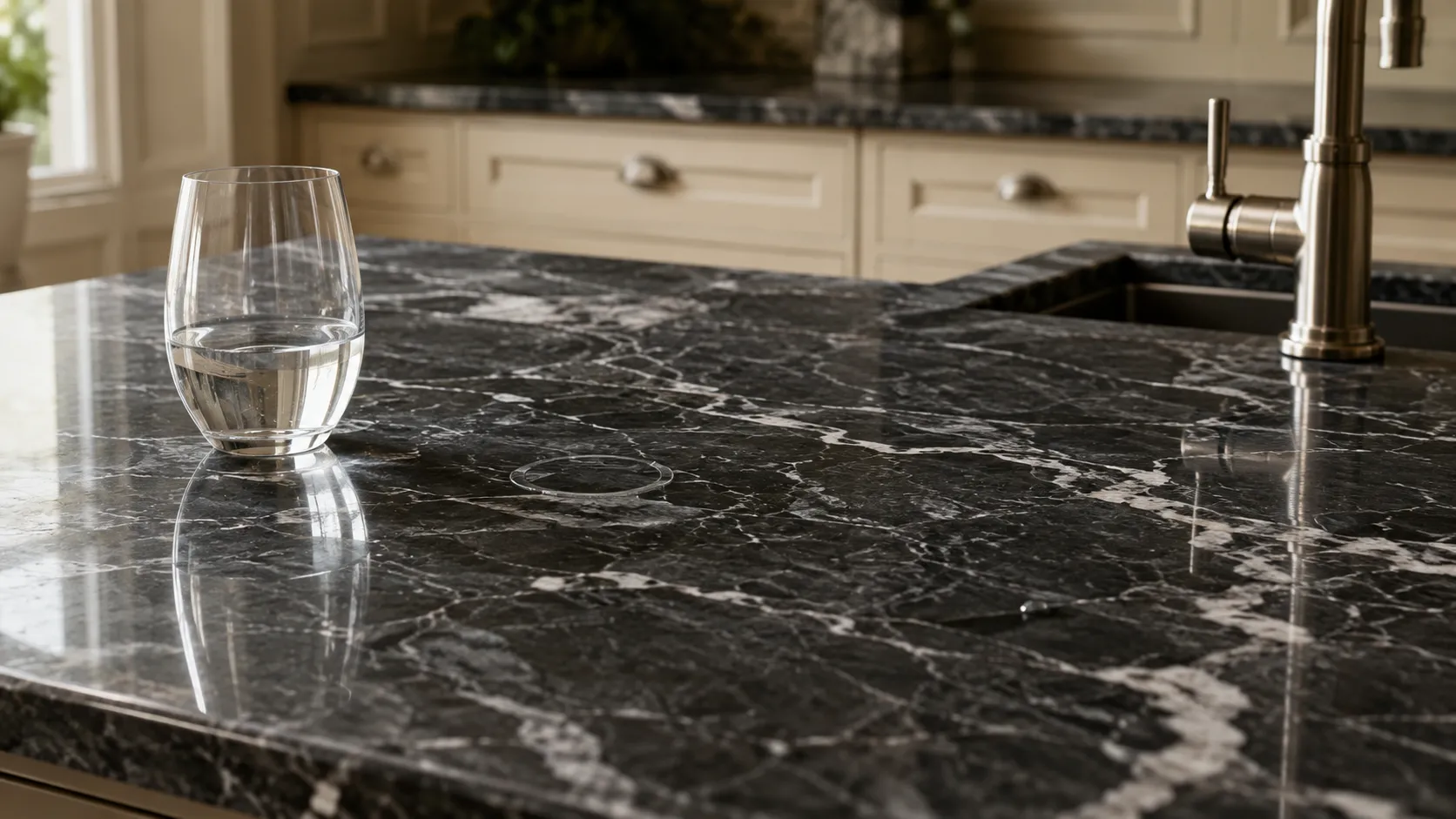
Marble diagnosis guide
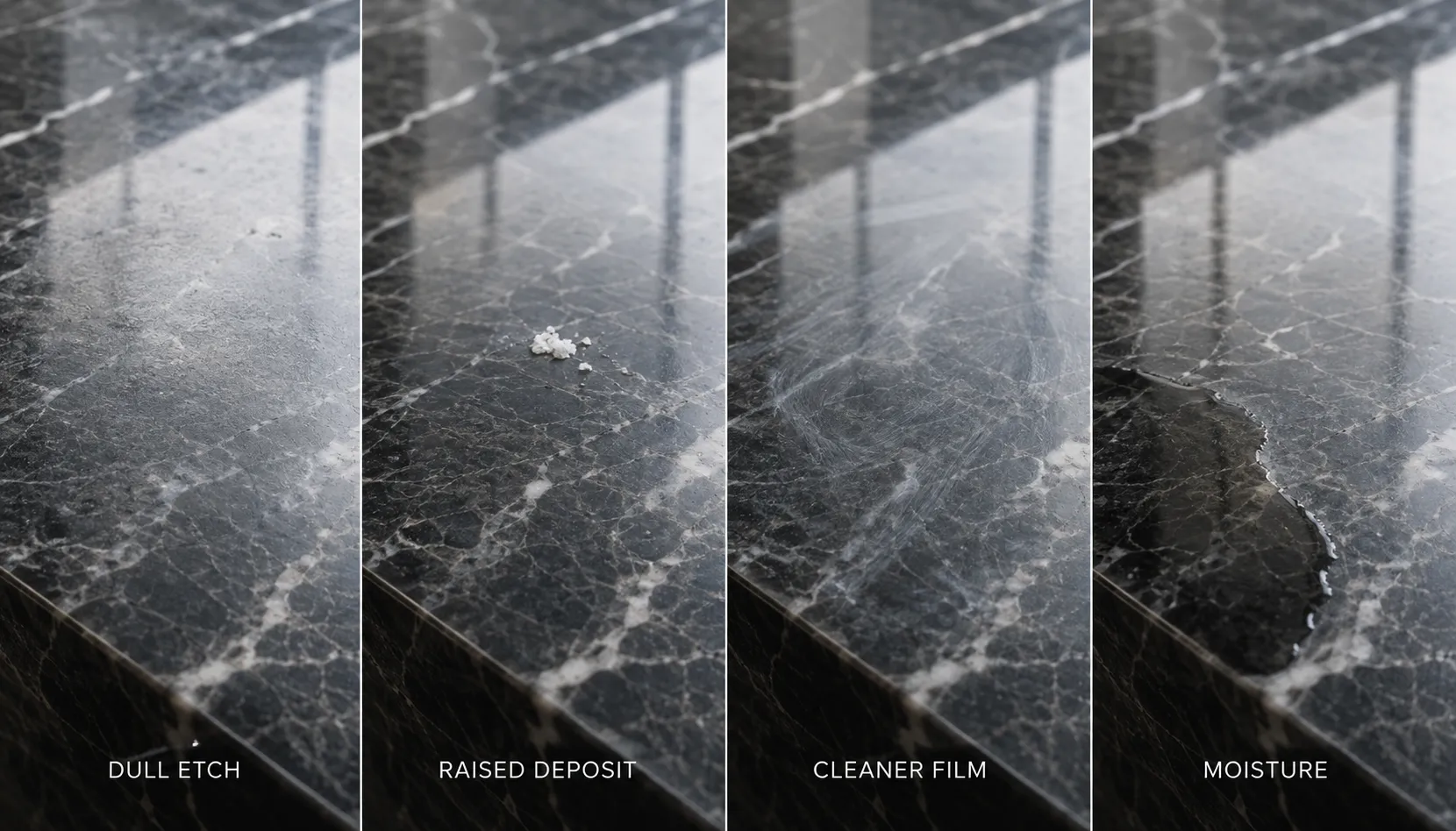
White marks on marble can be dull etching, a raised mineral deposit, cleaner film, a temporary moisture change, or a natural feature in the stone. The safest fix starts with identifying which one you actually have.
Quick Verdict
Do not reach for vinegar, lemon, descaler, abrasive powder or a mystery DIY paste. First photograph the dry mark and view it in angled light. A dull area that changes the reflection is usually finish damage; a raised, crusty mark is more consistent with a deposit; a dark area may still be damp. Start with one neutral clean-and-dry test. If the surface texture or reflection has changed, cleaning alone cannot restore the polish.
Why white marks on marble are easy to misdiagnose
“White” describes appearance, not cause. On polished dark marble, a tiny etched patch can look chalk-white because its roughened surface scatters light. On pale marble, the same damage may show mainly as a dull ring. Hard-water minerals may sit above the surface, while cleaner residue can leave a removable haze. Marble can also contain pale veins, filled pits and fissures that are part of the slab rather than a new stain.
The distinction matters because each condition needs a different response. A cleaner can remove residue, but it cannot rebuild a lost polish. A poultice may help draw some absorbed stains from stone, but it is not a universal treatment for dullness, deposits or unknown marks. Sealer can slow absorption; it does not make acid-sensitive marble etch-proof.
Diagnose the mark before you clean
Let the area reach its normal dry condition, then look from directly above and again with a lamp or window light grazing across the surface. Do not scratch the mark to “test” it. Use sight, a clean fingertip and recent history instead.
| What you observe | More likely explanation | Safest next move |
|---|---|---|
| Flat but dull; reflection breaks across the mark | Etching or finish abrasion | Clean once, dry, then assess restoration—not stronger cleaning |
| Raised, crusty or chalky material near a faucet or splash zone | Mineral deposit or residue above the stone | Avoid acid descalers; check stone-care guidance or a qualified stone professional |
| Hazy film that smears or changes after rinsing | Excess cleaner, soap or topical residue | Rinse with clean water and dry thoroughly |
| Area looks darker, especially around a sink seam or edge | Temporary moisture darkening or an ongoing moisture source | Keep dry, monitor, and investigate leaks if it persists or spreads |
| Fixed pale line, crystalline fleck, filled pinhole or vein | Natural feature, fabrication fill or small impact | Compare with older photos and nearby stone; do not chemically treat it |
What Should You Do With the White Mark?
Follow the path without escalating to acids, abrasive powders or unverified stain-removal mixtures.
Take one overhead photo and one angled-light photo before changing the surface.
Use a marble-compatible neutral cleaner, rinse away the residue and dry with a clean soft cloth.
Compare the mark’s height, texture and reflection with the surrounding marble.
Film or haze disappeared
The mark was likely cleaner or soap residue. Stop cleaning when the surface looks even.
Next action: rinse, dry and prevent new residueChalky deposit remains
Treat it as possible mineral buildup. Do not use vinegar, lemon or an ordinary acidic descaler on marble.
Next action: verify a marble-safe methodReflection or texture changed
The mark may be etching or finish damage. Stronger cleaning will not rebuild the lost polish.
Next action: seek restoration guidanceMoisture remains or returns
Persistent darkening near a seam, faucet or edge may indicate an ongoing moisture source.
Next action: investigate the moisture sourceThe safest baseline cleaning test
This test is for a sound, identified natural-marble surface. If the stone is cracked, flaking, loose, historically significant or coated with an unknown finish, pause and seek appropriate professional guidance.
Clear grit and photograph the area
Lift crumbs or loose dust with a clean, soft cloth. Photograph the mark while dry so you have a true before reference.
Use a marble-safe neutral cleaner
Follow the product label. If no verified stone cleaner is available, a small amount of mild dish detergent in warm water is a conservative general-care option cited by the Natural Stone Institute. Do not create a concentrated soap bath.
Wipe gently—do not grind
Use a clean, soft cloth. Let liquid loosen ordinary residue; avoid scouring pads, powders, razor blades and forceful rubbing.
Rinse away all cleaner
Wipe with a second clean cloth dampened with plain water. Residual cleaner can itself produce film or streaks.
Dry and inspect in angled light
Dry with a soft cloth. Compare the same view and lighting with the original photo. If the mark remains dull but flat, stop cleaning and treat it as possible finish damage.
If the white mark is a dull etch
An etch is not ordinary dirt. Acid contact can react with marble; abrasion can also disturb its finish. On polished stone, the affected patch often looks pale only because it reflects light differently. Wetting it may temporarily hide the dullness, but that does not prove the damage is gone.
A stronger cleaner will not restore missing polish. Small, shallow etches may have stone-specific polishing options, but suitability depends on the marble, finish, location and user skill. Dark stone, honed finishes, textured surfaces, large areas and valuable installations deserve professional assessment. If vinegar caused the damage, follow the dedicated vinegar etch mark on marble guide. For prevention, see whether white vinegar is safe for marble.
When white marks on marble are raised deposits
Deposits tend to form where water repeatedly evaporates—around faucets, soap dispensers, shower edges or drips. They may feel higher than the surrounding stone. The familiar household response is an acidic limescale remover, but that can attack the marble beneath the deposit.
Do not assume a product labeled “bathroom,” “natural” or “descaler” is marble-safe. Check the label for explicit compatibility with natural marble and follow its directions. Thick, bonded buildup is a good reason to call a stone-care professional, because removing the deposit without changing the finish requires controlled mechanical and product choices.
If the area is moisture-darkened
Moisture commonly makes absorbent stone look darker, not whiter. However, people may notice a pale rim or uneven patch as the area dries. Keep the surface free of mats and containers, dry it, and observe whether the appearance returns to normal. Avoid trapping the area under plastic as an improvised test.
Persistent darkening near a sink cutout, backsplash joint, seam, faucet base or floor edge can indicate an ongoing moisture source. If it spreads, returns without a new spill, smells musty, or accompanies a failed joint, prioritize leak and installation assessment over stain treatment.
When white marks on marble are cleaner film
Too much cleaner can create a cloudy layer that mimics damage. A film usually changes when wiped or rinsed and does not create a fixed break in the stone’s reflection. Repeat only the plain-water rinse and drying step if needed; continually adding more product compounds residue.
If a topical coating, wax or “shine” product was previously applied, stop before stripping it. The correct remover depends on the coating and the installation. Contact the product maker or a stone professional with the exact product name.
Should you use a poultice?
A poultice is not the default answer for white marks on marble. It is designed to draw certain absorbed stains from porous stone when the stain type and compatible chemical are known. It does not repolish an etch, safely dissolve every mineral deposit, repair an impact, or solve an active leak. A poorly chosen poultice can enlarge the affected appearance or leave moisture behind.
Use the Natural Stone Institute’s stain-identification framework or obtain stone-specific professional guidance before selecting a poultice chemistry. Never mix bleach and ammonia, and never combine cleaning products in the hope of making them stronger.
What not to use on marble
Acidic kitchen remedies
Vinegar, lemon juice and many calcium/lime removers can etch marble.
Abrasive tools
Scouring pads, abrasive powders, razor blades and harsh scrubbing can alter the finish.
Unverified pastes
Baking-soda or peroxide recipes are not interchangeable across etches, deposits, stains and coatings.
Mixed chemicals
Never mix cleaners. In particular, bleach and ammonia can form dangerous gases.
When to call a stone professional
- The mark changes the reflection or feels rough after a neutral clean.
- A mineral crust is thick, widespread or bonded to polished marble.
- The affected area is large, dark-colored, historically valuable or highly visible.
- Moisture darkening persists, spreads or returns without a new spill.
- The stone is cracked, spalling, loose, hollow-sounding or losing filler.
- You do not know whether the surface is marble, engineered stone, cultured marble or porcelain.
Send the professional a dry overhead photo, angled-light photo, location, approximate size, finish type, spill history and every product already used. That evidence makes remote triage far more useful.
How to prevent white marks on marble
Blot spills promptly, use coasters and trays under recurring drips, and dry splash zones instead of letting water evaporate. Clean with products explicitly compatible with natural marble, use only the label amount, rinse when directed and dry with a soft cloth. Keep acidic food and cleaners away from the surface.
Ask a fabricator or stone professional whether your installation needs sealing and how to test it. A penetrating sealer may buy response time against absorption, but it does not stop acidic etching or make poor maintenance chemistry safe.
Related user questions
Are white marks on marble always water stains?
No. They may be etches, mineral deposits, cleaner film, natural stone features or another form of finish change. Diagnose height and reflection before choosing treatment.
Can water alone etch marble?
Plain water is not an acid, but water can carry minerals, cleaner residue or acidic contaminants. A ring blamed on water may be a deposit or an etch from what was in the liquid.
Will vinegar remove white water spots from marble?
Do not use vinegar on natural marble. Its acidity can etch the calcite-rich surface and create or enlarge a dull mark.
Why does the mark disappear when wet and return when dry?
Water temporarily changes how a rough or dull surface reflects light, so an etch may look hidden while wet. The finish has not necessarily been restored.
Can baking soda remove white marks on marble?
Do not treat baking soda as a universal fix. The mark may be etching, a deposit, film or moisture; an abrasive or alkaline paste can create a second problem without correcting the first.
Does marble sealer prevent white marks?
Sealer may reduce absorption when properly selected and maintained, but it does not prevent acidic etching or every surface deposit.
How can I tell marble from cultured marble?
Do not rely on one visual clue. Check installation records, manufacturer information or ask a fabricator. Cultured marble has a resin-based surface and may require different care.
When is a white mark permanent?
Some finish damage remains until the surface is professionally honed or polished; other marks are removable residue. A persistent change in texture or reflection after neutral cleaning is the key reason to stop and seek restoration advice.
Bottom line
The safest response to white marks on marble is diagnosis, not stronger chemistry. Photograph the dry surface, compare height and reflection, perform one neutral clean-and-dry test, then choose the matching path. Residue may rinse away; moisture may need time and leak control; etching needs finish restoration; a bonded deposit may need stone-specific professional removal.

