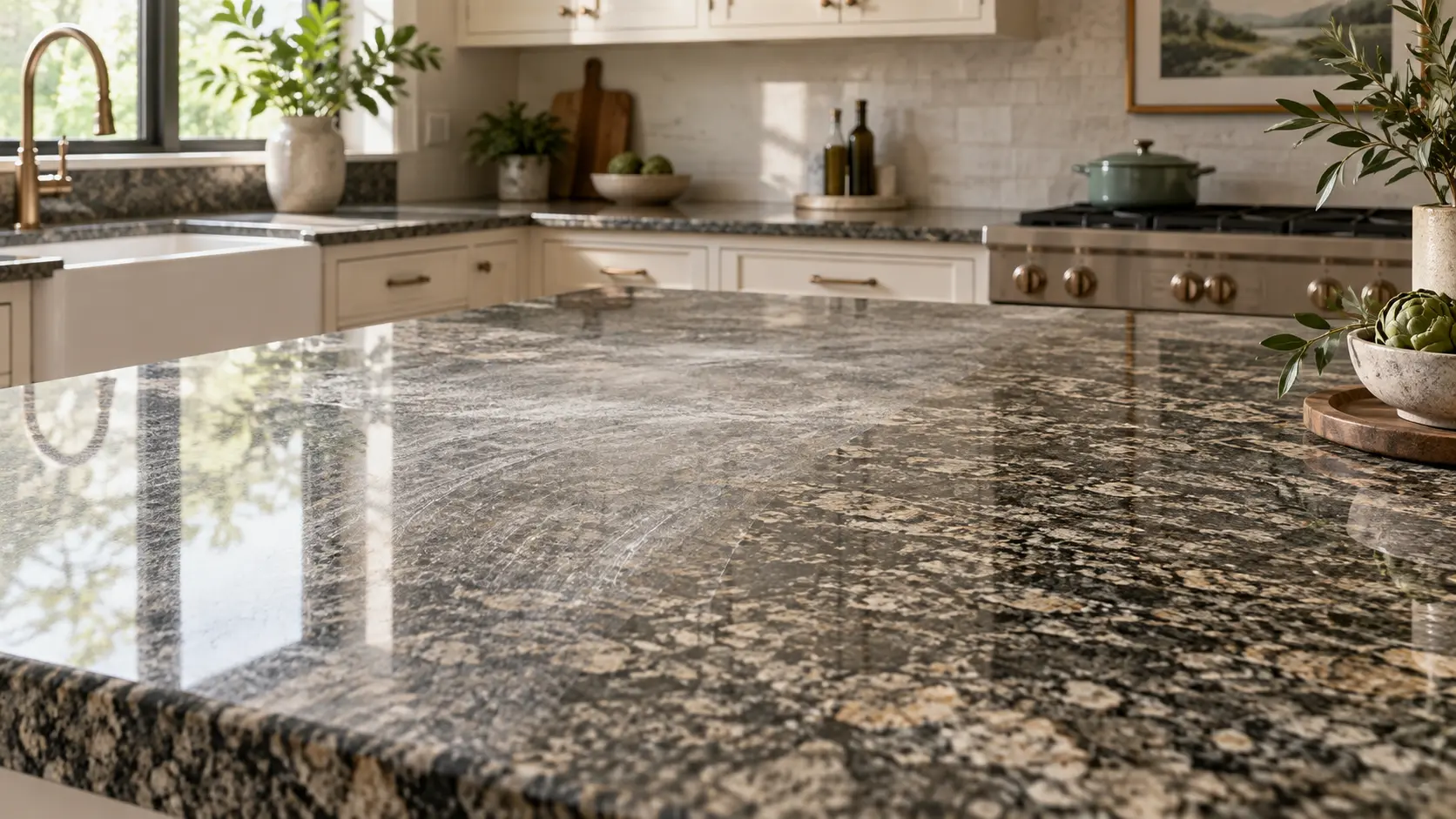
Countertop Care · Natural Granite
Learning how to clean granite countertops safely means using less cleaner, respecting the installed finish and judging marks only after the stone is dry. This guide prevents streaks, sealer mistakes and unnecessary stain treatment.
How to clean granite countertops: the short answer
Remove loose grit, then wipe confirmed granite with warm water and a small amount of mild dish soap or a neutral stone cleaner. Use a separate clean damp cloth to remove the cleaner and dry the surface completely. If a mark remains, identify whether it is film, grease, mineral residue, temporary moisture darkening, an absorbed stain or finish damage before using another product.
First, confirm the countertop is granite
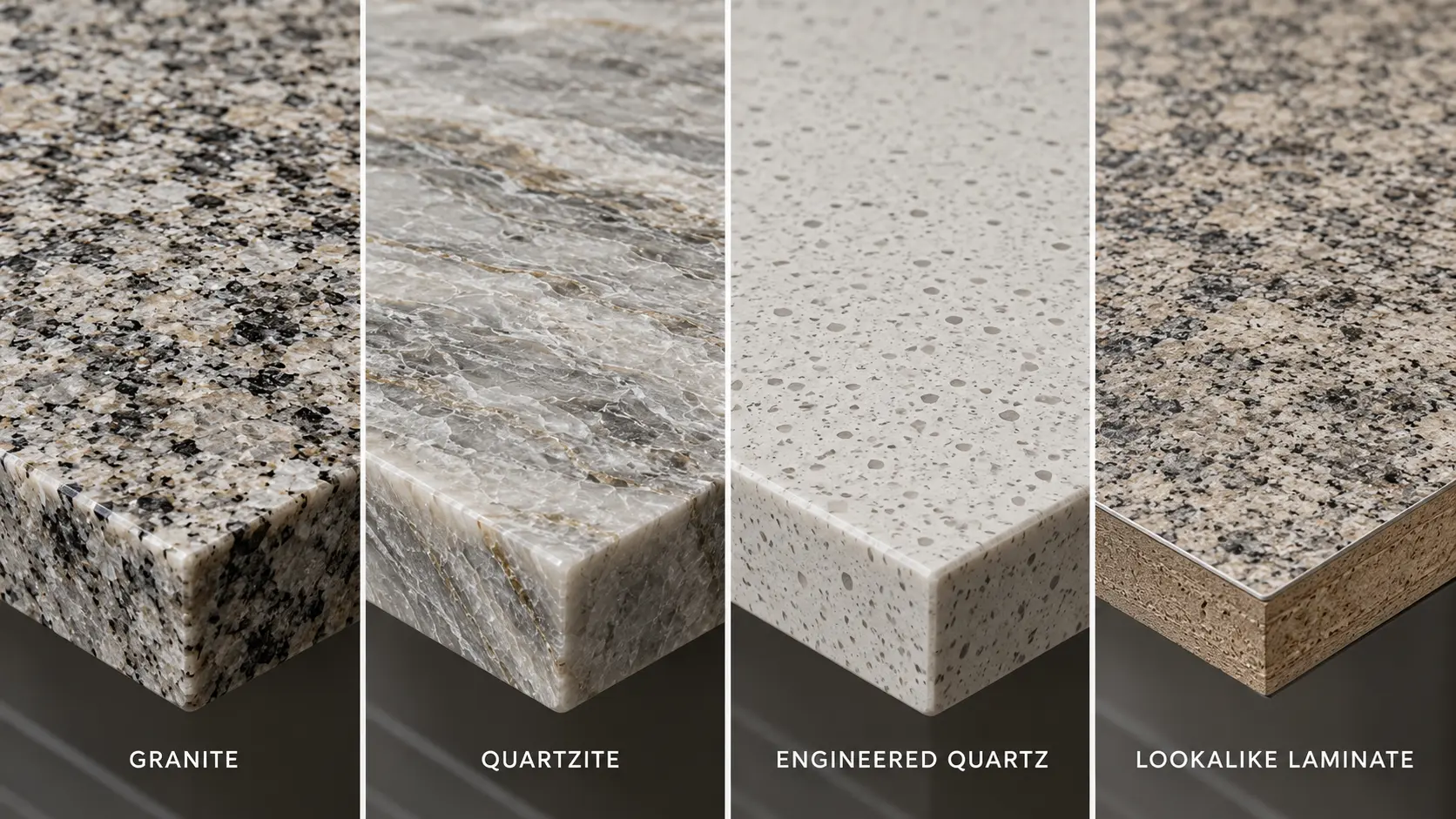
Granite, quartzite and engineered quartz can resemble one another, but they are not one care category. Granite and quartzite are natural stone; engineered quartz is a manufactured material containing mineral particles and binders. A granite-look laminate has a decorative layer over a core. Cleaner, sealer and repair rules can therefore differ.
Check reliable records
Use the renovation invoice, slab label, fabricator paperwork, warranty or installer’s care sheet. Pattern and color alone are not reliable identification tools.
Check the installed system
Identify the finish, penetrating sealer, topical coating, seam material, caulk and adjacent faucet or backsplash before escalating beyond mild cleaning.
Identify the granite finish before judging the result
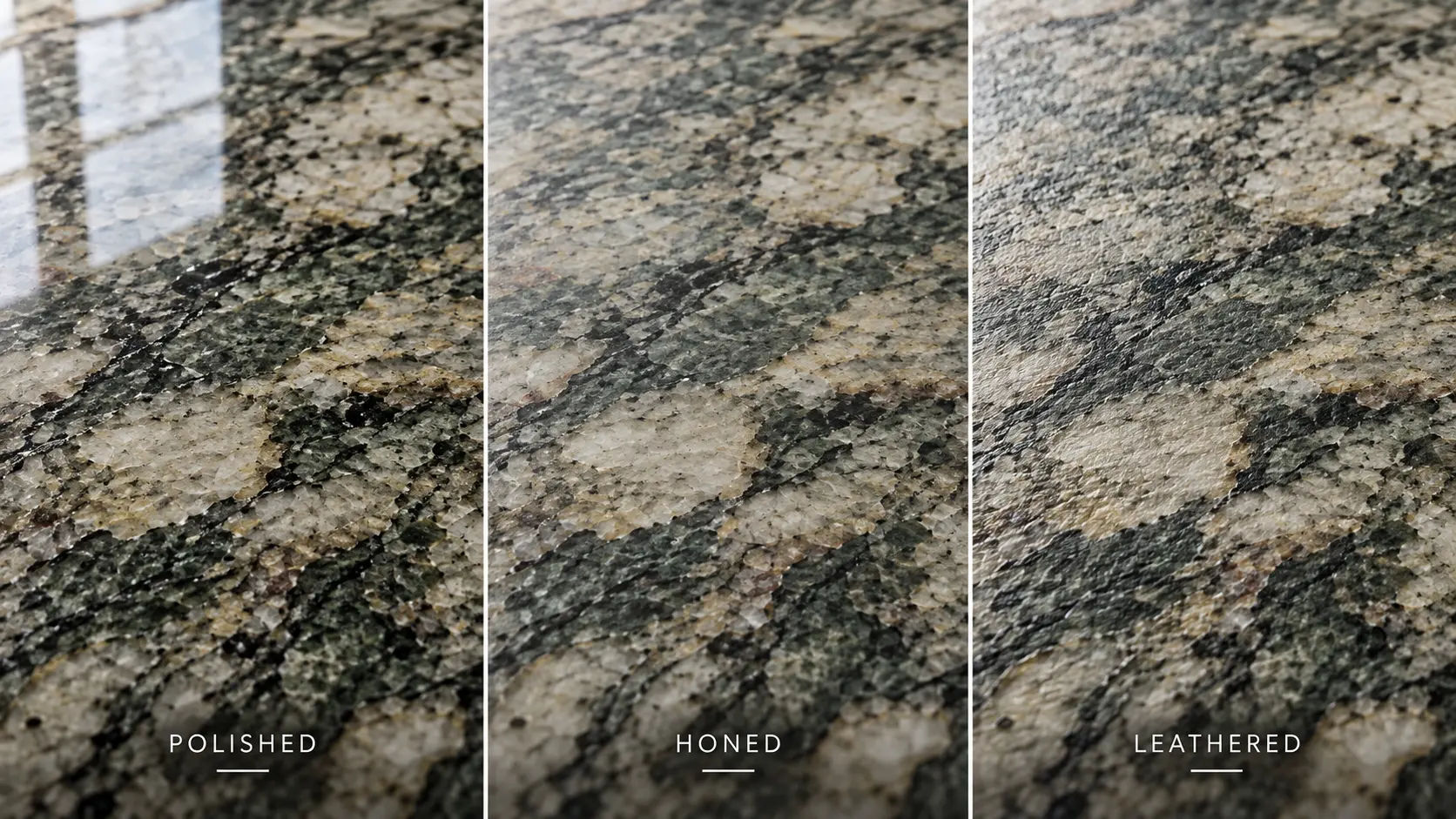
Polished granite
Its strong reflection reveals streaks and cleaner film easily. A fixed dull patch after rinsing is not automatically dirt.
Honed granite
The matte finish may show fingerprints and oil darkening more readily. Do not use polish to force it to look glossy.
Leathered or textured granite
Texture may hold residue and cloth fibers. Use a soft compatible tool instead of aggressive pressure.
Unknown topical finish
Patchy gloss or peeling may involve a coating rather than the granite. Obtain product-specific instructions.
Tools and supplies
- Warm water—not boiling water
- A small amount of mild liquid dish soap or a neutral cleaner labeled for natural stone
- Two clean microfiber cloths or soft lint-free cloths
- A soft nonabrasive sponge, if needed
- A clean dry towel
- The fabricator’s and sealer manufacturer’s instructions
The Natural Stone Institute recommends a neutral cleaner, stone soap or mild liquid dishwashing detergent with warm water, followed by thorough rinsing and drying. It also warns that excessive cleaner can leave film and streaks.
Granite cleaner and sealer compatibility guide
The best way to clean granite countertops is to choose the least aggressive compatible product that can remove the actual soil, then rinse it away instead of layering another product over the result.
| Product or method | Routine position | Important condition |
|---|---|---|
| Warm water | Baseline | Do not flood seams, edges or cutouts. |
| Mild dish soap | Suitable in a small amount | Remove it with clean water to prevent film. |
| Neutral natural-stone cleaner | Preferred optional product | Follow label dilution, dwell and rinsing directions. |
| Cleaner-and-polish combination | Conditional | May leave shine-enhancing residue; do not confuse deposited gloss with repaired stone. |
| Vinegar or lemon | Avoid | Acid is unnecessary and may affect mineral inclusions, treatment or adjacent materials. |
| Glass cleaner | Avoid unless approved | Ingredients and granite/sealer compatibility vary. |
| Bleach or ammonia | Not a routine cleaner | Use only when the product label and installed-surface guidance both permit it. |
| Alcohol | Conditional | Do not use a universal homemade recipe; verify sealer and food-contact directions. |
| Baking soda or poultice | Stain-specific—not routine | Identify an absorbed stain before treatment. |
| Melamine foam, abrasive powder or rough pad | Avoid | Can alter sheen or scratch the finish. |
| Granite sealer | Not a cleaner | Confirm need, existing treatment and compatibility before application. |
How to clean granite countertops in 7 safe steps
Use this sequence for fingerprints, food residue, light cooking grease and ordinary household soil. It deliberately stops before stain extraction, resealing or restoration.
Confirm granite, finish and treatment
Check records for the material, polished/honed/textured finish and any penetrating sealer or topical coating. If these are unknown, keep the method mild.
Clear the counter and remove grit
Lift appliances rather than dragging them. Remove crumbs and gritty particles with a clean soft cloth before wet cleaning.
Prepare only a small amount of cleaner
Use warm water with a small amount of mild dish soap, or dilute a neutral stone cleaner exactly as its label directs. More product can create more film.
Wipe gently in overlapping passes
Dampen rather than flood the cloth. Let dried food soften under the damp cloth instead of increasing pressure or reaching for an abrasive tool.
Remove greasy residue
Give a greasy zone another pass with the same mild solution. Turn or replace the cloth as it loads with soil so grease is not redistributed.
Rinse with a separate clean cloth
Wipe again using clean water. This removal pass matters especially on dark polished granite, where detergent and dirty-cloth arcs are highly visible.
Dry completely and inspect
Dry with a clean towel, then inspect from a shallow angle. If the mark remains after the granite is fully dry, identify its category instead of using a stronger cleaner blindly.
Film, stain, moisture or permanent finish change?
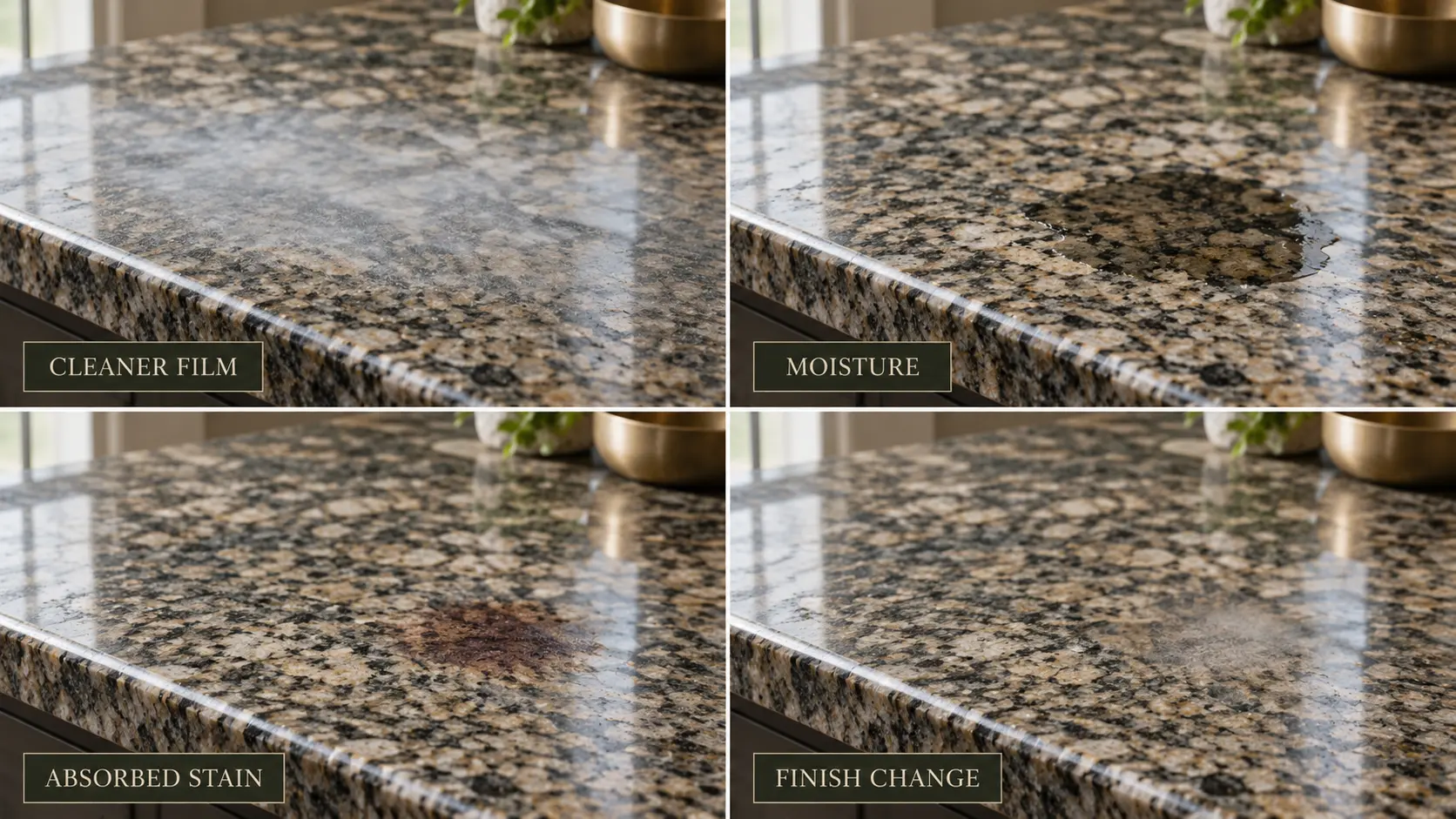
Knowing how to clean granite countertops also means recognizing when cleaning is finished. Evaluate the following conditions only after the area is dry.
| Fully dry result | Likely category | Safest next action |
|---|---|---|
| Uniform haze | Cleaner or polish film | Clean-water wipe; dry with a fresh cloth |
| Curved streaks | Dirty cloth or too much cleaner | Change cloths and repeat the removal pass |
| Greasy smear | Cooking grease or oily product residue | Repeat mild cleaning without adding polish |
| Raised chalky spot | Mineral or dried surface deposit | Confirm granite, finish and adjacent materials before targeted treatment |
| Dark patch that fades | Temporary moisture absorption | Allow drying; investigate recurrence and treatment history |
| Stable colored mark below the surface | Possible absorbed stain | Identify the stain source before selecting treatment |
| Fixed dull patch | Finish, mineral or coating change | Stop stronger cleaning and seek restoration guidance |
| Patchy or peeling gloss | Topical coating or sealer residue | Check treatment records; contact the installer |
| Line with depth or movement | Scratch, crack or seam issue | Stop DIY escalation |
CareBySurface decision map
What should you do after cleaning granite?
Make the decision only after the countertop has dried completely.
Rule out engineered quartz, quartzite and a granite-look product.
Polished, honed or textured? Penetrating sealer, topical coating or unknown?
Use little cleaner, remove it with clean water and inspect under angled light.
The problem was removable surface soil or residue.
Repeat the mild wash or clean-water removal with fresh cloths.
Allow moisture to dry; identify an absorbed stain before treating it.
Cleaner cannot repair finish, coating or structural change.
Cleaning, sanitizing and disinfecting are different jobs
Routine cleaning removes food, grease and soil and can reduce many germs. Disinfection is a separate process using a product registered for specific organisms and applications. The CDC says cleaning alone is sufficient in many household situations and recommends cleaning dirty surfaces before disinfecting.
If disinfection is genuinely needed, choose a product whose label permits the intended use and is compatible with the granite’s current sealer or coating. Follow dilution, ventilation, protective-equipment, wet-contact-time and food-contact-surface rinsing instructions. The EPA emphasizes following the registered label and contact time.
Does granite need resealing?
There is no responsible resealing interval for every granite countertop. Stone absorption, previous treatment, product chemistry, use and installation conditions vary. Sealer is not a cleaner and should not be applied over grease, detergent film, polish residue or unexplained discoloration.
A controlled water observation may reveal changing absorption: on clean, fully dry granite, note whether water darkens the stone and whether the change disappears after drying. But water behavior alone does not identify the existing chemistry or prove that immediate DIY resealing is correct.
When ordinary cleaning does not remove a stain
Do not assume every colored mark needs baking soda or a poultice. First identify the contaminant, location, color, shape, depth and whether the mark changes as the stone dries. The Natural Stone Institute also places stain identification before treatment.
For an oil-based mark that has moved below the surface, follow the separate CareBySurface guide to diagnose and remove an oil stain from granite. Keeping routine cleaning and stain extraction separate prevents unnecessary aggressive treatment.
What not to use as a first response
- Vinegar, lemon juice or descaling products
- Oven cleaner, drain cleaner or paint stripper
- Unapproved glass cleaner
- Steel wool, rough scouring pads or abrasive powder
- Melamine foam without finish-specific approval
- Razor blades or metal scrapers
- Countertop polish to hide a stain or damaged finish
- Sealer applied on a generic timetable
- Any mixture of cleaning or disinfecting chemicals
When to contact a fabricator or restoration professional
Stop DIY escalation for a crack, moving seam, loose sink, chip at a cutout, peeling coating, expanding dark area from below, widespread fixed dullness or a deep scratch that needs blending. Also stop when the countertop identity or prior treatment cannot be confirmed.
Send dry photographs in direct and angled light, plus the invoice, stone name, installation date, finish, sealer name and every product already used. These facts are more useful than describing the counter only as “cloudy” or “stained.”
A simple granite countertop care routine
Once you know how to clean granite countertops without leaving residue, routine care should remain short and predictable:
- Blot spills promptly instead of spreading them.
- Remove grit before wiping.
- Use minimal cleaner and clean cloths.
- Rinse off detergent instead of polishing over it.
- Dry before evaluating color or reflection.
- Use cutting boards and trivets.
- Record the sealer or coating used on the installation.
- Treat seams, caulk, faucet finishes and backsplash materials as separate surfaces.
Choose the guide for the surface you actually have
Frequently asked questions
What is the safest cleaner for granite countertops?
For confirmed granite, start with warm water and a small amount of mild dish soap or a neutral cleaner labeled for natural stone. Use a soft cloth, remove cleaner residue with clean water and dry completely. The fabricator’s instructions control when a specialty sealer or coating is present.
What is the best way to clean granite countertops every day?
The everyday answer to how to clean granite countertops is to remove crumbs, wipe with a small amount of mild soap or neutral stone cleaner, remove the cleaner with fresh water and dry. Do not add polish or sealer during ordinary cleaning.
How do you clean granite countertops without streaks?
Use less cleaner, wipe with a clean cloth, perform a separate clean-water removal pass and dry with a fresh lint-free towel. If curved marks remain, change the cloth rather than adding more product. Dark polished granite makes even a thin detergent film easy to see.
Can dish soap leave a film on granite?
Yes. Too much dish soap or incomplete rinsing can leave a dull-looking film. Wipe the area with a separate cloth dampened with clean water and dry it. A removable film is different from permanent loss of polish.
Can vinegar be used on granite countertops?
Vinegar is not needed for routine granite care and is a poor universal recommendation. It may affect mineral components, sealer, grout, caulk or adjacent finishes. Use a neutral natural-stone cleaner or a small amount of mild dish soap instead.
Can granite countertops be disinfected?
Yes, but cleaning and disinfecting are separate. First remove soil. When disinfection is necessary, use a registered product whose label permits the intended surface and food-contact use, confirm compatibility with the sealer, and follow its dilution, contact-time and rinsing directions.
Why does granite turn dark when it gets wet?
Temporary darkening can indicate moisture entering an absorbent area. Let it dry fully and observe whether the original color returns. Recurring or spreading darkening near a seam, sink or wall needs investigation rather than immediate sealer application.
Does every granite countertop need sealing every year?
No universal annual schedule fits every granite and treatment. Check the original sealer instructions, fabricator guidance and documented absorption behavior. Do not apply new sealer over residue or an unidentified existing coating.
Why does granite still look dull after cleaning?
If clean-water wiping removes the haze, it was probably film. If a dry area remains physically dull or reflects light differently, the finish, a mineral component or a coating may have changed. More cleaner or polish is not a reliable repair.
Evidence sources
- Natural Stone Institute: Cleaning Products for Natural Stone — neutral cleaning, rinsing, drying and film prevention.
- Natural Stone Institute: Stain Removal — stain identification before treatment.
- CDC: Cleaning and Disinfecting — distinction between routine cleaning and disinfection.
- EPA: Cleaning, Sanitizing and Disinfecting — label directions and wet contact time.
- MSI: Honed Granite Care — finish-specific routine cleaning considerations.
Evidence scope: General industry guidance does not override the instructions for the installed stone, sealer, coating or disinfectant label.

