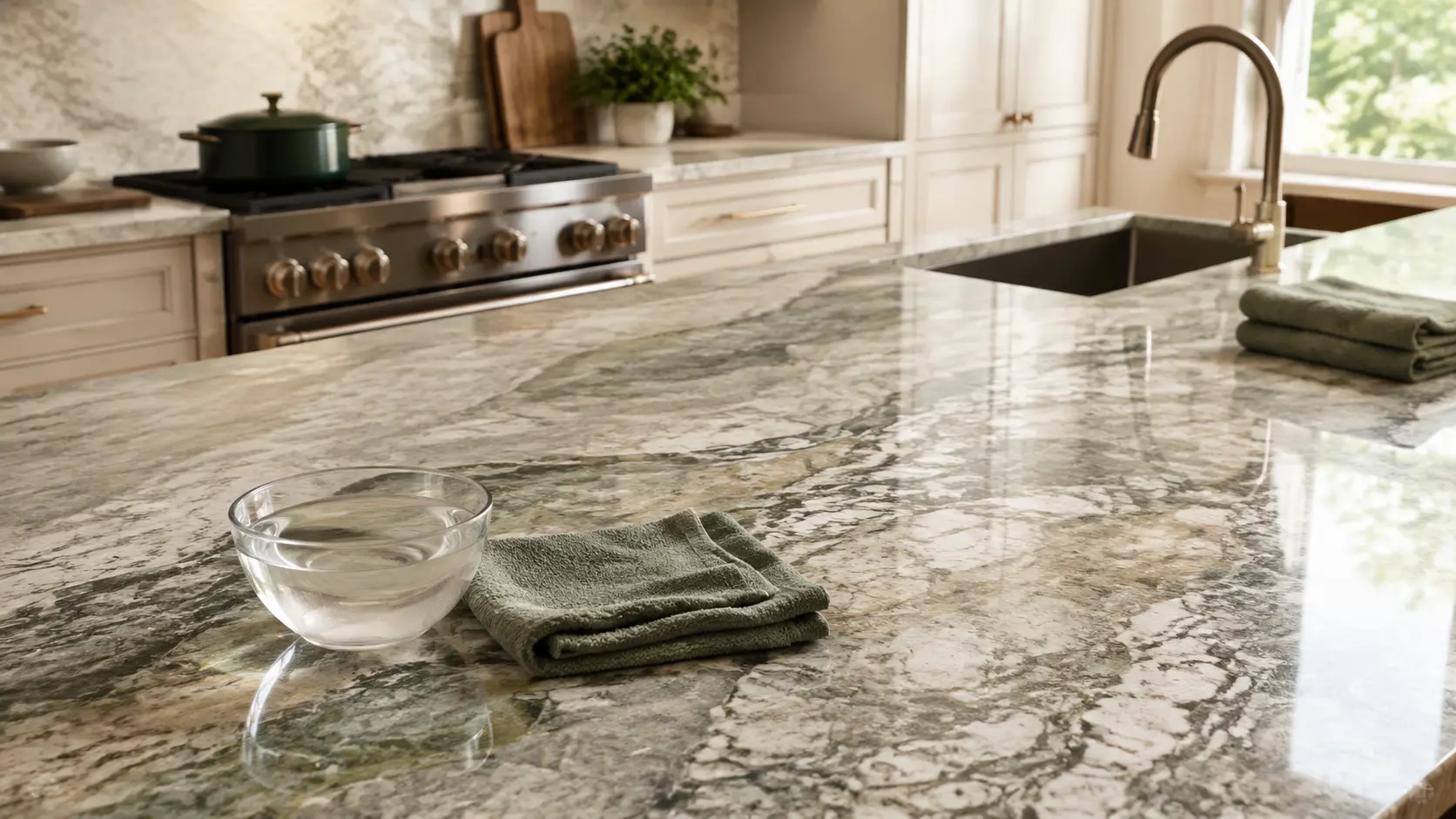
Quartzite countertop care
Learning how to clean quartzite countertops safely starts with knowing what stone you actually have, its finish, and the products applied to it. This guide gives you the daily method first, then helps you distinguish cleaner film, moisture, deposits, stains, and finish changes.
Quick verdict
How to clean quartzite countertops safely
Use warm water with a few drops of mild dish soap, or a cleaner whose label says it is suitable for natural stone. Wipe with a soft microfiber cloth, rinse with a second clean damp cloth, and dry completely. Avoid vinegar, lemon, abrasive powders, scouring pads, and unverified stain remedies.
First, confirm that the surface is quartzite
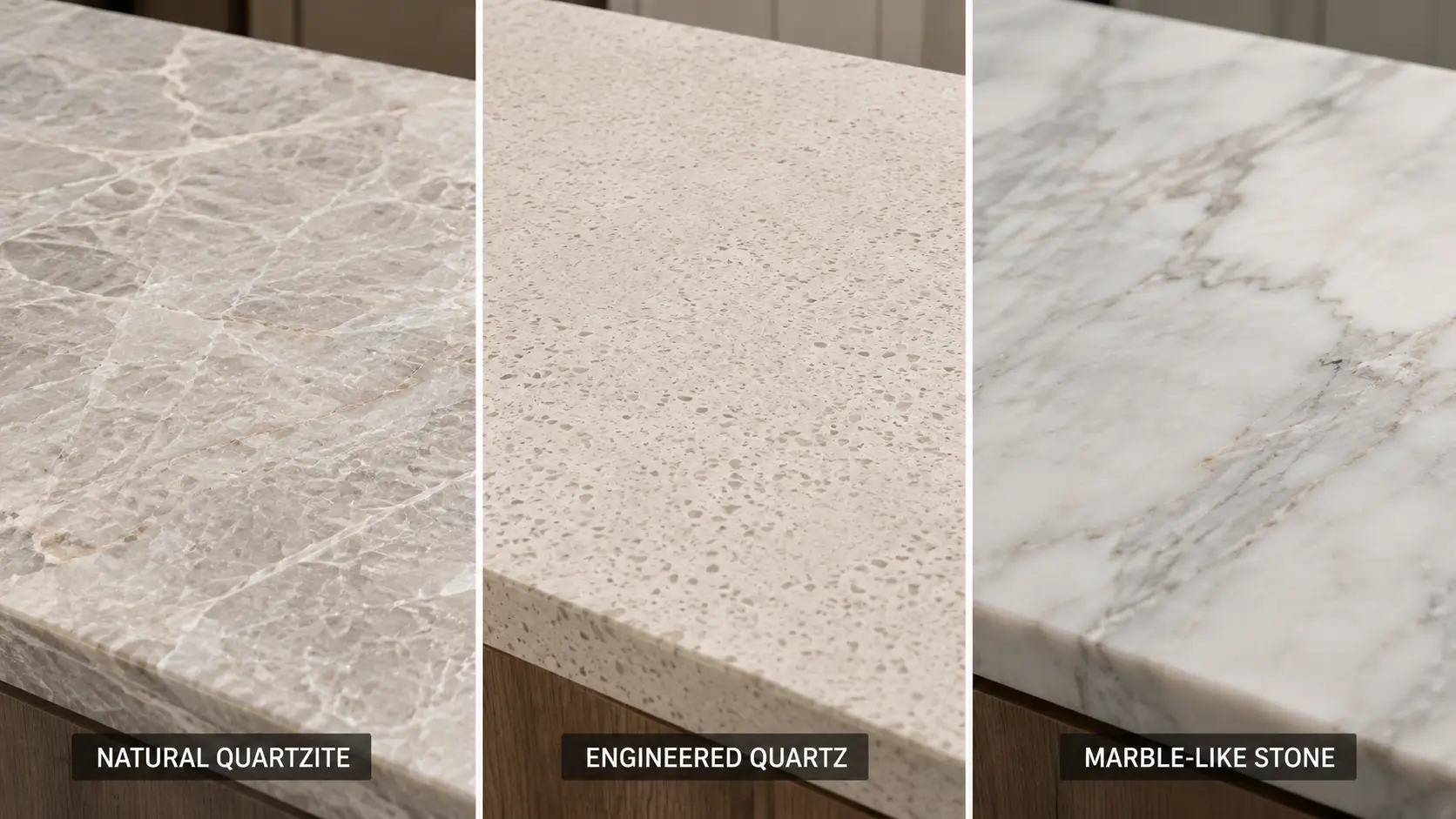
Natural quartzite and engineered quartz are not the same material. Natural quartzite is stone quarried from the earth; engineered quartz is a manufactured surface containing mineral particles and binders. Their product-care instructions are not automatically interchangeable. For example, a separate CareBySurface guide covers a rust stain on an engineered quartz countertop; that treatment should not be copied automatically onto natural quartzite.
There is another complication: some marble-like or dolomitic stones may be sold under trade names containing the word “quartzite.” These surfaces can react differently to acids and polishing methods. Appearance alone cannot provide a conclusive identification.
Check before cleaning
Look at the invoice, slab label, fabricator paperwork, warranty, and sealer instructions. Use the exact product guidance when it is available.
If the identity is uncertain
Use only the neutral baseline method below. Do not perform an acid test on an installed countertop or experiment with polishing compounds.
What you need—and what you do not
You do not need a complicated kit to learn how to clean quartzite countertops. Clean cloths, restrained cleaner use, and a separate rinse do most of the work.
Safe starting kit
- Warm water
- Two clean microfiber cloths
- A few drops of mild dish soap, or a label-approved pH-neutral natural-stone cleaner
- A dry, absorbent microfiber towel
- A soft-bristle brush only for compatible textured areas or grout
Keep away
- Vinegar, lemon juice, or acidic bathroom cleaner
- Abrasive powder, scouring pad, or steel wool
- Magic eraser used as a default scrubber
- Razor blades and metal scrapers
- Unverified polish, wax, or topical coating
More soap does not make quartzite cleaner. Excess detergent is a common reason a freshly wiped countertop looks smeary or cloudy.
How to clean quartzite countertops in 7 easy steps
Remove grit and crumbs
Lift loose debris with a dry microfiber cloth. Do not drag sand, salt crystals, or crumbs across a polished finish.
Check the cleaner label
Confirm that the product is intended for natural stone and follow its dilution directions. “Natural” or “green” does not by itself mean stone-safe.
Make a weak cleaning solution
For routine soil, add only a few drops of mild dish soap to a bowl or small bucket of warm water. Avoid creating heavy suds.
Wipe gently
Dampen—not soak—a clean microfiber cloth. Wipe the surface in overlapping passes, paying attention to cooking film and the area around the faucet.
Loosen stubborn greasy film
Hold the damp cloth over the spot briefly, then wipe again with light pressure. Do not jump straight to an abrasive or concentrated chemical.
Rinse away cleaner residue
Use a second cloth dampened with clean water. This separate rinse is essential; residual soap can dry as haze or streaks.
Dry and inspect
Buff dry with a fresh absorbent towel using gentle passes. Inspect the dry surface under angled light before deciding that a stain or finish problem remains.
Quartzite cleaning decision path
If a mark remains, diagnose it before treating it
A pale patch is not automatically a water stain, and a dark spot is not automatically permanent damage. Observe the clean, dry surface from the side so you can compare height, color, texture, and reflection.
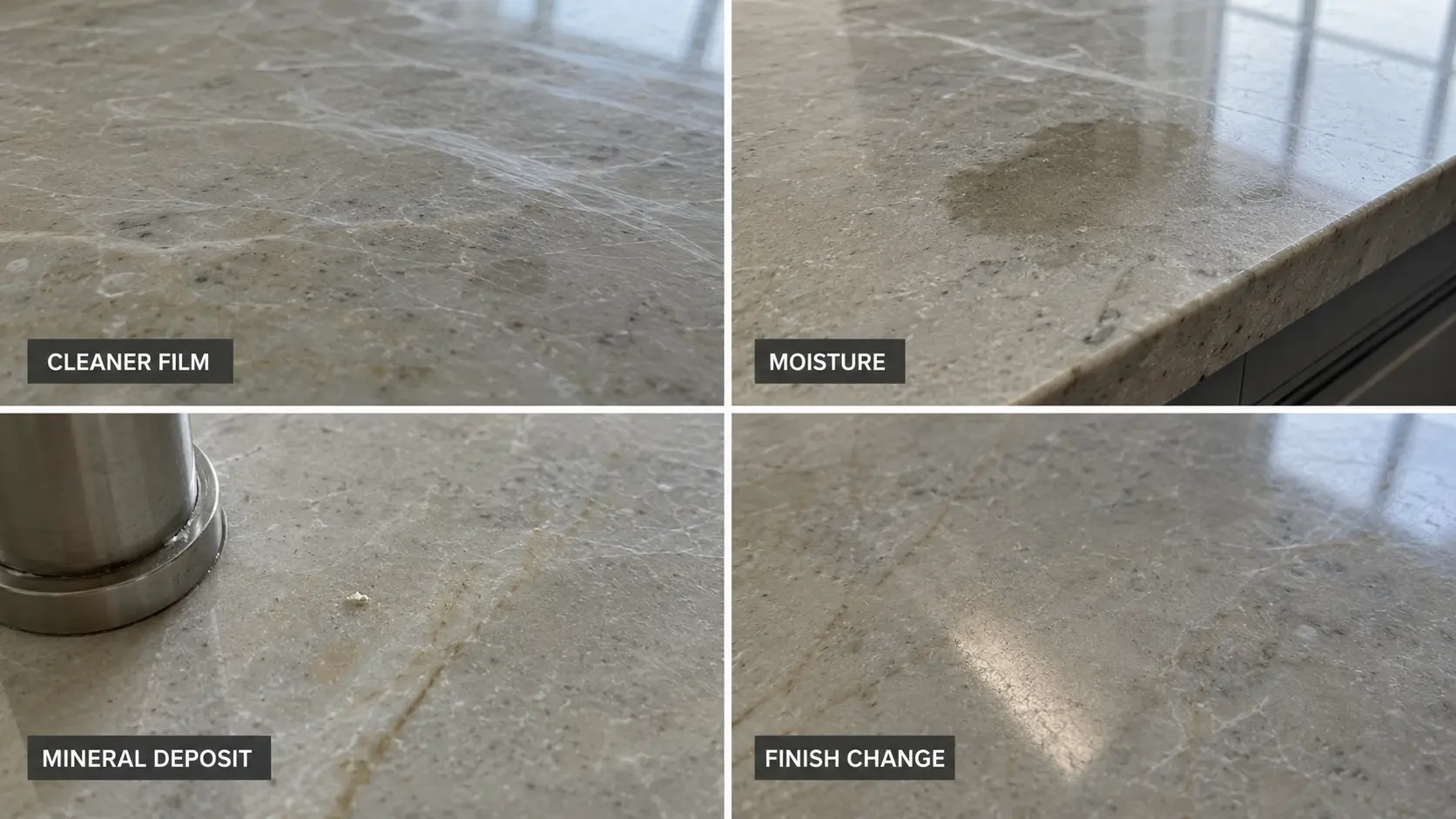
| Dry-surface observation | Possible explanation | Safest next action |
|---|---|---|
| Smear shifts or improves after rinsing | Soap or cleaner film | Rinse once more with a clean cloth and dry |
| Dark area lightens as it dries | Temporary absorbed moisture | Keep it dry, improve splash control, and monitor |
| Persistent dark spot | Oil or another absorbed stain | Identify the source before selecting a stain treatment |
| Raised, chalky, or crusty material | Mineral deposit or surface residue | Do not scrape aggressively; check fabricator guidance |
| Flat pale area with changed reflection | Finish change, sealer issue, or calcite-bearing stone | Stop chemical experiments and request professional identification |
| Sticky or greasy patch | Cooking oil or product residue | Repeat the mild cleaning and rinse process once |
| Open filler, chipped vein, or spreading crack | Filler or structural repair issue | Contact the installer, fabricator, or stone restorer |
The Natural Stone Institute’s stain guidance separates oil, organic, metal, biological, paint, and other stain classes. That is why one universal baking-soda paste is not a reliable answer for every quartzite stain.
How to deep-clean quartzite without creating haze
When homeowners ask how to clean quartzite countertops more deeply, the safest answer is a careful, complete version of the normal process—not stronger chemistry. Work in small sections. Give a compatible stone cleaner only the dwell time printed on its label, keep it from drying on the surface, then rinse and dry thoroughly.
For kitchen grease, repeat the mild method once with fresh water and clean cloths. A dirty cloth can redistribute oil across the countertop and make the entire slab look cloudy.
Clean faucet zones, seams, and edges carefully
The sink area combines standing water, hand soap, mineral deposits, cooking residue, caulk joints, seams, and exposed stone edges. Blot splashes instead of allowing water to remain around the faucet base. Use a folded microfiber cloth to reach the perimeter without flooding it.
If a seam or edge repeatedly turns dark, do not keep applying cleaner or sealer over a damp area. Document the pattern with dry photographs and contact the installer if darkening persists, spreads, or returns after every splash.
How to disinfect quartzite countertops safely
Routine cleaning with soap and water is often sufficient. After raw meat, illness, or another higher-risk contamination, first clean the surface; then use only a disinfectant whose label permits use on the relevant hard surface and whose compatibility is confirmed by the stone, sealer, or fabricator guidance.
Follow the label’s dilution, wet contact time, ventilation, and food-contact rinse directions exactly. The EPA’s registered-disinfectant guidance makes the product label—not a homemade recipe—the controlling instruction. The CDC also distinguishes routine cleaning from situations that call for sanitizing or disinfecting.
What should you not use on quartzite?
| Product or tool | Why it is a poor default | Better starting choice |
|---|---|---|
| Vinegar or lemon | Acid can affect calcite-bearing stone, filler, treatments, or an uncertain surface | Neutral natural-stone cleaner |
| Abrasive powder or scouring pad | May change sheen or leave visible scratches | Soft microfiber cloth |
| Magic eraser | Micro-abrasive action can alter some finishes | Damp microfiber and compatible cleaner |
| Window or bathroom cleaner | May contain acids, alkalis, solvents, or surfactants not approved for the stone system | Label-approved stone cleaner |
| Baking soda as daily scrub | Powder can be abrasive and does not identify the stain | Routine neutral cleaning |
| Razor or metal scraper | Can scratch, chip, or catch a resin-filled area | Professional guidance for bonded deposits |
Does quartzite need to be sealed?
Many quartzite countertops are treated with an impregnating sealer, but there is no honest universal “seal every year” rule. Porosity, finish, stone variety, exposure, sealer chemistry, installation details, and manufacturer instructions all affect the interval.
Cleaning and sealing are different jobs. Do not apply sealer to a dirty, stained, damp, or unidentified surface. If water behavior has changed, ask the fabricator which product was used and whether a controlled evaluation is appropriate.
Simple quartzite maintenance schedule
Use coasters, trivets, and cutting boards. These protect the sealer and finish from colored liquids, hot cookware, oils, grit, and knife contact even when the stone itself is durable. See the Use Natural Stone quartzite-care overview for similar preventive guidance.
When to stop and call a professional
- A dull area whose reflection or texture has changed
- A crack, open fissure, chipped resin fill, or loose seam
- Darkening that persists, spreads, or repeatedly returns at an edge
- A stain with an unknown source
- Widespread haze after sealing or another coating treatment
- A surface that reacts unlike the quartzite described in your paperwork
Photograph the clean, dry surface in daylight and angled light. Send the fabricator the slab or trade name, finish, sealer or cleaner names, installation date, and a short history of what touched the area.
The safest way to clean quartzite countertops
The key to how to clean quartzite countertops is not using the strongest product. It is using a compatible mild cleaner, removing its residue with clean water, drying the stone, and stopping once the surface is clean. If a dry mark remains, classify it before choosing another treatment.
Quartzite countertop cleaning FAQ
What is the best cleaner for quartzite countertops?
Can I use Dawn dish soap on quartzite?
Can you use vinegar on quartzite?
Can you use bleach on quartzite?
Is baking soda safe for quartzite countertops?
Why does my quartzite look cloudy after cleaning?
Why does quartzite turn dark near the faucet?
Can quartzite countertops etch?
How often should quartzite countertops be sealed?
Sources and editorial method
This guide uses the identify → clean gently → rinse → dry → diagnose → escalate method. Core references include the Natural Stone Institute’s stone-care guidance, its poultice guidance, and natural quartzite versus engineered quartz guidance. Product labels and the original fabricator’s instructions take priority for the installed surface.
This article provides general surface-care information. It cannot identify a stone, coating, or structural problem from appearance alone.

