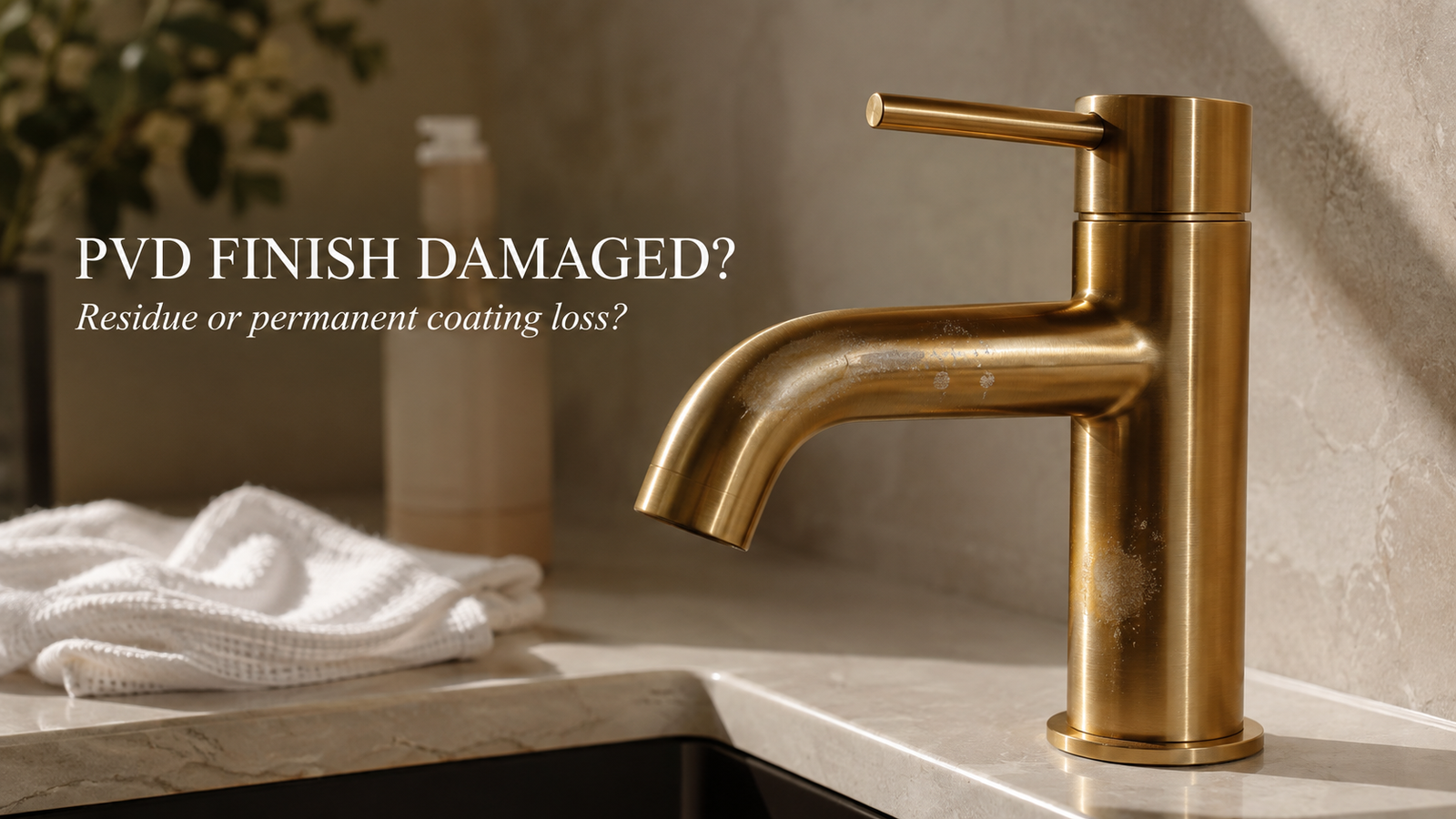
Stop adding cleaners until you know whether the finish actually changed
If your PVD faucet finish ruined after cleaning search started because the faucet suddenly looks cloudy, pale, blotchy or dull, do not assume that stronger cleaning is the answer. The visible change may be removable cleaner residue or mineral buildup—but abrasion, chemical dulling and actual coating loss need a different response.
- Do now: stop the cleaner that caused or preceded the change.
- Safest first action: where the faucet maker permits it, rinse away cleaner residue with plain water and dry with a soft non-abrasive cloth.
- Do not assume: that vinegar, descaler, alcohol, bleach or abrasive cream is safe because another PVD brand allows it.
- Check dry: mineral deposits and residue can look different after the faucet is completely dry.
- Stop DIY escalation: if the coating is peeling, flaking, blistering, scratched through or showing a different-colored substrate.
1First, Make Sure the Faucet Is Actually PVD
PVD stands for physical vapor deposition. In faucet manufacturing, the process deposits a thin decorative and protective layer onto a prepared surface. It can produce finishes sold under names such as brushed gold, polished nickel, brushed nickel, bronze, stainless-look or other metallic colors.
But the words brushed brass, gold, gunmetal or black do not automatically prove that a faucet is PVD. Similar-looking fixtures can be electroplated, powder coated, lacquered, painted, plated or left as an organic metal finish.
Check the faucet model number, product page, installation manual, warranty paperwork or finish code. If you cannot identify the coating, use the faucet manufacturer’s general care instructions and avoid chemical escalation.
2Residue, Hard-Water Haze or Permanent Damage?
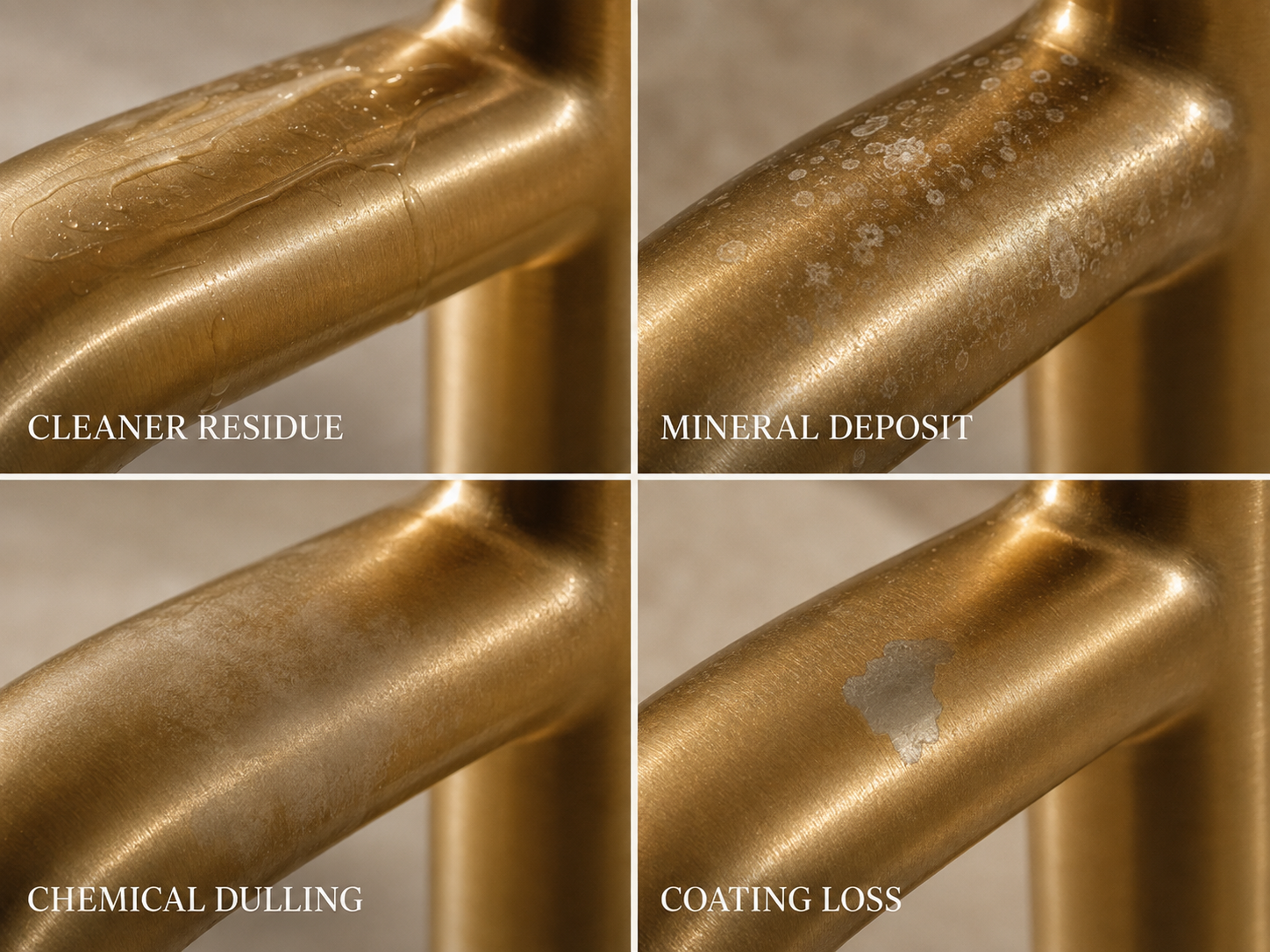
The most important step is to decide whether something is sitting on the finish or whether the finish itself has changed.
| What you see | More consistent with | Can cleaning help? | Next move |
|---|---|---|---|
| Smeary film or fingerprints that shift when wiped with water | Cleaner, soap or polish residue | Often | Use the manufacturer’s mild rinse/soap method. |
| Chalky white spots, crust or water-drop outlines | Mineral/limescale deposit | Often, if the approved descaling method is used | Check the exact brand before using vinegar or acid. |
| Uniform cloudy or dull patch after chemical exposure | Chemical alteration or stubborn residue | Uncertain | Rinse approved residue away, dry, then stop if appearance remains changed. |
| Fine directional scratches or visibly scuffed patch | Abrasion | No, not if material was physically removed | Stop polishing or scrubbing. |
| Peeling, flaking, bubbling or a different metal color underneath | Coating loss / delamination / exposed substrate | No | Document it and contact the manufacturer. |
3PVD Faucet Finish Ruined After Cleaning: What to Do First
If the appearance changed immediately after a cleaner was applied, do not “neutralize” it with another random household chemical. That can turn one exposure into two.
- Stop using the product. Save the bottle or photograph the ingredient label if possible.
- Check the faucet instructions. Look for the exact finish name as well as the faucet model. Manufacturer-specific rules take priority over generic PVD advice.
- Remove remaining cleaner as the manufacturer directs. Several manufacturers advise rinsing faucet finishes thoroughly with clear water after cleaning. Do not let an unknown cleaner continue to sit on the coating.
- Dry gently. Use a clean, soft cloth and blot or wipe without abrasive pressure. Kohler specifically emphasizes drying rather than leaving water to evaporate into deposits.
- Inspect only when dry. Compare the affected area with an untouched part of the same faucet under side lighting.
- Do not polish automatically. If the appearance remains different, polishing can add abrasion and make diagnosis harder.
4Why “PVD-Safe Cleaner” Is Not a Universal Category
The strongest reason to avoid generic internet recipes is that faucet manufacturers publish different chemical limits for their PVD finishes.
| Manufacturer | Routine care | Vinegar / acid position | Important avoid guidance |
|---|---|---|---|
| Kohler Vibrant PVD | Mild detergent, rinse and dry | Acid-containing cleaners are prohibited in its published PVD care guidance | Ammonia, bleach, acid and abrasives |
| Brodware inFinium PVD | Warm water, dry microfiber; mild liquid soap where appropriate | Specifically says to avoid vinegar and citrus acid | Caustics, abrasives, citrus acid, bleach, vinegar and alcohol |
| Franke PVD faucets | Soapy water or dishwashing detergent | Publishes a vinegar-and-water route for PVD limescale removal | Abrasive cleaners; its broader guidance also warns against solvents, alcohol and harsh chemicals |
| Riobel PVD finishes | Mild soap, clear-water rinse and soft-cloth drying | Permits a controlled 50/50 white-vinegar/water application for mineral buildup and warns not to soak | Abrasives, ammonia, bleach and alcohol |
For current instructions, consult the official Kohler faucet care guide, Brodware maintenance guidance, Franke faucet-surface guidance, or Riobel care instructions for your exact finish.
5If the Problem Looks Like Hard-Water Haze
Hard water can leave calcium and other mineral deposits as droplets evaporate. On a polished or dark decorative faucet, even a thin mineral film may create a dramatic cloudy or whitish appearance.
The safest starting point is prevention and manufacturer-approved routine care: remove fresh water, rinse away soap and dry the faucet before deposits build into a thicker layer.
For established limescale, however, do not choose a descaler based on the word “PVD” alone. As the manufacturer comparison above shows, the permitted chemistry varies.
- Confirm the faucet manufacturer and exact finish.
- Check its current limescale instructions.
- Use only the specified cleaner, dilution and exposure approach.
- Do not extend contact time because the first pass was incomplete.
- Rinse and dry as instructed.
- Reassess the finish before another application.
If the white material disappears but the underlying patch remains dull, scratched or differently colored, stop treating it as ordinary limescale.
6How Chemical Dulling Differs From Cleaner Residue
Cleaner residue usually sits on the surface. It may smear, redistribute or rinse away. Chemical dulling is more concerning because the reflectivity or color of the finish itself appears altered after residue is gone.
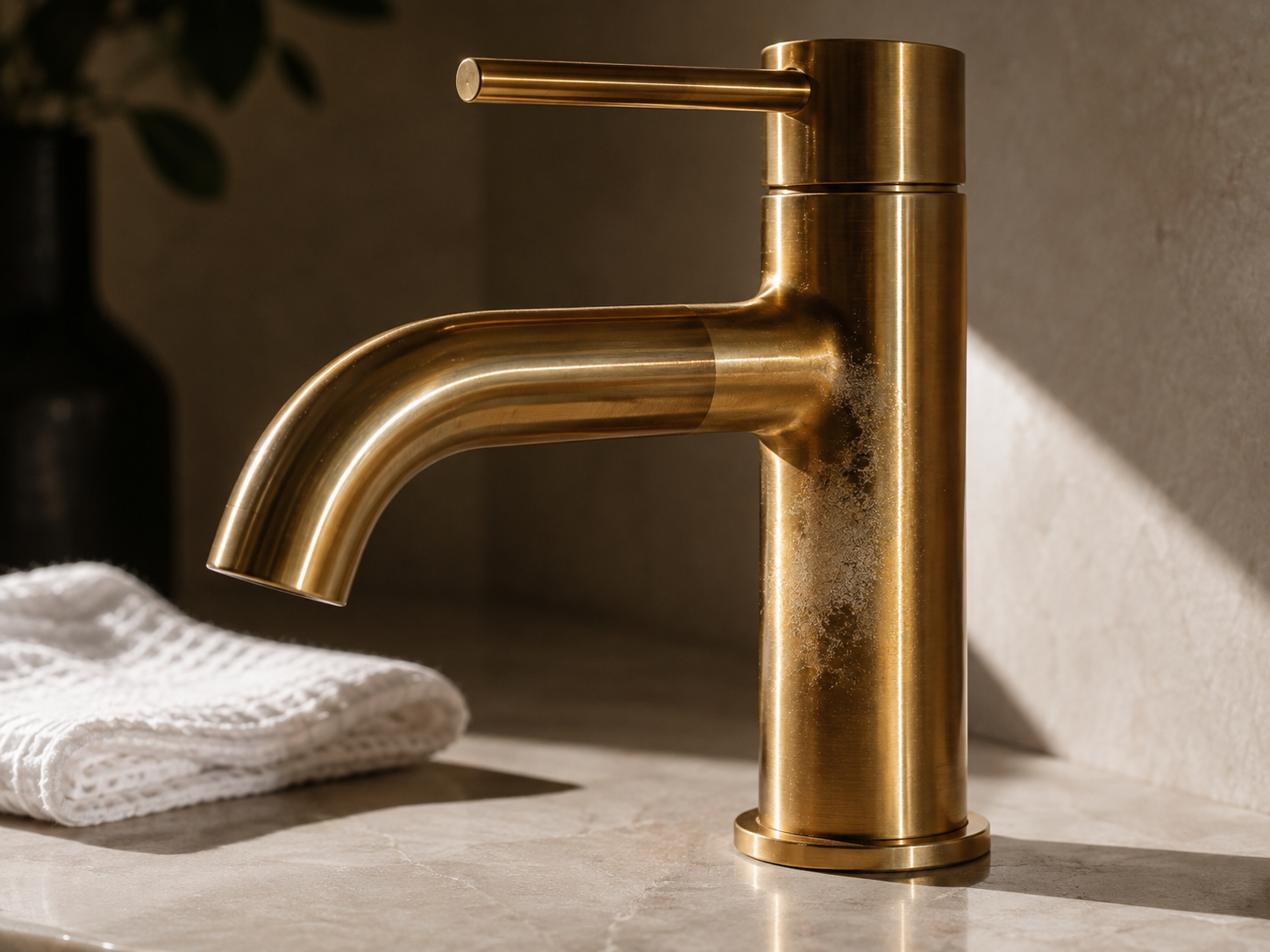
Use indirect side lighting rather than harsh flash. Compare:
- texture of the affected and unaffected areas;
- sharpness of reflected light;
- whether the patch has a boundary matching where cleaner sat;
- whether another gentle water rinse changes the appearance;
- whether the underlying color appears different.
If the dry patch remains visibly flatter, lighter, darker or less reflective after all manufacturer-approved residue has been removed, further cleaning may not restore it.
7Scratches and Abrasion: When Polishing Can Make It Worse
Abrasive powders, scouring pads, steel wool, rough sponges and aggressive polishing can physically alter decorative faucet surfaces. Even manufacturers that describe PVD as durable still warn against abrasive maintenance.
Do not assume that automotive polish, metal polish or a rubbing compound will “bring the shine back.” A polish works partly by abrasion; on a thin decorative finish it may increase the size of the visibly altered area.
8If the Finish Is Peeling, Flaking or Bubbling
Peeling changes the diagnosis completely. Mineral deposits sit on top of the finish; peeling means layers are separating or material has already been lost.
Before doing anything else:
- Stop chemical cleaning and polishing.
- Do not pick at a loose coating edge.
- Photograph the complete faucet and close-up damage under neutral light.
- Locate the receipt, model number and finish code.
- Write down what cleaner, concentration and tool were used.
- Contact the retailer or manufacturer before attempting refinishing.
Some faucet warranties distinguish manufacturing finish failure from damage caused by improper care. That makes documentation important before additional DIY work obscures the original condition.
9Result Checkpoint: Continue, Stop or Make a Warranty Claim?
10What Not to Use Unless Your Exact Faucet Manufacturer Allows It
| Product/method | Why it deserves caution |
|---|---|
| Vinegar | Allowed for some PVD finishes and prohibited for others. Never generalize. |
| CLR / strong descalers | Acid chemistry and contact-time tolerance can conflict with decorative-finish instructions. |
| Bleach | Explicitly prohibited by several major PVD-finish care guides. |
| Alcohol / solvent cleaners | Several manufacturers prohibit alcohol or solvent exposure. |
| Abrasive cream or powder | Can mechanically dull or scratch decorative finishes. |
| Magic Eraser / melamine foam | Its mild abrasive action may alter gloss or texture. |
| Metal polish | Abrasive polishing is not automatically appropriate for a deposited decorative coating. |
| Scouring pads / steel wool | Can physically scratch or remove finish. |
11Check the Warranty Before Trying to Restore a Damaged Finish
When a coating appears permanently changed, the next step may be warranty assessment rather than a stronger cleaning product.
Kohler’s current care documentation warns that failure to follow its cleaning instructions may affect warranty obligations. Franke asks warranty claimants to provide proof of purchase plus photographs of the complete product and the problem area. These requirements are another reason to document the faucet before further experimentation.
If the fixture is relatively new and coating loss appeared during normal care, contact the manufacturer with:
- model and finish code;
- date and place of purchase;
- clear overall and close-up photographs;
- water conditions if relevant;
- the exact cleaner and tool used;
- when the appearance first changed.
12How to Prevent PVD Faucet Haze and Finish Damage
- Keep the exact faucet care instructions rather than relying on generic bathroom-cleaning advice.
- Dry water drops regularly in hard-water areas.
- Spray tile, mirror and shower cleaners onto the cloth rather than allowing overspray to land on decorative faucets.
- Rinse accidental overspray promptly where the manufacturer directs.
- Use soft cloths rather than abrasive pads.
- Do not let cleaners soak longer because buildup looks stubborn.
- Test a new manufacturer-approved cleaner in an inconspicuous location first when the instructions recommend testing.
- Keep acidic toilet, tile and limescale products away from faucet finishes unless the exact faucet documentation approves them.
13Frequently Asked Questions
Can vinegar damage a PVD faucet?
Yes on some finishes—and it may be specifically permitted on others. Brodware says to avoid vinegar on its inFinium PVD finishes, while Franke and Riobel publish controlled vinegar-and-water methods for certain PVD limescale situations. Follow the instructions for your exact brand and finish.
Can a cloudy PVD faucet be restored?
If cloudiness comes from cleaner residue or mineral buildup, manufacturer-approved cleaning may restore the appearance. If the coating itself has been chemically altered, abraded or removed, ordinary cleaning cannot recreate the original deposited finish.
How can I tell hard-water spots from damaged PVD?
Hard-water deposits commonly appear as chalky spots, crust or droplet outlines sitting on the surface. Damage is more likely when a dry area remains permanently different in texture, gloss or color after all manufacturer-approved mineral removal has been completed.
Can I use CLR on a PVD faucet?
Do not assume so. CLR and similar descalers use chemistry that may conflict with decorative-finish care instructions. Use it only when the exact faucet manufacturer expressly approves the product or chemistry for that finish.
Can I polish scratches out of a PVD faucet?
Not safely as a general rule. Polishing compounds can be abrasive and may remove additional finish. If the scratch exposes another color or the substrate underneath, contact the faucet manufacturer rather than trying to polish the coating back.
Why did my faucet turn dull after bathroom cleaner was sprayed nearby?
Overspray can leave residue or expose the finish to chemistry that was never intended for it. Several manufacturers specifically tell owners to rinse or clean faucets after nearby surfaces have been sprayed. Rinse according to your faucet’s instructions, dry it, then reassess the appearance.
Is peeling PVD fixable with cleaning?
No. Peeling or flaking indicates that material is separating or already missing. Stop cleaning, document the condition and contact the manufacturer, retailer or a qualified refinishing professional.
Final Safe Recommendation
If your PVD faucet finish ruined after cleaning problem is still visible after approved cleaner residue has been rinsed away and the faucet is dry, resist the urge to keep escalating. First distinguish removable mineral buildup from chemical dulling, abrasion or actual coating loss. Then follow the care instructions for the exact faucet—not another brand’s PVD recipe. Peeling, exposed substrate, persistent gloss change or physical scratching are stop signs for DIY cleaning and a reason to contact the manufacturer.

