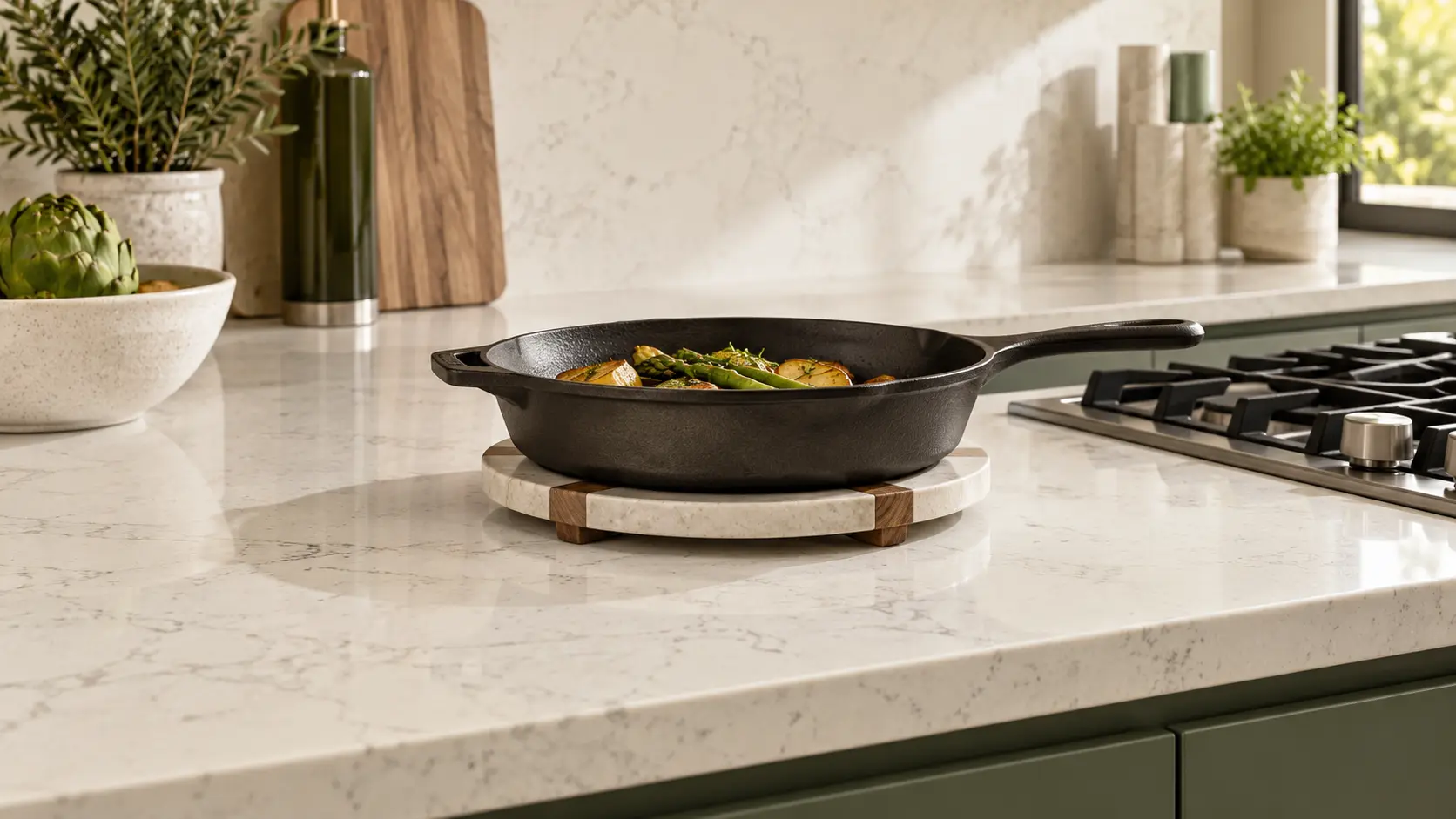
The practical answer to hot pans, countertop appliances and accidental heat marks
Can quartz handle heat? Engineered quartz tolerates ordinary kitchen warmth, but it is not a safe landing zone for hot cookware or sustained appliance heat. The safest rule is simple: place a solid trivet or heat pad between every hot item and the countertop—every time.
Quick answer
Do not put a hot pan, baking sheet, air fryer, slow cooker, electric skillet or griddle directly on engineered quartz. Manufacturers consistently call for trivets or hot pads, while exact temperature claims vary by product, duration and location. Heat can affect the resin-rich surface, and rapid temperature change can stress the slab—especially near edges, seams and cutouts.
First, make sure the surface is engineered quartz
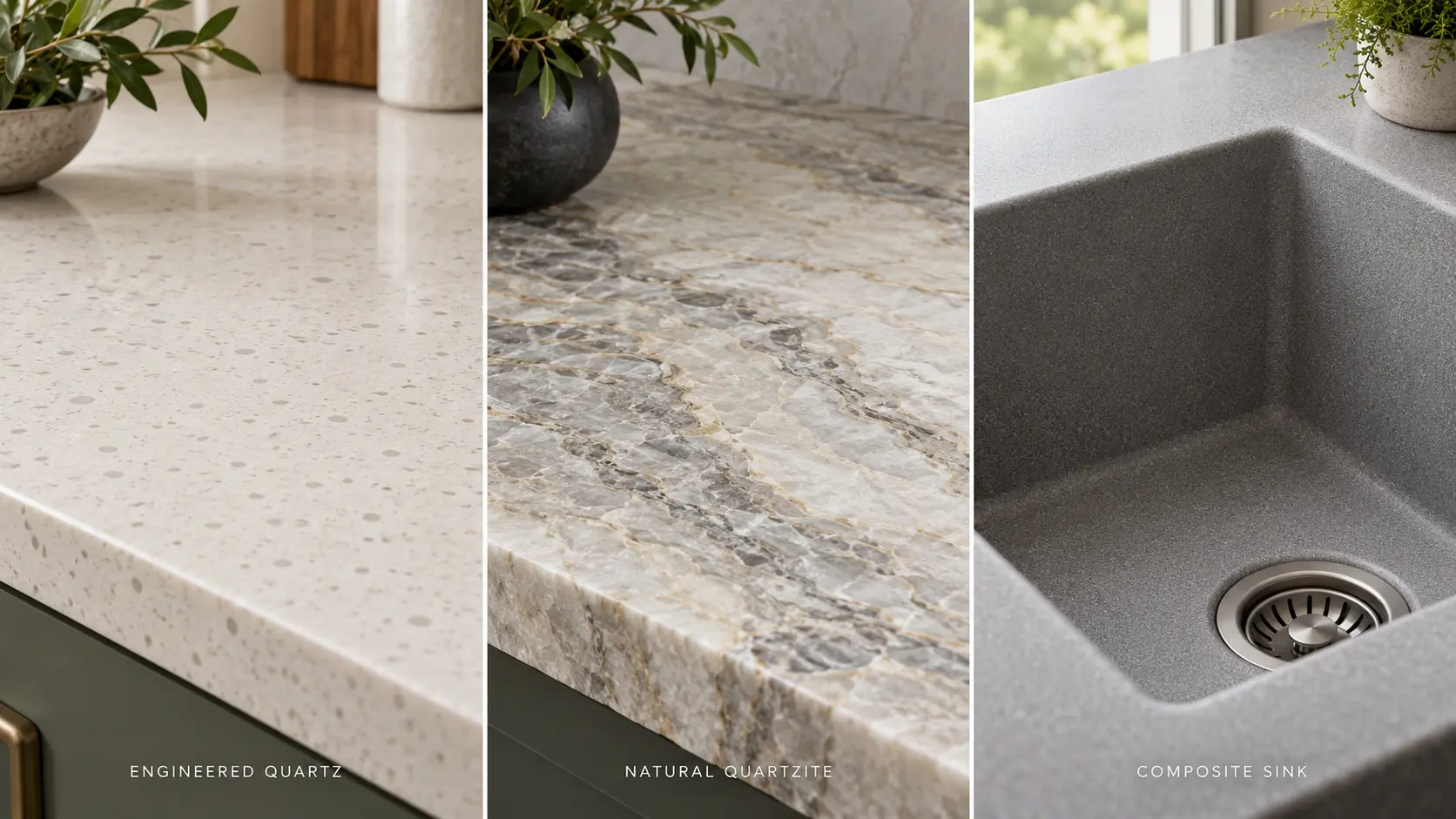
“Quartz” is used for several different materials. This guide covers engineered quartz countertops: manufactured slabs made from mineral particles, pigments and polymer binders. Natural quartzite is quarried stone and follows different care rules. A quartz-composite sink is another manufactured material with its own maker instructions.
| Surface | Useful clues | Heat-care action |
|---|---|---|
| Engineered quartz | Consistent pattern; brand paperwork may name Cambria, Caesarstone, Silestone, Corian Quartz, MSI Q or another slab maker. | Follow the slab maker’s instructions and use a trivet. |
| Natural quartzite | Geologic movement and natural variation; often sold through a stone fabricator. | Use our quartzite care guide and confirm sealer/fabricator advice. |
| Quartz-composite sink | Molded basin with a uniform granular look. | Check the sink manufacturer’s use-and-care document. |
Can quartz handle heat at one universal “safe temperature”?
No single number answers can quartz handle heat in every home. Search results commonly quote a threshold, but that number can create false confidence. Real-world risk depends on the exact slab formulation, heat-source temperature, contact time, barrier quality, countertop color, installation, and whether heat is concentrated near a seam, edge or cooktop cutout.
Manufacturer guidance is much more consistent than online temperature charts: Cambria, Caesarstone, MSI, Corian Quartz and Silestone all direct owners to use a trivet or hot pad.
How heat can damage a quartz countertop
Usually low concern
- Warm plate or mug
- Brief ambient warmth
- Appliance placed on an approved insulating base
Higher concern
- Hot pan or oven tray
- Sustained heat from appliances
- Rapid hot-to-cold change
- Heat at seams, edges or cutouts
Three mechanisms matter. Surface discoloration or scorching can appear when heat affects pigments or binder. Thermal stress can contribute to cracking when a small area changes temperature quickly. Installation-zone stress is more consequential at openings and transitions, where the slab geometry and support differ from an open field area.
What major quartz manufacturers actually recommend
| Manufacturer | Published direction | Practical takeaway |
|---|---|---|
| Cambria | Calls for a closed-weave hot pad or solid trivet beneath cookware and heat-producing appliances; warns about direct or sustained heat and rapid temperature changes. | Protect against both hot pans and long appliance cycles. |
| Caesarstone | Directs users to place hot cookware on trivets or hot pads. | No direct hot cookware contact. |
| MSI Q | Calls for trivets/hot pads for cookware and countertop appliances; flags sudden temperature change and sustained heat, particularly around edges and cutouts. | Treat appliance bases and vulnerable zones as real heat risks. |
| Corian Quartz | Says not to place hot skillets or roasting pans directly on the surface and to use trivets or hot pads. | A brief contact is still an accident, not an approved practice. |
| Silestone | Describes heat resistance but warns that sudden temperature changes can affect the surface; recommends trivets. | “Heat resistant” does not mean heatproof. |
Always prioritize the current document for your exact product, region and warranty. Manufacturer wording can change.
Heat-source risk guide
| Heat source | Main risk | Safer setup |
|---|---|---|
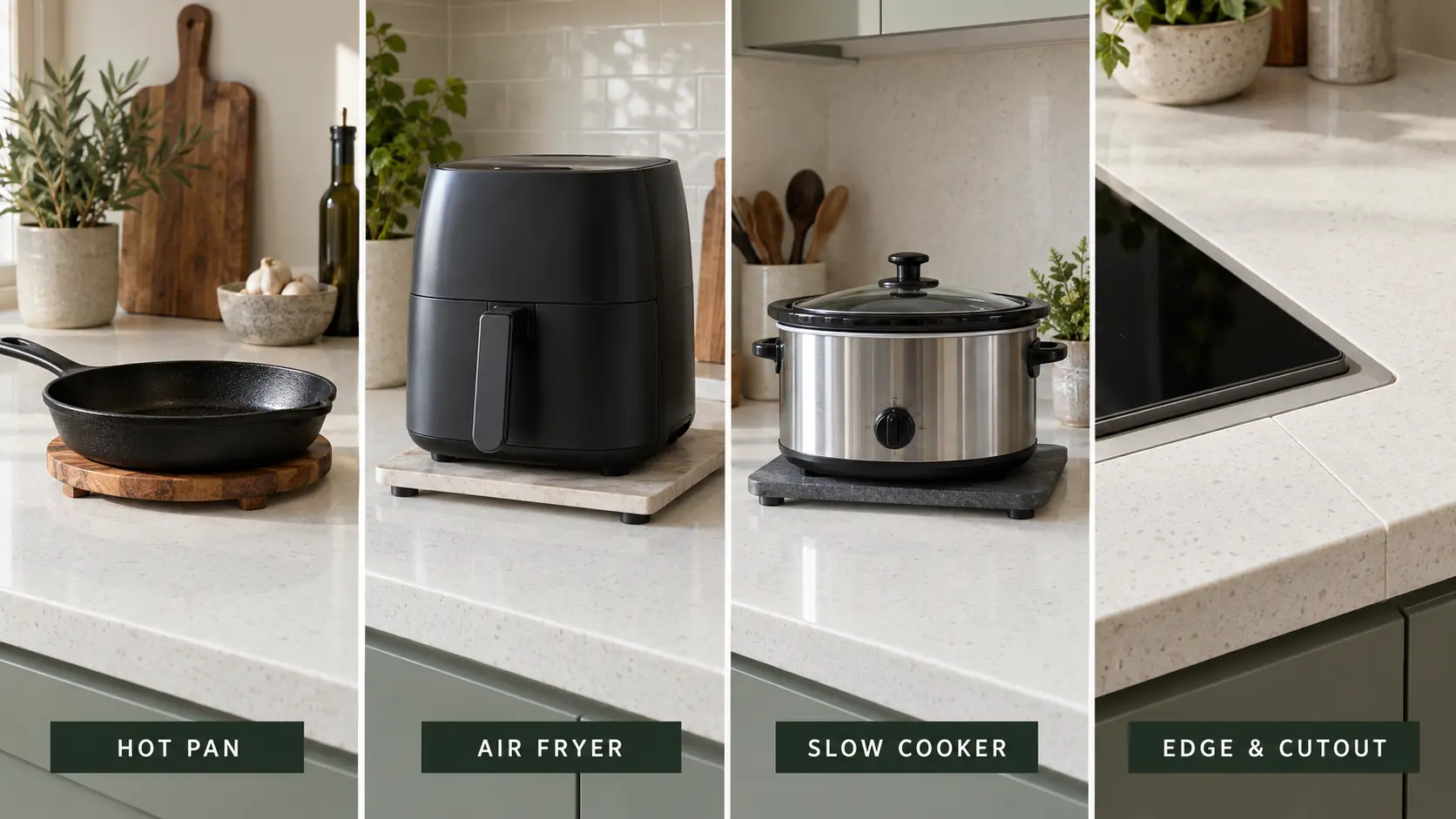
| Warm mug or plate | Usually low, but moisture or residue can leave rings. | Use a coaster or placemat if the item is notably hot. |
| Hot pan or skillet | Concentrated direct heat; possible discoloration or thermal stress. | Move directly from cooktop to a solid, stable trivet. |
| Oven tray or roasting pan | Large, very hot contact area. | Use a trivet sized for the entire hot base. |
| Slow cooker | Moderate heat sustained for hours. | Place on the manufacturer-approved heat barrier from the start. |
| Air fryer or toaster oven | Long cycles plus hot exhaust, often near a backsplash. | Follow appliance clearances and place it on a stable insulating board or trivet approved by both makers. |
| Electric skillet or griddle | Sustained heat through feet/base and localized hot zones. | Use a solid heat barrier; never rely on a thin dish towel. |
| Cooktop edge, seam or cutout | Heat concentration at a structurally sensitive zone. | Maintain installation clearances; ask the fabricator if anything has moved or cracked. |
Choose a barrier that covers the whole hot base
Use a flat, stable trivet or heat pad designed for the item. It should support the entire hot base without rocking and should not trap grit that can scratch the finish. A folded towel, paper towel, decorative mat or thin silicone sheet should not be treated as a universal substitute unless both the quartz and appliance manufacturers approve that use.
Countertop-appliance setup check
- Read the appliance’s clearance and countertop-protection instructions.
- Keep exhaust heat away from walls, backsplashes and overhangs.
- Use a barrier large enough for the feet and hot base.
- Do not straddle a seam or crowd an edge/cutout.
- Inspect the area after the first full cycle.
What to do if a hot pan touched quartz
Remove the item safely
Lift it straight onto a proper trivet. Do not slide hot metal across the countertop.
Let the surface cool naturally
Do not add ice, cold water or a wet cloth; a sudden temperature change can add stress.
Photograph before cleaning
Take one normal-light photo and one under low side light. Include an object for scale.
Check flatness and seams
Without pressing hard, look for a raised seam, new gap, edge change or crack.
Clean once, gently
After cooling, use the routine method from our quartz cleaning guide: a maker-compatible cleaner, clean microfiber, rinse wipe and dry buff.
Recheck color and reflection
If the mark disappears, it was likely removable residue. If color or gloss remains changed, stop experimenting.
Escalate damage
Contact the fabricator or manufacturer for a crack, open seam, edge change or persistent discoloration.
Heat-mark decision map
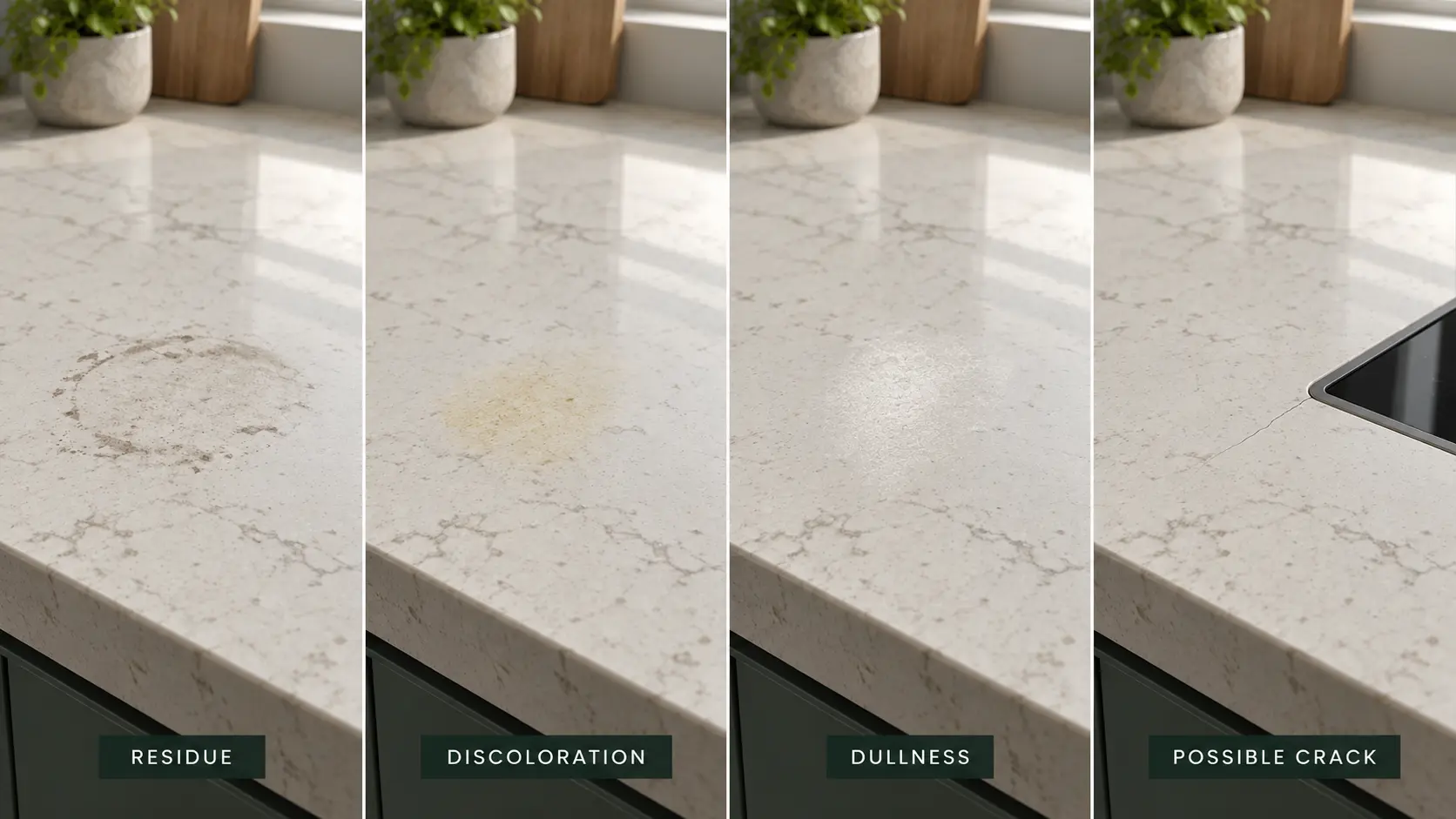
Is it residue, discoloration, dullness or a crack?
| What you see | Likely category | Next action |
|---|---|---|
| Smeary or transferable mark that improves after a mild clean | Residue or film | Rinse-wipe, dry buff and stop when clear. |
| Fixed yellow, brown or pale color shift | Possible discoloration | Do not bleach, sand or use a poultice without written maker approval. |
| Reflection changes but the area feels flat | Possible finish change | Stop DIY polish and seek professional guidance. |
| Line, gap, raised seam, chipped edge or movement | Possible crack or installation change | Avoid pressure and contact the fabricator. |
A simple prevention routine that actually works
If someone asks can quartz handle heat, the useful answer is not a risky temperature guess—it is a repeatable protection routine.
- Keep two full-size trivets beside the cooktop and one beside the oven.
- Give heat-producing appliances a permanent protected station.
- Do not place appliances over seams or tight against a backsplash.
- Lift cookware; do not slide it.
- Save the product name, fabricator contact and warranty PDF.
- Teach every household member the same no-direct-heat rule.
If a rust-colored mark appears without a known heat event, use the diagnosis in our quartz rust-stain guide instead of assuming scorch damage.
Frequently asked questions
Can quartz handle heat from a hot pan?
Do not place a hot pan directly on engineered quartz. Manufacturer guidance consistently recommends a trivet or hot pad because direct or sustained heat can discolor the surface or contribute to thermal stress.
Can you put hot pans on a quartz countertop for a few seconds?
Treat even brief direct contact as an accident, not a safe routine. Pan temperature and contact conditions vary, and a trivet removes the guesswork.
Can an air fryer sit on quartz?
It can be used only with the clearances and countertop protection required by the appliance maker and your quartz manufacturer. Use a stable, properly sized heat barrier and keep exhaust heat away from nearby surfaces.
Will a slow cooker damage quartz?
A slow cooker produces sustained heat, so major quartz manufacturers advise placing heat-producing countertop appliances on a trivet or hot pad. Do this before the cooking cycle starts.
What temperature can quartz countertops withstand?
There is no responsible universal household threshold for every engineered-quartz product. Formulation, duration, location and installation matter. Follow the current use-and-care document for your exact slab and use a trivet regardless.
Can a burn mark be removed from quartz?
A removable surface deposit may improve with a manufacturer-compatible routine clean. Fixed discoloration, dullness or a crack is not an ordinary stain; stop DIY treatments and ask the manufacturer or fabricator to assess it.
Can I use a towel under a hot appliance?
Do not assume a towel is a sufficient heat barrier. Use a stable product intended for heat protection and follow both the appliance and countertop manufacturers’ instructions.
Manufacturer evidence used
- Cambria Product Care
- Caesarstone Quartz Care & Maintenance
- MSI Q Quartz Care and Maintenance
- Corian Quartz Use & Care
- Silestone Maintenance
CareBySurface summarizes general manufacturer guidance; your product document, installer instructions and warranty control for your countertop.

