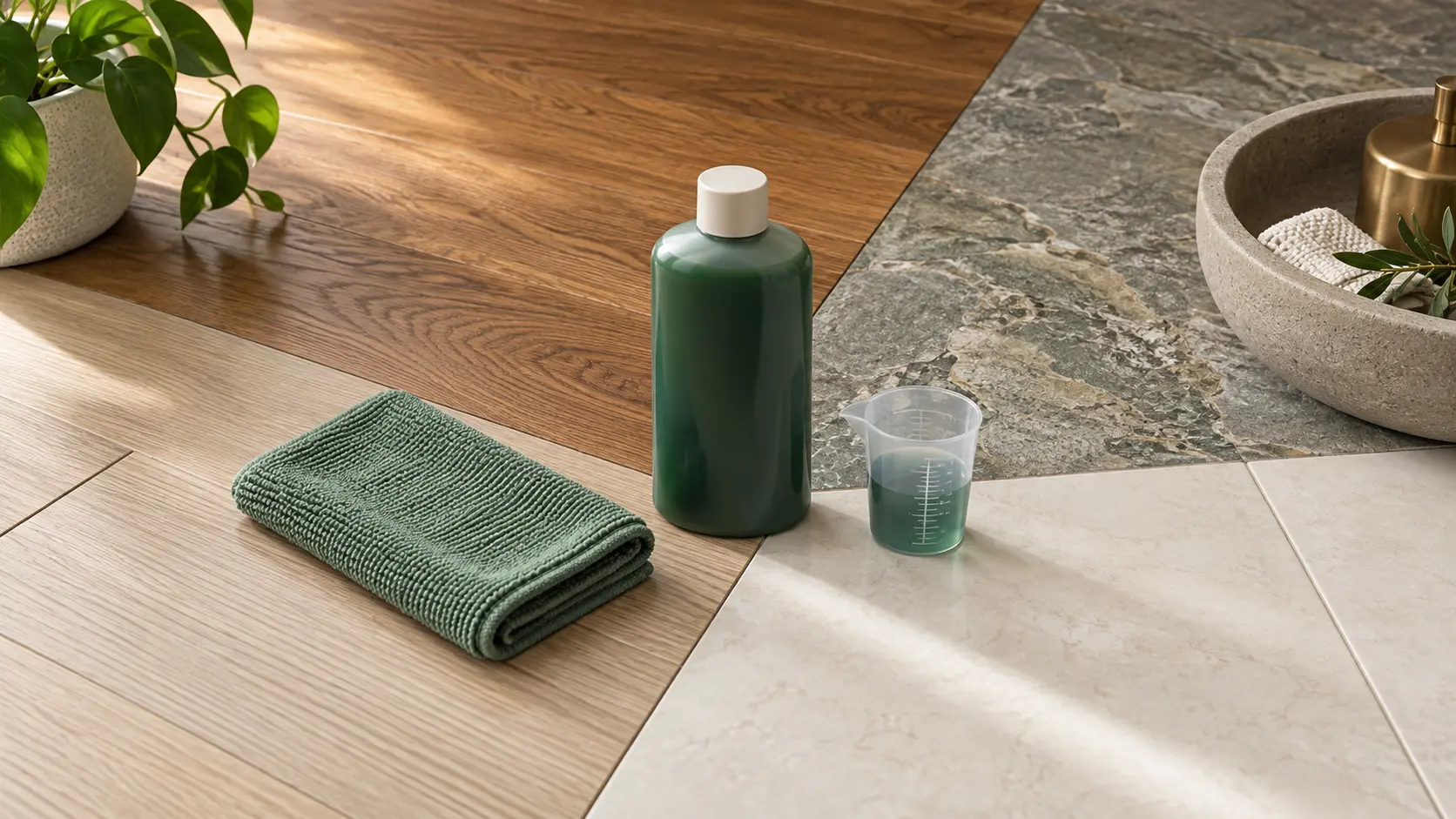
CareBySurface compatibility guide
Choose, dilute and use concentrated floor cleaner without leaving a sticky film—or guessing whether it belongs on your floor.
A floor cleaner concentrate can be economical and effective, but only when the exact product is approved for both the floor system and the cleaning equipment. This guide turns the label, floor warranty and dry result into a practical decision.
Quick verdict
Do not choose a floor cleaner concentrate by “pH-neutral” or “safe for all floors” alone. Confirm the exact floor and finish, read its care instructions, then match those instructions to the cleaner label. Dilute only at the product’s stated rate, use a clean pad and the least moisture the floor permits, and judge the result only after it dries. If the floor becomes sticky, hazy, dull or unusually slick, stop adding cleaner and diagnose the cause.
What Is Floor Cleaner Concentrate?
Floor cleaner concentrate is a formula intended to be mixed—usually with water—before use. It is not automatically stronger, safer or better than a ready-to-use cleaner. Its performance depends on the exact formula, approved surfaces, dilution, soil load, water quality, application tool and any coating or finish on the floor.
Concentrated cleaner
Designed for measured dilution. Using it straight can leave residue or harm a finish unless the label explicitly permits undiluted use.
Ready-to-use cleaner
Already diluted for its stated use. It reduces measuring errors but still requires floor and finish approval.
Polish or restorer
Deposits or alters a film. It is not interchangeable with a routine cleaner and can create buildup.
Disinfectant
Uses an EPA-registered label in the United States and may require a specific dilution and wet contact time.
Pass the Two-Key Compatibility Gate
A product is a reasonable candidate only when it passes both keys below. Marketing language on the front of the bottle does not replace either one.
Key 1: Floor + finish approval
The flooring manufacturer or current care document permits the cleaner type, and the product label names the applicable surface. “Wood” is not precise enough when the floor may be polyurethane-coated, oiled, waxed or hardwax-oiled.
Key 2: Tool + equipment approval
The mop, spray system, automatic scrubber or robot manufacturer permits that exact solution type. A cleaner that is surface-compatible may still foam, clog or violate equipment instructions.
| Floor or finish | Approval checkpoint | Main mistake to avoid | Safer decision |
|---|---|---|---|
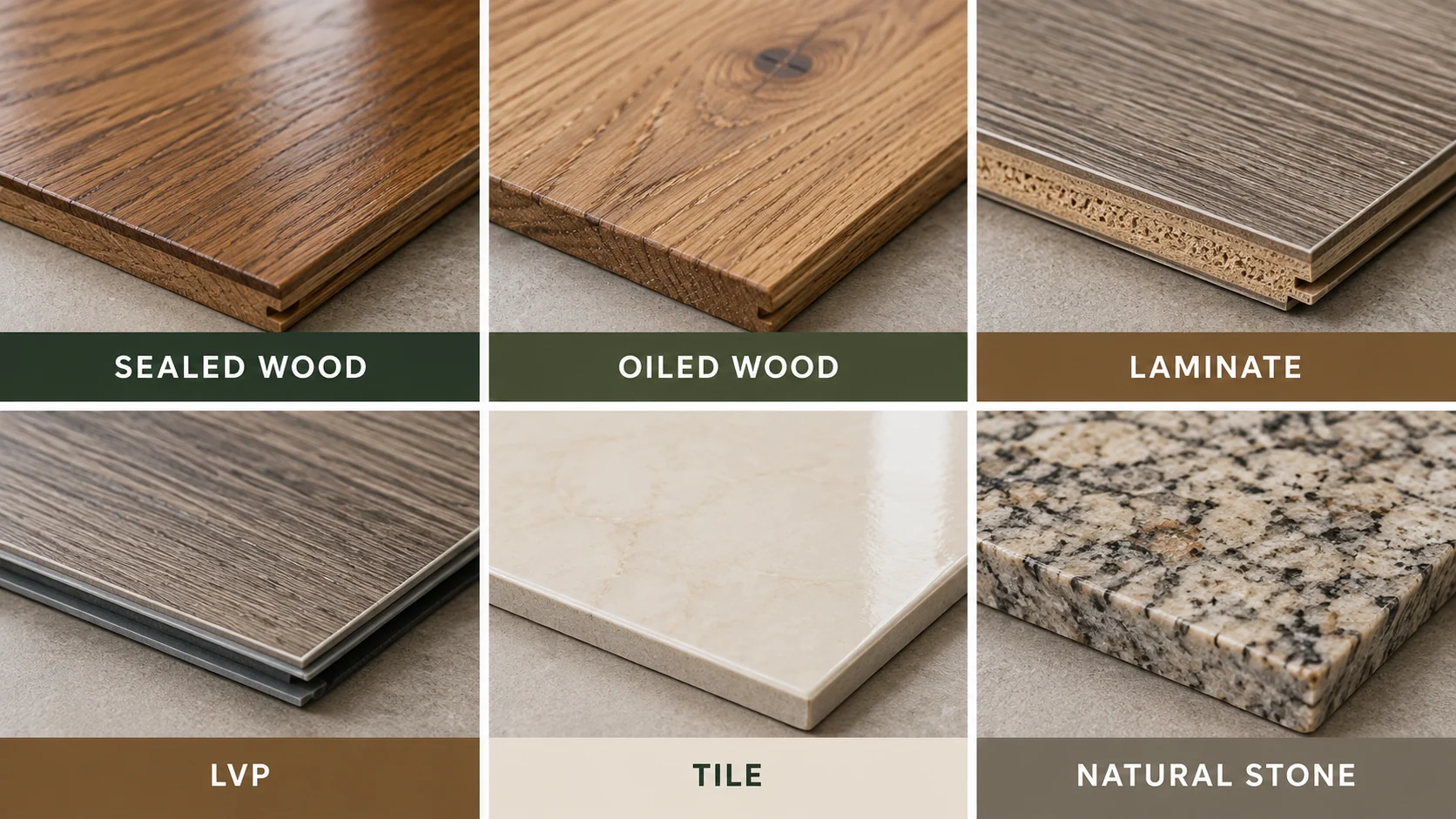
| Sealed hardwood | Floor maker’s approved cleaner list | Assuming all “wood-safe” concentrates fit every coating | Use only a coating-approved formula with a barely damp method |
| Oiled, waxed or hardwax-oil wood | Exact finish brand and maintenance system | Using a general neutral cleaner that removes or clouds maintenance layers | Use the finish maker’s maintenance cleaner |
| Laminate | Plank maker’s moisture and cleaner limits | Flooding joints or leaving solution at edges | Use minimal liquid and dry promptly |
| LVP or LVT | Wear-layer care guide | Polishes, waxes or excess surfactant film | Choose a residue-controlled cleaner approved for resilient flooring |
| Ceramic or porcelain tile | Tile, grout and sealer compatibility | Treating grout and adjacent stone as if they were glazed tile | Check every material the solution will touch |
| Natural stone | Stone type, finish and sealer guidance | Acidic or otherwise unapproved chemistry | Use a stone-specific neutral cleaner approved by the supplier |
| Linoleum, rubber or sealed concrete | Material and coating manufacturer | Relying on the generic word “floor” | Verify the exact material and any topical coating |
What Current Manufacturer Directions Actually Show
This is a label-reading comparison, not a universal ranking. Formulas and directions can change; the container in your hand and its current technical document control.
| Example | Published surface scope | Published dilution | Rinse language | Important boundary |
|---|---|---|---|---|
| OdoBan No Rinse Neutral pH | Lists sealed hardwood, laminate, vinyl, sealed concrete, glazed tile and rubber among other surfaces | Manufacturer says one concentrated gallon makes up to 128 gallons; use the current label for the exact task | Sold as “No Rinse” | Manufacturer says not recommended for unfinished or oiled wood |
| Zep Neutral pH Concentrate | Water-friendly finished floors; examples include rubber, stone, tile, marble and VCT | 1 oz/gal light, 2 oz/gal normal, 3–5 oz/gal heavy | Page tells users to rinse; FAQ says routine rinsing may not always be needed but advises it for heavy soil or high gloss | Follow the floor and equipment manufacturer |
| 3M 3-in-1 Concentrate | Washable hard floors including marble, ceramic, terrazzo, vinyl, rubber and VCT | ½ oz per gallon (1:256) for that product | Document says no rinse is required, yet recommends one or two clean-water rinses for complete neutralization | Too much concentrate may dull the finish; document is commercial and product-specific |
Representative examples were checked September 11, 2026. Inclusion is not an endorsement, affiliate ranking or substitute for the current label.
How to Dilute Without Guessing
There is no safe universal floor-cleaner ratio. A rate printed for one formula does not transfer to another. Find the label line for your surface, soil level and tool, then measure the final solution—not the size of the room.
concentrate needed = label dose per unit × final solution volume
If a hypothetical label states 1 fluid ounce per gallon and you are making 2 gallons, the arithmetic is 2 fluid ounces. That is a math example, not a recommendation for another product. If a label uses a ratio such as 1:64, confirm whether it means one part concentrate plus 64 parts water or one part in 64 total; labels and dispensing systems do not always express ratios the same way.
A Seven-Step Finish-Aware Method
- Identify the floor and finish. Separate solid or engineered wood, laminate, resilient vinyl, glazed tile, natural stone, linoleum, rubber and coated concrete. Record the coating or sealer when applicable.
- Read the floor maker’s current care guide. Note approved cleaner categories, prohibited ingredients, moisture limits and warranty language.
- Read the entire concentrate label. Match the named surface, finish, soil level and method. Review warnings and the safety data sheet when supplied.
- Check the applicator or machine. Confirm solution compatibility before filling a spray mop, automatic scrubber or robot tank.
- Prepare a measured batch. Use the label’s water type, temperature, order of mixing and exact dose. Make only what you need.
- Remove dry grit, then clean a small zone. Use a clean pad, control moisture and change dirty solution or pads before they redeposit soil.
- Let the test zone dry completely. Inspect in angled light and underfoot. Continue only if it is clean, even, non-sticky and unchanged in sheen.
Useful supplies
- The current floor care guide and cleaner label
- A dedicated measuring cup or dosing device—never food-use equipment
- Clean microfiber pads suitable for the floor finish
- Fresh water if the label calls for it
- Gloves or eye protection when required by the label
- A dry white cloth for checking residue after the test area dries
Why a Floor Looks Hazy or Feels Sticky
| What you observe | Likely category | Next safe move | Stop sign |
|---|---|---|---|
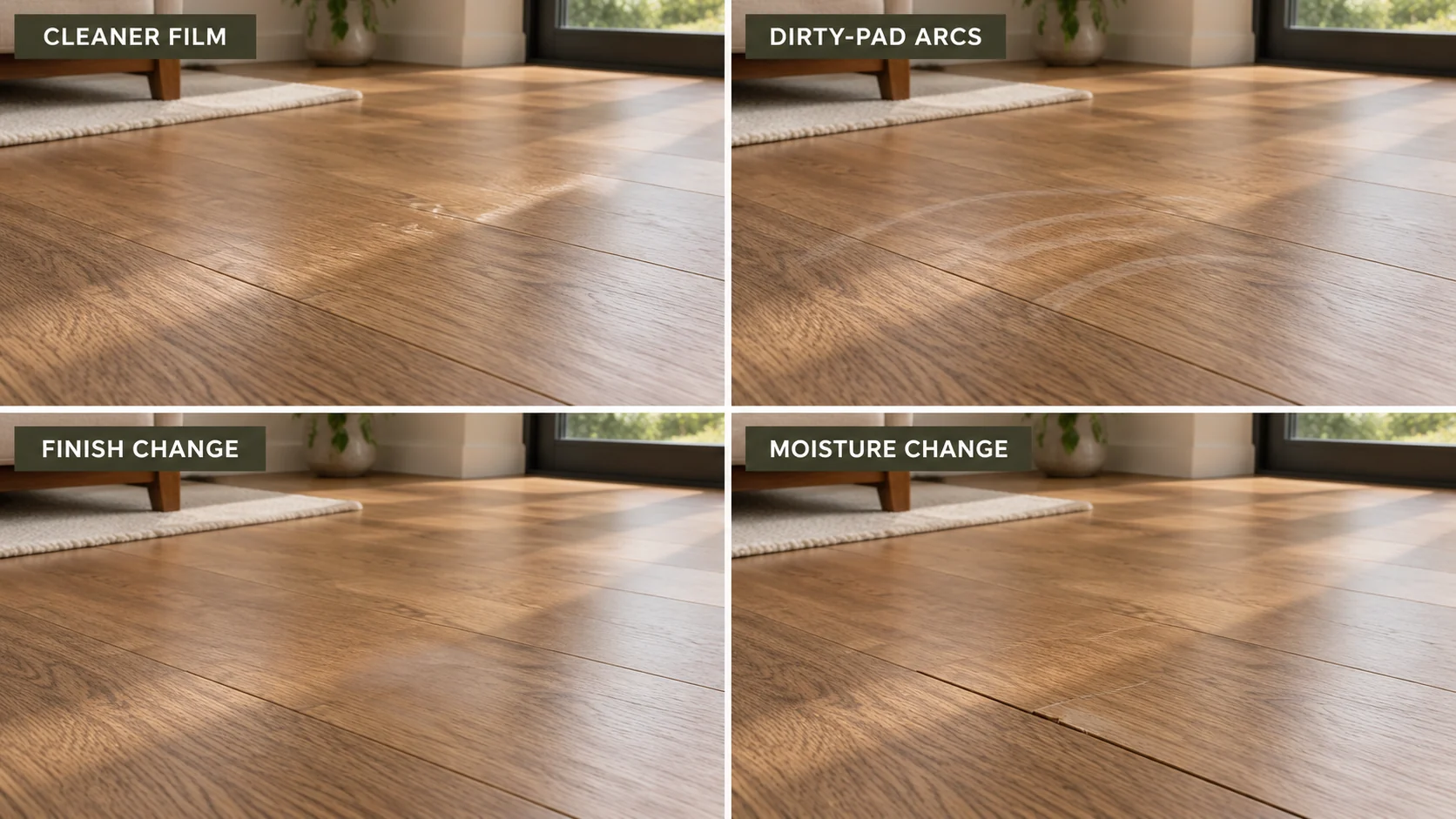
| Uniform haze or tackiness after drying | Overdosing, incompatible residue or inadequate removal | Stop adding product; check the label’s residue or rinse directions and the floor maker’s approved removal method | Sheen changes or coating softens |
| Curved mop arcs or patchy film | Dirty pad, dirty water or uneven application | Replace the pad or solution; re-test with the approved method | Marks remain fixed after the approved cleanup |
| White or gray deposits concentrated at edges | Mineral residue, cleaner solids or an existing finish issue | Photograph dry; compare with water quality and product instructions | Raised seams, open joints or crumbling grout |
| Dull patch that does not wipe away | Finish change, wear or previous coating buildup | Stop experimenting and contact the floor or finish manufacturer | Color transfer, peeling or a larger dull area |
| Dark seam or raised plank edge | Possible moisture entry—not ordinary cleaner film | Stop wet cleaning, dry the surface and investigate the source | Spreading darkening, swelling or movement |
Accessible decision map
Can Concentrate Go in a Robot Mop or Machine?
Only when the equipment maker approves that solution type and dose. Tank seals, pumps, tubing, sensors and foaming tolerances are separate from floor compatibility. Do not assume that a low-foam or pH-neutral floor cleaner concentrate belongs in every machine. For a robot, use the exact model’s support page or manual; for an automatic scrubber, match the cleaner, dilution and pad to both the machine and floor finish.
Does “No Rinse” Mean Never Rinse?
No. It means the product permits a no-rinse procedure under its stated conditions; it does not override heavy-soil instructions, floor-maker guidance or a poor dry result. Current manufacturer pages demonstrate why the label context matters: Zep distinguishes routine use from heavy soil or high-gloss conditions, while 3M’s technical sheet says rinsing is not required but also recommends clean-water rinses for complete neutralization. Resolve the apparent conflict by following the current instructions for the exact product, task and floor.
Cleaning Is Not the Same as Disinfecting
A routine cleaner removes soil. A disinfectant makes regulated antimicrobial claims. In the United States, the EPA directs users to the product label for approved sites, organisms, dilution and contact time. Never improvise a disinfecting claim from a general floor-cleaner label, and never mix cleaners unless the label explicitly directs it.
When a Safer Alternative Is Better
Choose the flooring or finish manufacturer’s ready-to-use cleaner when the material is unknown, the warranty names a specific system, accurate dosing is inconvenient, or the room is too small to use a diluted batch before it ages. Plain water is not universally safe either: moisture-sensitive wood and laminate still need controlled application, and water alone may not remove oily soil.
Frequently Asked Questions
What is the best dilution ratio for floor cleaner concentrate?
The ratio on the current label for your exact product, floor, soil level and tool. There is no universal ratio. Measure the final batch instead of estimating by capfuls.
Can I use concentrated floor cleaner on hardwood?
Only if the hardwood or finish manufacturer permits it and the product label includes that finished surface. Oiled, waxed and hardwax-oil floors often require their own maintenance system.
Why is my floor sticky after mopping?
Common causes include overdosing, a dirty pad, dirty water, incompatible residue or skipping a required removal step. Stop adding cleaner and follow the floor-approved residue-removal method.
Is pH-neutral cleaner safe for every floor?
No. pH is only one property. Solvents, surfactants, fragrance, film-forming ingredients, dose and moisture can still conflict with a finish or equipment.
Can I put floor cleaner concentrate in a robot mop?
Only if the robot manufacturer approves that solution for the exact model and the floor manufacturer approves it for the surface. Surface compatibility alone is not equipment approval.
Should I rinse a no-rinse floor cleaner?
Follow the exact label. Routine use may not require rinsing, while heavy soil, high-gloss finishes or residue may change the instruction. Do not create a universal rule from the words “no rinse.”
Is vinegar a safer alternative?
Not universally. Acid can conflict with natural stone and some finishes. Use the material manufacturer’s approved cleaner rather than treating “natural” as a compatibility guarantee.
Continue With the Surface-Specific Guide
Evidence and scope
This guide prioritizes the current floor manual and product label over generic recipes. Supporting sources include OdoBan’s product directions, Zep’s current directions and FAQ, 3M’s technical data sheet, the Natural Stone Institute’s care guidance and EPA disinfectant-label guidance. Product instructions can change; recheck them before use.
Editorial scope: compatibility education, not laboratory testing, medical advice or a claim that one cleaner fits every floor.

