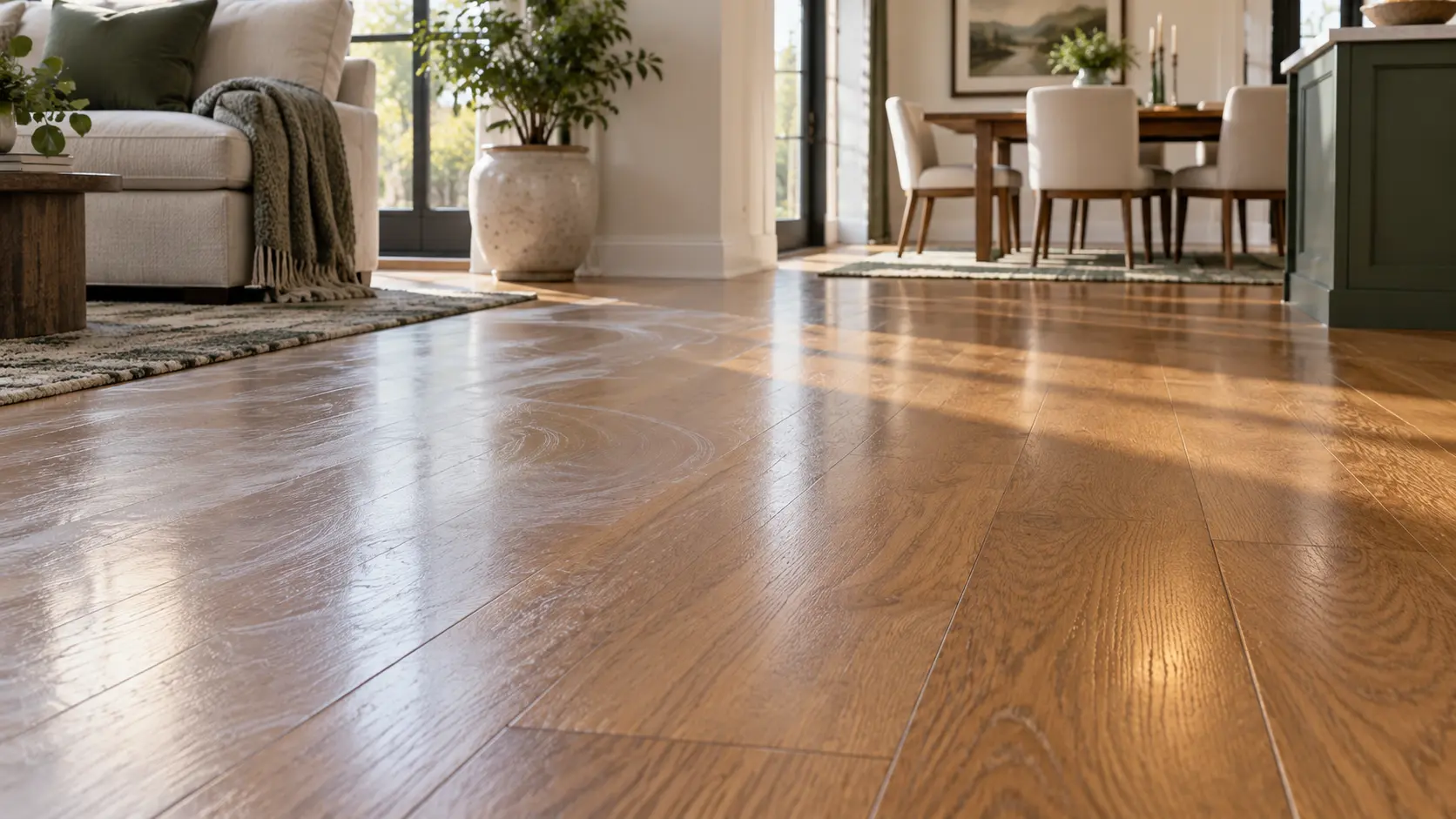
Hardwood floor care
To understand how to clean hardwood floors safely, identify both the plank construction and the finish covering it. Use the least moisture that will do the job, and judge the result only after the floor is dry.
Quick answer: how to clean hardwood floors safely
Remove loose grit first, then clean small sections with a clean microfiber pad and a cleaner approved for your floor’s finish. Keep the pad only lightly damp, never allow liquid to pool at seams, and inspect the floor after it dries. Do not use steam, vinegar, wax, polish or a homemade mixture unless the exact flooring or finish manufacturer permits it.
Before cleaning, identify the floor under your feet
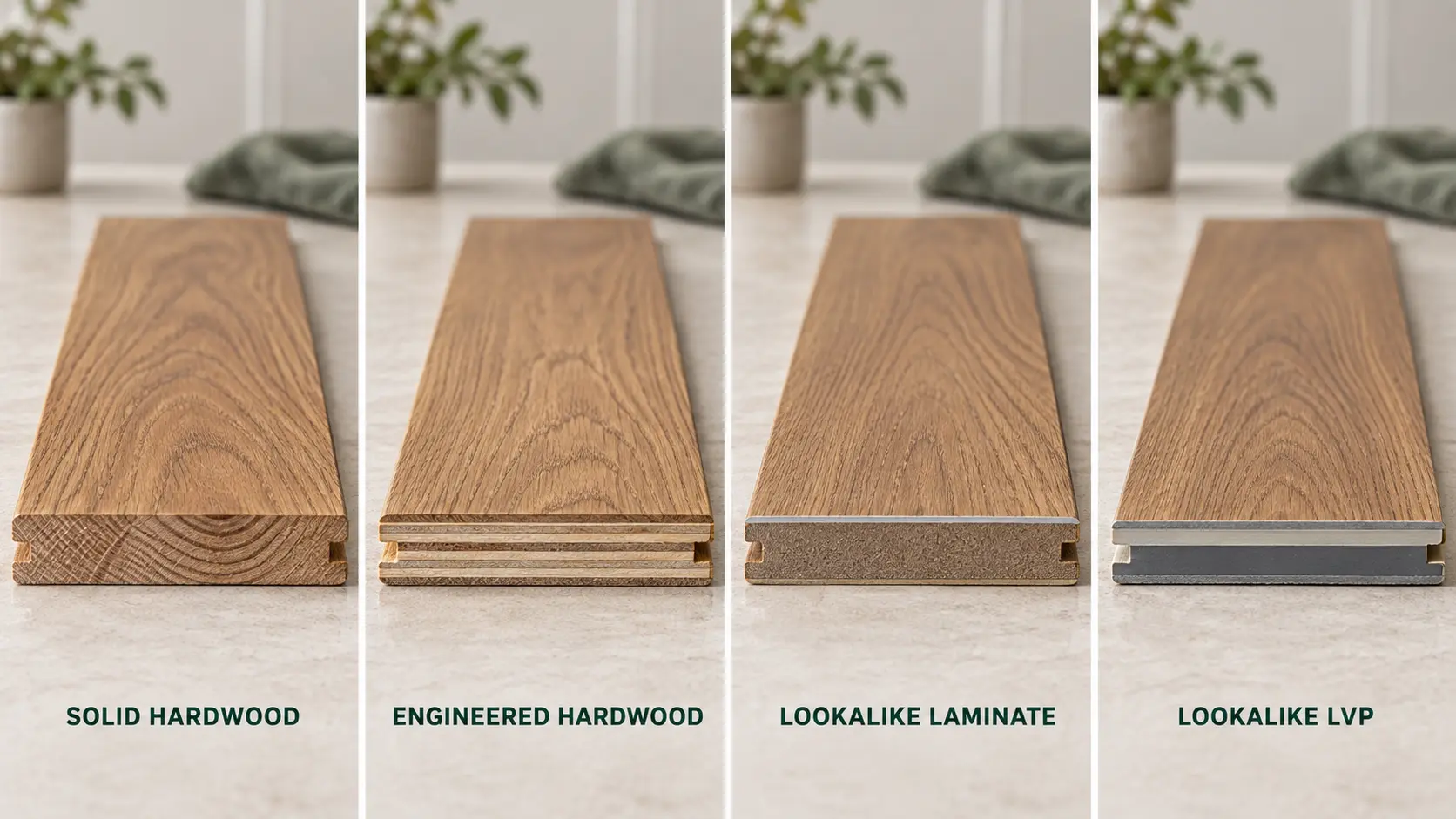
Before deciding how to clean hardwood floors, confirm that the surface is actually wood. “Wood floor” is often used for several products that only look alike. Solid hardwood is one piece of wood. Engineered hardwood has a real-wood wear layer over a layered core. Bamboo is a grass-based manufactured flooring product, while laminate and luxury vinyl use different surface layers and care rules.
Check the purchase invoice, carton, installation record, warranty, manufacturer website or an unused plank. Do not identify a product only from the printed grain. At a floor vent or threshold, a visible edge may help, but avoid lifting installed planks just to investigate.
Solid vs engineered hardwood: what changes?
Solid hardwood
A solid-wood plank can react to prolonged moisture through swelling, cupping, gaps or finish failure. Its refinishing potential depends on plank condition, profile and previous sanding—not simply on the word “solid.”
Engineered hardwood
A real-wood top layer is bonded to a layered core. Liquid can still enter seams and affect the veneer, adhesive or core. Do not assume “engineered” means waterproof or use its veneer thickness to choose a cleaner.
Knowing how to clean hardwood floors requires both facts: the routine method can be similar when solid and engineered floors have the same factory coating, but their warranties, seam construction, moisture tolerance and repair paths can differ.
Identify the hardwood-floor finish
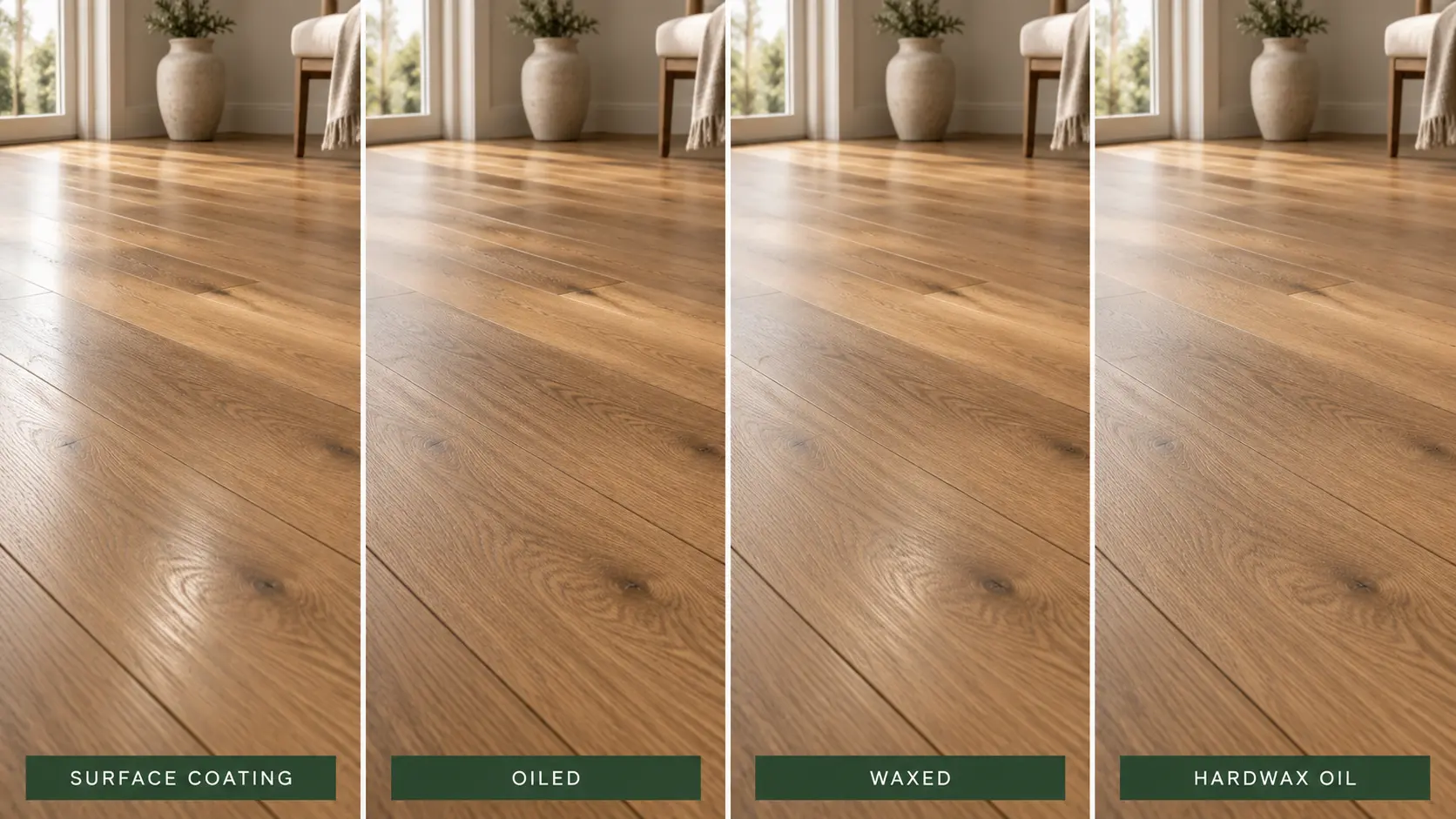
Any reliable explanation of how to clean hardwood floors must start with records rather than appearance. A glossy floor is not automatically polyurethane, and a matte floor is not automatically oiled. Factory finishes may also contain multiple cured coating layers that cannot be identified accurately by a household test.
| Finish condition | Safest starting choice | Avoid or treat as conditional | Verify with |
|---|---|---|---|
| Polyurethane or other surface coating | Ready-to-use cleaner approved for coated hardwood | Wax, oil soap and polish unless expressly compatible | Flooring manual, warranty or coating maker |
| Penetrating oil | Cleaner or maintenance soap for that oil system | General-purpose degreasers and coated-floor polish | Installed oil-finish manufacturer |
| Wax | Wax-compatible maintenance system | Water-heavy cleaning and polyurethane-floor polish | Installer records or wax manufacturer |
| Hardwax oil | Exact hardwax-oil cleaner or soap | Generic wood-floor polish and aggressive degreaser | Hardwax-oil brand instructions |
| Unknown | Dry soil removal while you locate records | Steam, vinegar, polish, wax, stripper and improvised mixtures | Manufacturer, installer or qualified flooring professional |
Tools and supplies
- Soft-bristle broom, clean dry microfiber dust mop or vacuum with a bare-floor setting
- Two or more clean, non-abrasive microfiber pads
- Cleaner approved for the exact floor or finish
- Clean absorbent cloths for spills and immediate drying
- Product manual or care page, especially for an unfamiliar finish
To clean hardwood floors without over-wetting them, use a lightly damp pad that does not drip, leave puddles or push liquid into joints. Replace a soiled pad instead of carrying dissolved dirt across the room.
How to clean hardwood floors in 7 controlled steps
Confirm the product and finish
Find the manufacturer, collection and finish when possible. Read the current care and warranty instructions. If identity remains unknown, stay with dry cleaning until a conservative test and professional guidance are available.
Remove grit before moisture
Sweep, dust-mop or vacuum. Use a bare-floor setting or soft attachment, and disable or avoid a rotating beater bar that could scratch the finish. Pay attention to entrances, chair paths and plank bevels.
Prepare clean pads
Start with a freshly laundered, residue-free microfiber pad. Fabric softener and old cleaner trapped in a pad can produce streaks that look like floor damage.
Test the complete method
Test the approved cleaner, pad and drying method together in an inconspicuous area. A spot test reduces risk but cannot prove compatibility across an entire worn or previously treated floor.
Apply the minimum useful amount
Follow the label. If the manufacturer allows spraying, use a controlled mist on a small section or on the pad as directed. Never pour cleaner or water onto the floor.
Clean small sections
Move the pad in smooth overlapping passes, generally following the plank direction. Turn or replace it as soon as it becomes visibly soiled. Blot any liquid that collects near seams or edges.
Let the area dry, then inspect
Keep traffic off the area until dry. Look from a low angle in consistent light. Stop if the result is clean and even; diagnose persistent film, dullness, darkening or raised edges before repeating anything.
Hardwood-floor cleaning decision map
Stop. Resume normal care.
Check the pad, cleaner and prior buildup.
Stop moisture and investigate the source.
Diagnose what remains after cleaning
| Dry appearance | Likely category | Safest next decision |
|---|---|---|
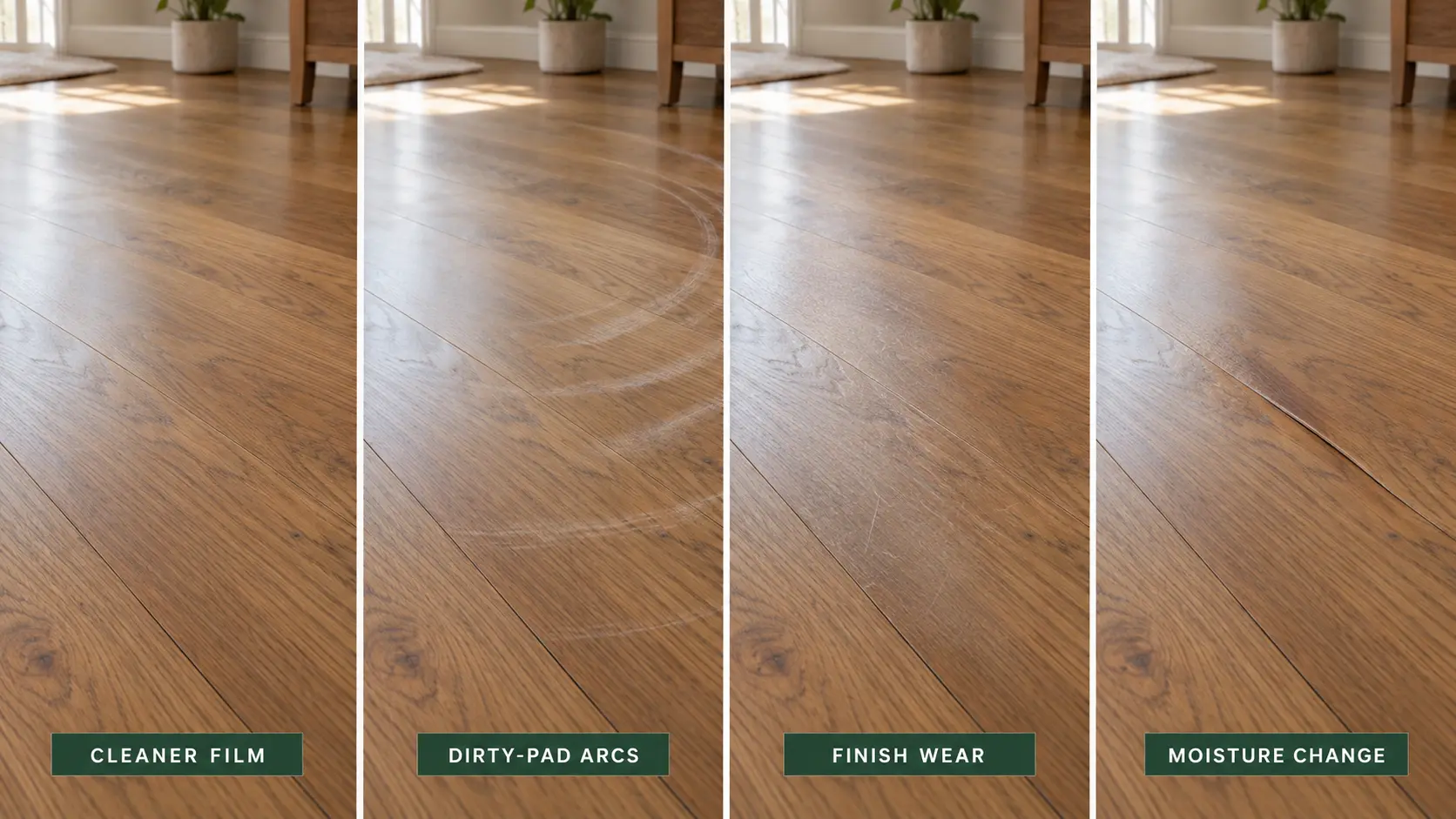
| Uniform haze, sticky footprints or smearing | Cleaner, soap, oil or polish residue | Stop adding products. Identify what was previously applied and follow its removal instructions. |
| Curved arcs matching mop movement | Dirty pad, excessive cleaner or redistributed soil | Use a fresh pad and only the approved amount; do not scrub harder. |
| Fixed dull traffic lane or fine scratches | Finish wear or abrasion | Cleaning will not replace missing finish. Ask about compatible maintenance or recoating. |
| Dark seam, raised edge, cupping or peeling | Moisture entry or substrate/finish change | Stop wet cleaning, find the moisture source and contact the manufacturer or professional. |
| Localized dark or black mark after a spill | Possible penetration, wood reaction or finish damage | Do not bleach or sand blindly. Document the area and seek finish-specific advice. |
Spot cleaning and pet spills
When you clean hardwood floors after a fresh spill, blot rather than spread the liquid. Use a dry or slightly damp cloth, then the compatible cleaner if the manufacturer calls for it. Dry the area promptly, including the edges of nearby boards.
For pet urine, remove liquid immediately and keep pets and people away until the area is clean and dry. Persistent odor, blackening, edge lift or a mark that returns can indicate penetration below the cleanable finish. More fragrance or cleaner will not solve a contaminated underlayer.
For greasy food, sticky drink residue or tracked winter salt, first remove loose material without abrasion. Use the exact maker-approved cleaner and inspect dry. Do not escalate to baking soda, melamine foam, bleach or solvent unless the finish manufacturer specifically supports it.
How to clean hardwood floors with modern tools—or when not to
Steam mop
The National Wood Flooring Association advises against wet and steam mops because moisture can damage the finish and wood over time. Treat a steam-appliance marketing claim as appliance-specific—not permission for every hardwood floor.
Vinegar
Vinegar is not a universal wood-floor cleaner. Some online recipes permit it, while flooring manufacturers such as Bruce expressly list acidic vinegar among products to avoid. The exact floor instructions control.
Spray mop
The mop body is only one variable. Check the liquid, spray volume, pad cleanliness and floor warranty. A fine controlled application may be suitable when the floor manufacturer allows it; pooling is not.
Robot mop
Use only when the exact flooring instructions permit damp robotic cleaning and the device can reliably limit output, avoid repeated wet passes and keep away from damaged seams. Test supervision is still needed.
Cleaning is not polishing, recoating or refinishing
Learning how to clean hardwood floors also means recognizing what cleaning cannot accomplish. Cleaning removes compatible surface soil and residue. Polish adds a sacrificial product layer. Recoating adds a compatible new finish layer after preparation. Refinishing removes or abrades existing material before rebuilding the finish. These treatments are not interchangeable.
A dull area that stays fixed after drying may be worn or chemically altered. Adding shine product without identifying the finish can create haze, adhesion problems or an uneven appearance. Bona notes that products such as oil soap, paste wax and furniture polish can contribute to cloudy buildup; its cloudy wood-floor guidance focuses on identifying and removing the offending layer.
A maintenance rhythm based on use—not a universal calendar
The best way to decide how to clean hardwood floors over time is to respond to actual soil and traffic. Remove visible grit before it is walked across the finish, clean spills immediately, and damp-clean when soil can no longer be removed dry under the floor maker’s instructions.
Avoid automatic advice such as “polish monthly” or “refinish every ten years.” Finish condition, household traffic, product construction and previous maintenance determine the correct interval. Use breathable entrance mats, felt furniture protectors and sensible indoor humidity control recommended for the installed floor.
Hardwood-floor cleaning FAQs
What is the best way to clean hardwood floors?
Remove grit with a soft broom, dust mop or bare-floor vacuum. Then use a clean microfiber pad and the minimum amount of a cleaner approved for the floor’s finish. Work in small sections, prevent pooling and inspect after drying.
Can I clean hardwood floors with only water?
When deciding how to clean hardwood floors, do not assume water is universally safe. Some manufacturers permit a lightly damp cloth or pad; others specify their cleaner and prohibit water mopping. Follow the exact product instructions and never leave standing moisture.
Is engineered hardwood cleaned differently from solid hardwood?
The basic answer to how to clean hardwood floors may be similar when solid and engineered products have the same compatible factory finish, but their warranties, seam construction and repair limits can differ. Identify both construction and finish before choosing the method.
Why do my hardwood floors look cloudy after mopping?
Cloudiness may come from too much cleaner, a dirty pad, incompatible soap, oil or polish buildup. If the dull area is fixed and follows traffic rather than mop passes, it may be finish wear instead of removable film.
Can I use a steam mop on sealed hardwood?
“Sealed” does not describe the coating condition or every seam. The NWFA advises against steam mops. Unless the exact flooring manufacturer explicitly permits the exact method, choose a lower-moisture routine.
Can vinegar remove hardwood-floor haze?
Do not use vinegar as a default residue remover. Acidic solutions may be prohibited by the manufacturer, and the haze may be polish, wax, oil soap or finish wear. Identify the residue and finish first.
How often should hardwood floors be damp-cleaned?
There is no single schedule for how to clean hardwood floors in every household. Remove grit routinely, clean spills immediately and damp-clean when needed under the manufacturer’s instructions. Traffic, pets, entrances and finish type change the interval.
Can cleaning restore worn shine?
Cleaning can remove a dulling film, but it cannot replace missing or abraded finish. If a clean, dry area remains dull, obtain finish-specific advice before using polish, wax, recoat products or abrasives.
Sources and verification
This guide uses conservative industry and manufacturer guidance. Review the NWFA maintenance recommendations, Bruce Floor Care restrictions, Lowe’s surface-versus-penetrating-finish overview and Bona’s cloudy-floor diagnosis. Your exact floor manual and warranty take priority when instructions differ.
Related CareBySurface guide
No additional internal URLs were forced because another directly relevant live CareBySurface page was not verified during production.

