Stainless-steel sink care
To understand how to clean stainless steel sink surfaces safely, identify the finish first, start with a mild wash, rinse completely and inspect the dry basin before treating any remaining white, brown, dull or rough mark.
Quick answer: how to clean stainless steel sink surfaces
Remove loose debris, wash with water and a mild liquid detergent approved by the sink manufacturer, and use a soft cloth or non-scratch sponge with the grain. Rinse away all cleaner and dry with microfiber. If a mark remains, identify it as film, mineral scale, transferred rust, a scratch or possible pitting before using acid, abrasive powder or a restoration pad.
First identify the sink and its finish
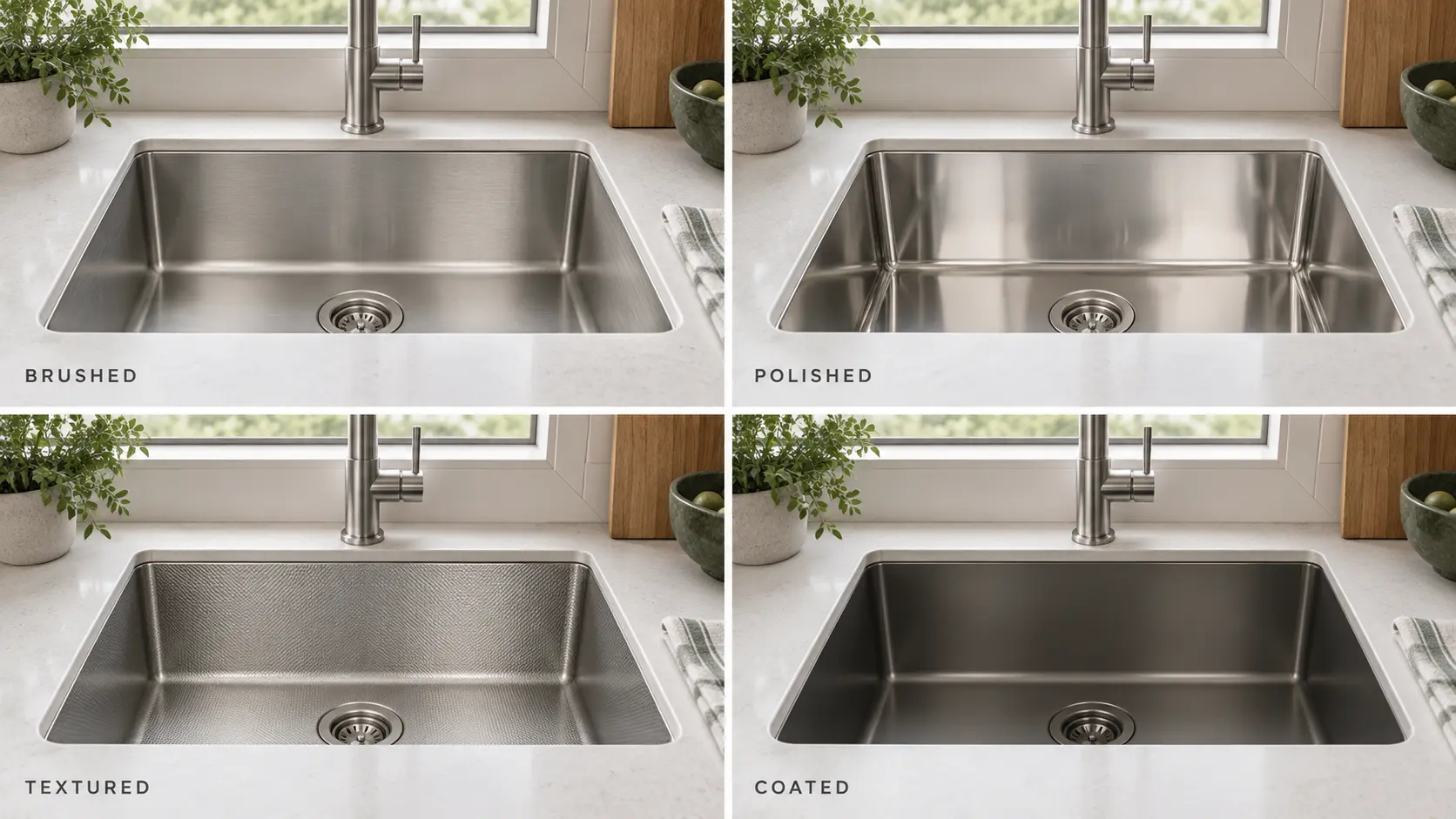
Knowing how to clean stainless steel sink finishes safely starts with identification. Most familiar silver sinks have a brushed or satin finish, but polished, textured and specially coated or colored sinks also exist. A method tolerated by one plain brushed sink can alter the sheen or color of another finish.
Check the model label beneath the bowl, purchase record, installation guide or manufacturer care page. Look at the dry sink from an angle to find a directional grain, but do not assume that appearance alone proves the finish.
What you may need
Before learning how to clean stainless steel sink surfaces with a stronger product, assemble a mild baseline kit:
- Mild liquid dish detergent permitted by the sink manufacturer
- Soft microfiber cloth or non-scratch sponge
- Separate clean microfiber towel for drying
- Soft detail brush only if permitted for the drain edge and corners
- The current model-specific care instructions
Stainless-steel sink cleaner matrix
This matrix answers how to clean stainless steel sink surfaces without treating every cleaner as universally compatible.
| Cleaner or tool | Starting status | Condition or reason |
|---|---|---|
| Mild liquid detergent | Safest baseline | Use when approved; rinse fully so soap does not become a new film. |
| Soft microfiber or non-scratch sponge | Safest baseline | Use light pressure; follow visible grain. |
| Manufacturer stainless-steel cleaner | Conditional | Match the exact sink finish and product directions. |
| Baking soda | Conditional abrasive | “Natural” does not mean nonabrasive; use only when the maker permits it. |
| White vinegar or acid descaler | Conditional acid | Use only with verified dilution, contact time, tool and rinse instructions. |
| Oxalic-acid stainless cleaner | Controlled escalation | Some manufacturers permit it for deposits or transferred rust; others restrict abrasives or acids. |
| Bleach or chloride cleaner | Avoid by default | Chlorides can damage the passive surface and contribute to corrosion or pitting. |
| Steel wool or wire brush | Avoid | Can scratch and deposit rusting ordinary-steel particles. |
| Olive or mineral oil | Not a cleaner | May temporarily alter reflection while leaving a greasy food-contact film. |
How to clean stainless steel sink surfaces in 7 steps
The safest procedure for how to clean stainless steel sink surfaces is a controlled wash-and-check sequence rather than an immediate abrasive scrub.
Confirm the finish
Find the brand, model and finish. If the sink is colored, coated, highly polished or specially textured, do not transfer instructions from a standard brushed sink.
Empty the basin
Remove dishes, metal cans, cookware, wet cloths, sponges and the bottom grid. Rinse loose food away so particles are not dragged across the finish.
Rinse surface soil
Use ordinary water at a temperature allowed by the care guide. The purpose is to remove loose contamination—not to soak a stubborn mark.
Apply the mild cleaner
Put the permitted mild detergent on a damp soft cloth or non-scratch sponge. Follow the product label instead of guessing a stronger concentration.
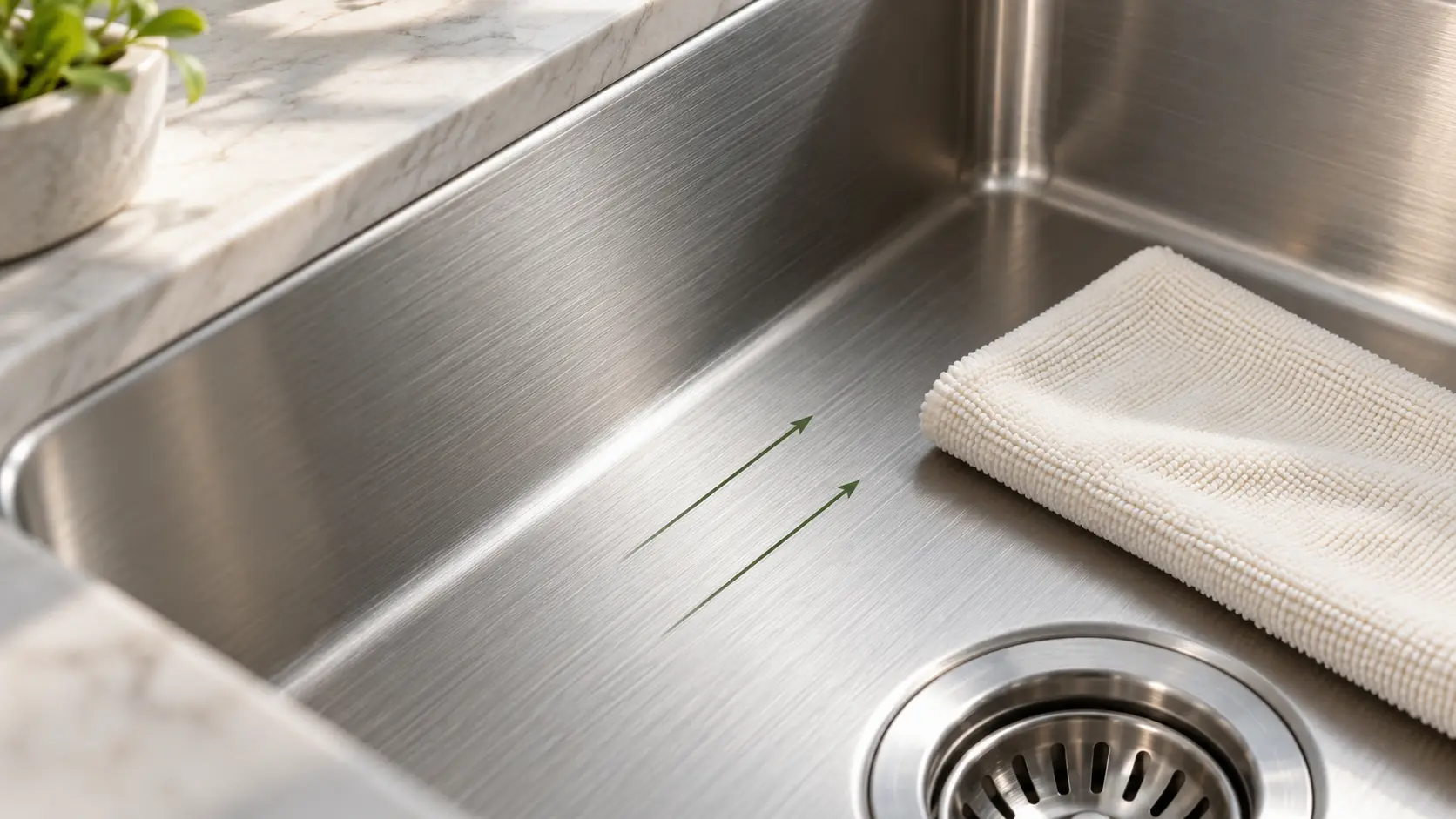
Wipe with the grain
Use light, even strokes in the visible brushing direction. Different walls or drainboards may have different grain directions. If no grain is visible, avoid aggressive rubbing and follow the manufacturer method.
Rinse completely
Remove loosened soil and every trace of detergent. Cleaner allowed to dry can leave haze or streaks that resemble a damaged finish.
Dry and inspect
Use a clean microfiber towel, then inspect in angled light. If the sink looks clean and even, stop. Diagnose anything that remains before repeating or escalating.
What should you do after the sink dries?
Stop and resume routine care.
Choose only a finish-approved escalation.
Stop abrasion and contact the manufacturer.
Film, scale, rust, scratches or pitting?
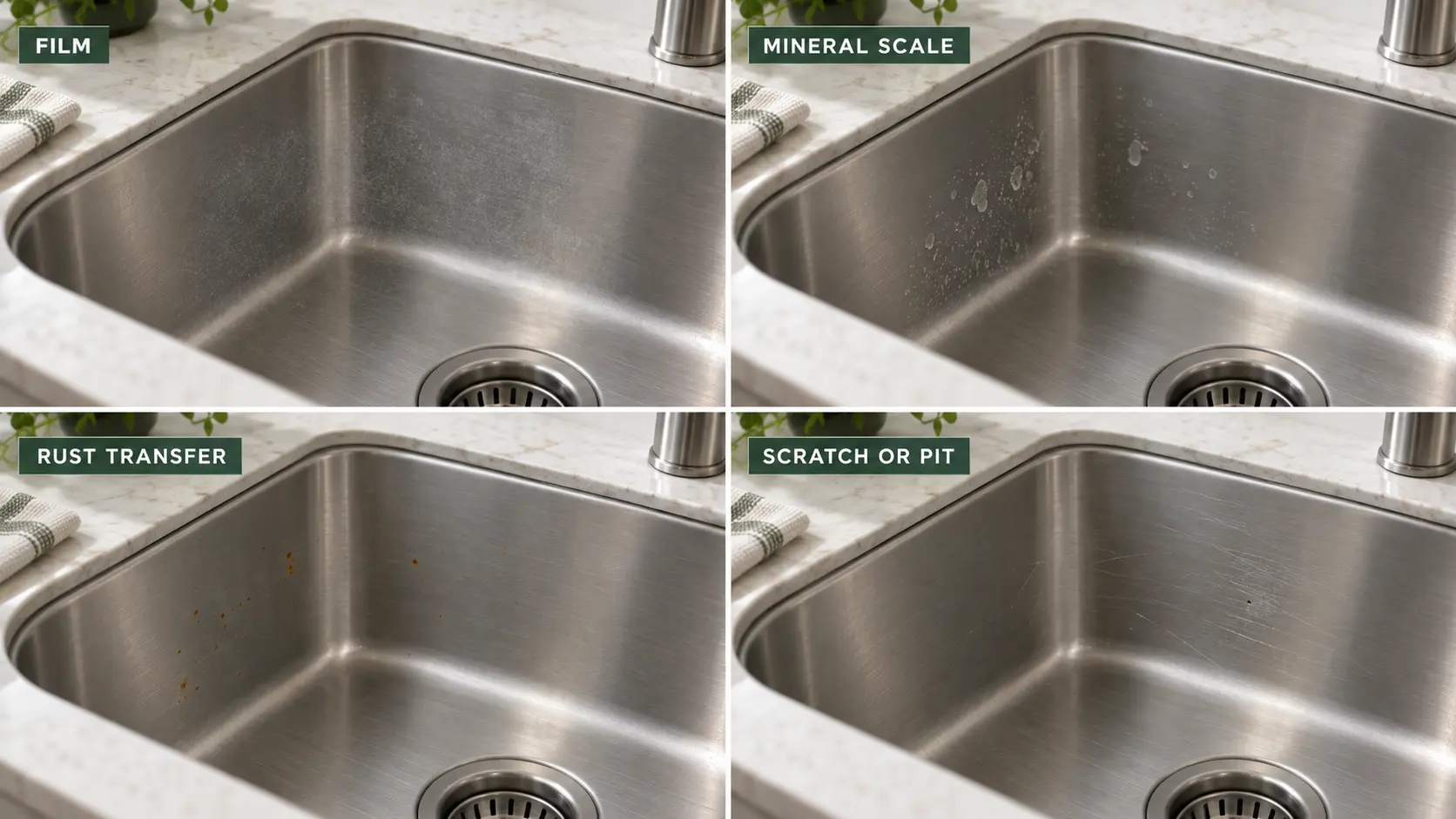
A complete answer to how to clean stainless steel sink marks must separate removable material from a changed surface.
| What you observe | More consistent with | Safest next decision |
|---|---|---|
| Smeary, greasy or rainbow-like film that shifts during wiping | Food, detergent or polishing residue | Repeat only the approved mild wash with a clean cloth, rinse and dry. |
| Raised, chalky white deposit near the faucet, drain or drying line | Hard-water mineral scale | Find the exact maker-approved descaling procedure. |
| Small orange-brown specks where a can, steel tool or cast-iron item sat | Transferred iron particles or external rust | Remove the source and use only the manufacturer’s rust-deposit method. |
| Fine lines that catch light but do not wipe away | Scratching or normal use wear | Do not scrub harder; check whether the model permits grain blending or professional restoration. |
| Rough dark pinpoints, pits or recurring corrosion | Possible chloride exposure, embedded contamination or corrosion | Stop household experiments and contact the sink manufacturer. |
| Patchy color or sheen on a colored/coated sink | Coating wear or chemical change | Do not abrade or polish; obtain finish-specific support. |
If a white mineral deposit remains
When researching how to clean stainless steel sink water marks, first check whether the dry deposit is raised and chalky. Hard water can leave calcium-rich scale after droplets evaporate. Over-softened or mineral-rich water can also produce a visible film.
Do not jump directly to a universal vinegar soak. Manufacturer instructions conflict: some allow defined vinegar procedures, while others specify a proprietary cleaner or restrict acids on a particular finish. Verify the cleaner, dilution, contact time, applicator and rinsing step for the exact model.
BLANCO’s general stainless-steel guidance starts with detergent, the soft side of a sponge, cleaning with the brushing direction, thorough rinsing and drying.
Why a stainless-steel sink can show rust-colored spots
Understanding how to clean stainless steel sink rust-colored marks begins with their source. A brown spot does not automatically mean the bowl is rusting from within. Ordinary iron particles from steel wool, tools, cans, cast-iron cookware, water supply or nearby fabrication can settle on the surface and corrode.
Elkay warns against steel wool and wire brushes because particles can adhere and eventually rust. Moen likewise notes that water quality and iron content can create brown staining. Remove the contamination source before treating the appearance.
Clean the grid, drain edge and hidden contact points
Lift the bottom grid rather than cleaning only around it. Wash both sides under its own care instructions, rinse and dry it before replacement. Trapped food, metal contact and moisture beneath grids or rubber mats can create staining that appears to originate in the sink.
Clean carefully around the drain flange and corners without forcing liquid or debris into gaps. A garbage disposal is separate equipment: disconnect or control power as its manufacturer requires, and never reach into it or mix drain cleaner with another cleaning chemical.
Cleaning is not the same as sanitizing or disinfecting
Advice about how to clean stainless steel sink surfaces is not automatically disinfection guidance. Routine cleaning removes food soil and residue. Sanitizing or disinfecting makes a regulated antimicrobial claim and depends on the exact product label. Visible soil usually must be removed first.
If disinfection is necessary, use a product whose label lists the intended hard, nonporous surface and application. Follow the exact wet contact time, ventilation, personal-protection and food-contact rinsing directions. The EPA distinguishes products that require a potable-water rinse on food-contact surfaces from products labelled for no-rinse food-contact sanitizing. Check the EPA label terminology and the product’s current label.
Baking soda, vinegar, bleach and oil: the practical verdict
Baking soda
It can act as an abrasive. Reserve it for a specific finish and problem only when the sink maker allows it; use the approved pressure and applicator.
White vinegar
It can dissolve some mineral deposits, but acid permission and contact time vary. Do not copy one brand’s vinegar instructions to another sink.
Bleach
Chloride exposure can damage stainless steel. It is not the default cleaning or disinfecting choice. Follow both the sink maker and exact disinfectant label.
Olive or mineral oil
Oil can temporarily alter reflection but does not prove film, scale or damage was removed. It may leave a greasy layer inside a food-contact basin.
Can scratches be removed?
A guide to how to clean stainless steel sink surfaces must not confuse cleaning with scratch removal. Routine use can produce fine lines that gradually blend into a directional finish, but cleaning does not remove a true scratch. Some manufacturers permit a particular pad or restoration kit on specified uncoated grain finishes, but using that technique across the grain—or on polished, textured or coated steel—can make the area more visible.
If a dry mark remains fixed, catches a fingernail, has a different texture or began after aggressive cleaning, stop. Record the model, finish, product and tool used, photograph the mark in angled light, and ask the manufacturer whether restoration is appropriate.
Prevent film, water spots and transferred rust
For long-term decisions about how to clean stainless steel sink surfaces, prevention is safer than repeated aggressive deep cleaning.
- Rinse food, detergent and acidic residue instead of letting it dry.
- Dry highly visible areas when practical, especially in hard-water homes.
- Remove and clean both sides of the sink grid regularly.
- Do not leave wet sponges, cloths, steel cans or cast-iron items in the basin.
- Keep steel wool and wire brushes away from the sink.
- Use only care products approved for the exact finish.
There is no universal deep-cleaning calendar. Usage, water chemistry, finish and manufacturer instructions should determine frequency.
Stainless-steel sink cleaning FAQs
What is the best way to clean a stainless-steel sink?
Use a mild manufacturer-approved detergent with a soft cloth or non-scratch sponge, work with the grain, rinse completely and dry. Diagnose any remaining deposit or surface change before escalating.
Can I use baking soda on stainless steel?
Only conditionally. Baking soda is abrasive, and pressure, applicator and finish matter. Use it only when your exact sink manufacturer’s instructions permit it.
Can vinegar remove hard-water spots?
Vinegar may be allowed for mineral scale on certain sinks, but the safe concentration and contact time are manufacturer-dependent. Do not apply a universal soak; verify, rinse and dry as directed.
Why does my stainless-steel sink have brown spots?
Brown spots may be iron transferred from steel wool, cans, cookware, tools or iron-rich water. They may also represent corrosion. Location, texture and exposure history help determine the next step.
Can I use bleach to disinfect the sink?
Do not use bleach by default. Chlorides can damage stainless steel, and disinfectants require label-specific compatibility, wet contact time and food-contact rinse instructions. Never mix bleach with another cleaner.
Should I scrub with or across the grain?
Use the visible grain direction when the manufacturer instructs it. Different sink areas can be brushed differently. If the finish or grain is uncertain, use a soft tool and avoid abrasive escalation.
Why does the sink look cloudy after cleaning?
Cloudiness may be detergent residue, oil, hard-water scale or a changed finish. Rinse and dry first. A movable smear behaves differently from raised chalky scale or a fixed dull patch.
Can I remove scratches with a scouring pad?
Only if the exact sink maker approves the exact pad and technique for that finish. Blind abrasion can deepen scratches, change grain or permanently damage a coating.

