Porcelain Sink CareStain RemovalManufacturer-Aware
How to remove rust from porcelain sink surfaces safely depends on what “porcelain” actually means in your sink. First remove ordinary soil, then identify whether you have vitreous china or porcelain enamel over metal. Escalate only with a cleaner allowed by the care guide for that exact material, using a non-scratching applicator and a complete rinse.
Quick verdict
Most orange rings are removable—but inspect the glaze first
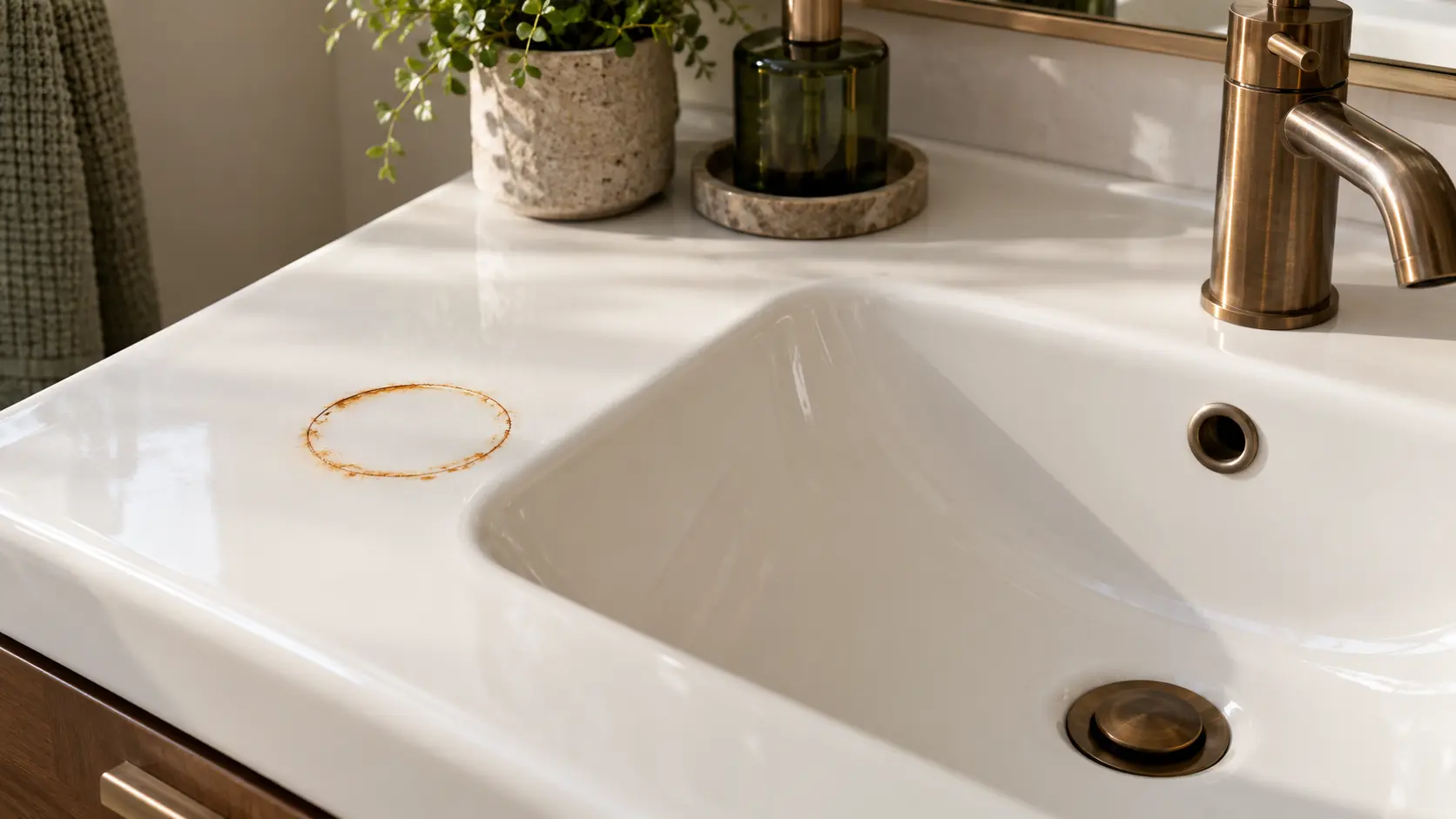
If a wet can, cast-iron pan, shaving-cream can, bobby pin, or another metal object left an orange-brown mark on an otherwise smooth, intact sink, the problem is often rust transferred onto the surface. Start with warm water, a small amount of mild dish detergent, and a soft cloth or non-scratch sponge. Rinse and dry.
If rust remains, locate the sink’s brand and material. Use only a rust-removal product or method listed for that exact sink—or explicitly allowed on the current product label. Do not use steel wool, a wire brush, a green scouring pad, or an internet acid-and-abrasive mixture.
Step zero
Confirm what your “porcelain” sink is made from
“Porcelain sink” is a common visual description, not a precise construction label. A glossy white sink may be vitreous china/ceramic, or it may be porcelain enamel fused over cast iron or steel. Those surfaces can look similar while their manufacturers publish different care instructions.
Check the model label under the basin, the purchase invoice, the manufacturer’s website, or the installation and care document. If you cannot confirm the material, stay with the mild baseline clean and contact the manufacturer before using a rust remover.
Likely vitreous china
Common in bathroom sinks and pedestal basins. The body is ceramic rather than metal. A chip may reveal a ceramic-looking body.
Likely enameled metal
Common in cast-iron kitchen sinks and some steel fixtures. A magnet may be attracted to the metal body, but model documentation is better evidence.
Do not rely on color alone
White, biscuit, and colored finishes occur across multiple materials. A hidden-area test also cannot prove that an incompatible cleaner is safe for the entire sink.
If the sink is actually composite rather than porcelain, use the material-specific guidance in our black composite sink diagnosis. If a rust ring is on engineered quartz instead of inside the sink, follow the separate quartz rust-stain guide.
Is it transferred rust, a mineral stain, or damage?
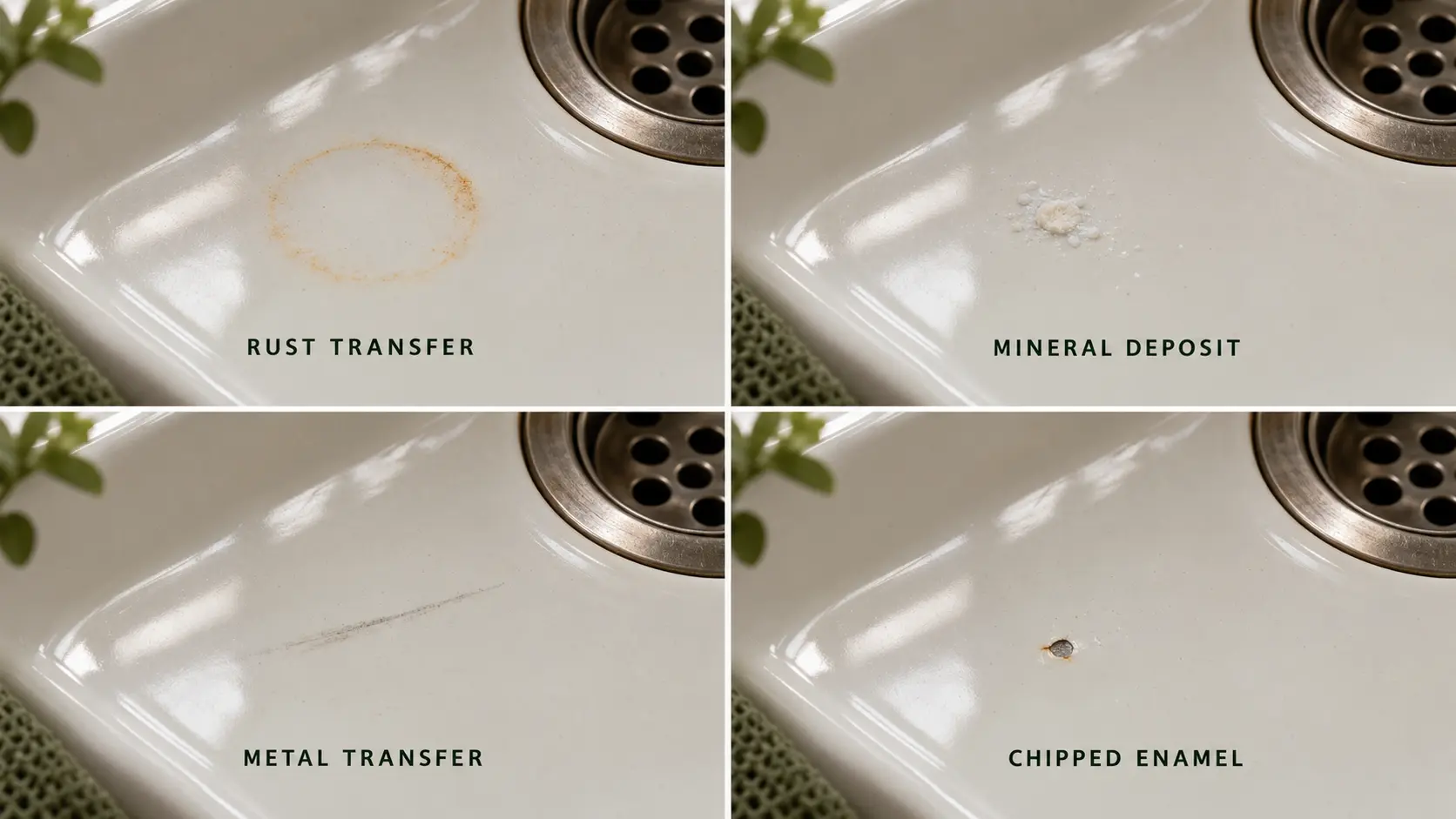
Correct diagnosis matters more than scrubbing strength. Dry the sink and inspect the mark under bright, angled light. Then compare what you see and feel with the table below.
| What you observe | Likely explanation | Next decision |
|---|---|---|
| Orange-brown ring exactly where a wet metal item sat; surrounding glaze is smooth | Transferred rust on top of an intact finish | Use the gentle baseline, then a manufacturer-permitted rust treatment if needed |
| Orange streak beginning at the drain, overflow, chip, or exposed dark spot | Corrosion may be coming from metal beneath or beside the glaze | Stop repeated stain removal and address the damaged component or coating |
| White or chalky crust with no orange color | Mineral buildup is more likely than rust | Do not assume a rust remover is the correct product |
| Gray line after a pot or utensil rubbed the sink | Metal transfer may be present without true rust | Check the manufacturer’s guidance for pot marks or metal marks |
| Rough edge, pit, crack, missing glaze, or mark that returns from the same damaged point | Surface damage rather than a removable deposit alone | Stop and seek manufacturer, refinishing, or plumbing advice |
What you may need
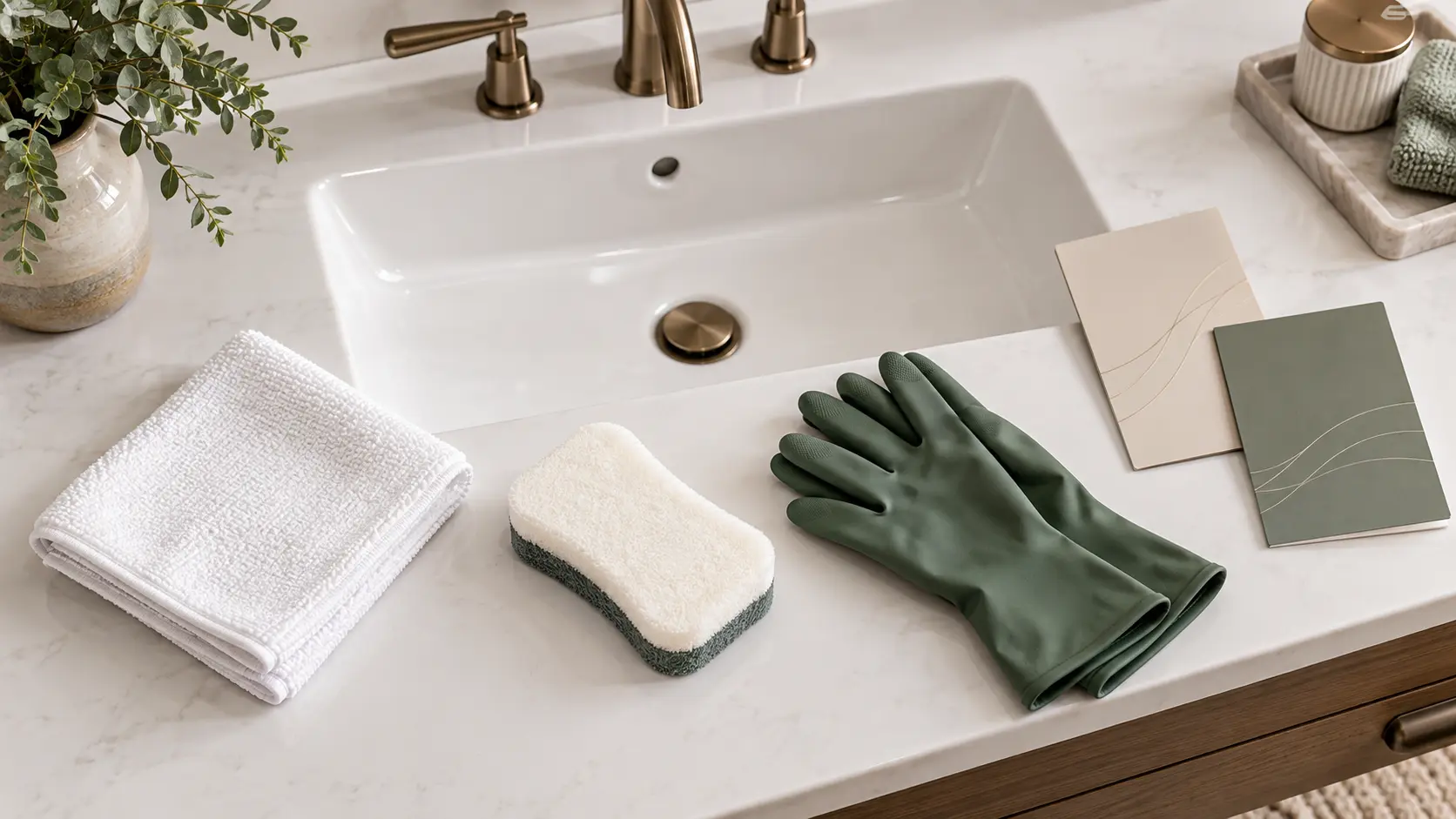
- Warm water
- Mild dish detergent without added abrasive particles
- White or colorfast microfiber cloth
- Soft, non-scratching sponge
- Clean towel for the dry-result check
- The exact sink care guide or model page
- A manufacturer-listed rust remover, only if the baseline clean does not work
- Gloves and ventilation when the selected product label requires them
Least-aggressive first action
Start by removing ordinary soil and cleaner residue
-
Clear and rinse the sink
Remove dishes, mats, drain accessories, and loose particles. Rinse the affected area with warm—not extreme—water so grit is not dragged over the glaze.
-
Wash with mild detergent
Put a small amount of mild dish detergent on a damp soft cloth or the soft side of a non-scratch sponge. Clean the mark and a small surrounding area using light pressure.
-
Rinse completely
Remove the detergent with clean water. Residual soap can create a film that makes the result harder to judge.
-
Dry and inspect
Dry the sink with a clean towel. Check whether the orange color changed and whether the glaze still looks and feels smooth.
Checkpoint after the baseline
Gone or clearly lighter: repeat the same gentle method once if necessary. Unchanged but the glaze is intact: move to the exact manufacturer-guided treatment. Rough, chipped, pitted, or rusting from underneath: stop cleaning and investigate damage.
How to remove rust from porcelain sink finishes that remain stained
There is no single escalation product that is automatically approved for every sink sold as porcelain. Use the path matching your confirmed material:
Vitreous china or ceramic sink
Sterling/Kohler’s vitreous-china care guidance names Super Iron Out Rust Stain Remover for rust and tells owners to follow the product manufacturer’s directions. Treat that as brand-specific guidance, not permission for an unidentified sink.
Porcelain-enameled cast iron
Kohler’s current enameled cast-iron care page directs owners to use a small amount of KOHLER Cast Iron Cleaner with a soft cloth or cork for marks. Treat that as Kohler-specific guidance, not universal approval for another brand or a damaged finish.
Proprietary or refinished surface
Use its own current care document. A proprietary composite, factory coating or refinished sink may have restrictions that do not apply to vitreous china or factory-fired porcelain enamel. If the exact surface cannot be confirmed, stop after the mild baseline clean and contact the maker or refinisher.
Manufacturer-safe treatment matrix
| Confirmed surface | Safe first action | Controlled escalation | Stop when |
|---|---|---|---|
| Vitreous china | Mild detergent, soft cloth, full rinse and dry inspection | Use the exact maker’s rust recommendation; Sterling/Kohler currently names Super Iron Out and directs users to its instructions | The glaze is rough, cracked, altered or previously refinished |
| Porcelain-enameled cast iron | Mild detergent and a non-scratch cloth | Use only the enamel-care cleaner and applicator named by the exact manufacturer | A chip exposes dark metal or rust returns from beneath the enamel |
| Porcelain-enameled steel | Gentle baseline clean and dry inspection | Follow the model-specific care document and current cleaner label | Metal is exposed, the coating flexes, bubbles or continues corroding |
| Proprietary, composite or refinished | Use only its written care instructions | Contact the manufacturer or refinisher before stain chemistry | Material identity is uncertain or the coating peels, dulls or transfers color |
Controlled application rules
-
Read both labels
Confirm that the sink care guide and the current cleaner label both allow the surface. If either excludes colored, refinished, cracked, coated, or damaged finishes, do not proceed.
-
Test conservatively
Test a small inconspicuous area when the label calls for it. A successful spot test lowers uncertainty but does not override the sink manufacturer’s prohibition.
-
Treat a small area with a non-scratch applicator
Use only the amount, contact time, and applicator specified on the current product label. Do not extend dwell time because a stain is old.
-
Rinse exactly as directed
Remove the cleaner completely. Do not add vinegar, bleach, ammonia, baking soda, or another product to “neutralize” or strengthen it unless the product manufacturer explicitly instructs that step.
-
Dry before deciding
Inspect the fully dry surface. If the stain improved and the glaze did not change, repeat only as the label allows. If sheen, color, or texture changed, stop.
Product example, not universal approval: Bar Keepers Friend markets formulas for porcelain sinks, but formulas and directions can differ. Use a specific product only when both the exact sink guide and that product’s current label allow it. Follow the label’s own amount, applicator, dwell and rinsing directions; never borrow timing from a different formula or surface, and never mix it with another cleaner.
Check the dry result: repeat, escalate, or stop
Repeat carefully
The orange mark is lighter, the finish remains smooth, and the selected product label permits another application. Repeat only the same controlled process.
Recheck the diagnosis
The color did not change. Confirm that it is rust—not mineral scale, metal transfer, dye, adhesive, or discoloration under the glaze—before trying another chemistry.
Stop
The area is rough, duller, scratched, chipped, pitted, discolored, or rust returns from a drain or exposed spot. More cleaning may enlarge the damage without fixing its source.
Rust-mark decision map
What not to use on an unidentified porcelain sink
| Method | Why it is a poor default | Safer decision |
|---|---|---|
| Steel wool or wire brush | Can scratch the glaze and may leave metal particles that later rust | Use only a manufacturer-approved non-scratch cloth, sponge, or pad |
| Green scouring pad or aggressive powder scrubbing | “Porcelain” does not guarantee resistance to every abrasive | Follow the exact sink and cleaner instructions |
| Pumice stone | Online advice rarely accounts for colored, thin, refinished, textured, or damaged glaze | Do not improvise unless the exact manufacturer authorizes it |
| Vinegar, lemon, or toilet-bowl cleaner | Acid strength, finish compatibility, and prior-cleaner interactions are uncertain | Use a listed rust treatment with label-controlled contact and rinsing |
| Bleach | It is not the default chemistry for iron oxide and can form dangerous gases when mixed with acids or ammonia | Never mix cleaners; use the material-specific rust path |
| Longer soaking or harder scrubbing | Extra exposure can change sheen, color, or texture without correcting subsurface corrosion | Obey label limits and use the dry-result checkpoint |
Why the rust stain may keep coming back
A returning stain is evidence to investigate, not a signal to scrub more aggressively.
- Metal left wet: cans, cast-iron cookware, clips, bobby pins, razors, and metal sink accessories can transfer new rust.
- Iron in the water: repeated orange spotting across several fixtures may point to a water-supply issue rather than a dirty sink.
- Corroding drain or overflow: a streak that begins at metal hardware may require hardware repair or replacement.
- Chipped enamel: exposed metal beneath porcelain enamel can corrode. Surface cleaning cannot restore missing glaze.
- Residual product: incomplete rinsing can leave a new film that changes the appearance of the repaired area.
How to prevent new rust rings
- Do not leave cast-iron pans, food cans, shaving cans, razors, hairpins, or metal-bottom containers sitting in a wet sink.
- Rinse and dry the basin after contact with rust-prone metal.
- Use a sink rack or mat only if the sink manufacturer allows it, and lift it regularly so trapped moisture can dry.
- Replace corroding drain, overflow, or accessory components instead of repeatedly treating the stain they create.
- Investigate recurring orange deposits across multiple fixtures as a possible water issue.
- Repair chips through an appropriate professional or manufacturer-approved route before exposed metal corrosion spreads.
For other sink materials, use the dedicated guide rather than transferring this method. See how to clean a stainless steel sink, how to diagnose haze on a composite sink, or how to treat a rust-colored mark on engineered quartz.
Related user questions / article FAQ
Frequently asked questions
Can rust permanently stain a porcelain sink?
Transferred rust on an intact, smooth glaze is often removable. A mark caused by a chip, exposed metal, worn coating, or corrosion beneath porcelain enamel may return until the damaged source is repaired. Cleaning cannot replace missing glaze.
Is a porcelain sink the same as a vitreous china sink?
Not always. “Porcelain sink” is often used visually, while vitreous china describes a ceramic body with a fired glazed surface. Other porcelain-looking sinks may be enamel fused over cast iron or steel. Confirm the model and construction before choosing a stain treatment.
Can I use Bar Keepers Friend on a porcelain sink?
Only if the current label for the exact Bar Keepers Friend formula and the care guide for your exact sink both allow it. Product formulas and directions differ, so follow that container’s stated amount, applicator, contact time and rinsing instructions. A cleaner label never overrides a sink manufacturer’s restriction.
Will vinegar remove rust from porcelain?
Acids can dissolve rust, but vinegar is not a safe universal recommendation for every porcelain-looking sink, colored glaze, proprietary finish, damaged area, or previous-cleaner situation. A manufacturer-listed rust treatment provides a clearer compatibility and label-controlled path.
Does bleach remove rust stains?
Bleach is not the default treatment for iron oxide. More importantly, it must never be combined with acids, ammonia, toilet-bowl cleaner, or another unknown cleaner. Rinse away previous products according to their labels before starting a separate treatment.
Can a Magic Eraser scratch porcelain glaze?
Melamine foam is mildly abrasive and is not universally approved for every glaze or refinished surface. Do not assume “soft to the touch” means non-abrasive. Check the sink manufacturer’s care instructions first.
Why did a metal can leave a rust ring overnight?
Moisture trapped under an uncoated or damaged metal base can start corrosion and transfer iron oxide onto the sink. The ring may sit on top of intact glaze even though the sink itself is not rusting.
Why does rust keep appearing around the drain?
The drain assembly, overflow, fastener, or exposed base metal may be corroding. If the stain begins at the same hardware or chipped point after each cleaning, repair the source rather than repeatedly escalating cleaners.
How do I know whether the glaze is scratched?
Rinse and dry the area, then inspect it under angled light. A scratch or worn patch may have a line, changed sheen, rough edge, or texture that remains after the orange deposit is gone. Stop abrasive cleaning if the finish itself has changed.
The safest final recommendation
Treat the orange mark as removable transfer only while the glaze is smooth and intact. Begin with detergent, rinse, and a fully dry inspection. If rust remains, identify the sink and follow its current manufacturer guidance plus the rust-remover label. Stop when the finish is damaged or the stain returns from a corroding component—those conditions need repair, not stronger scrubbing.

