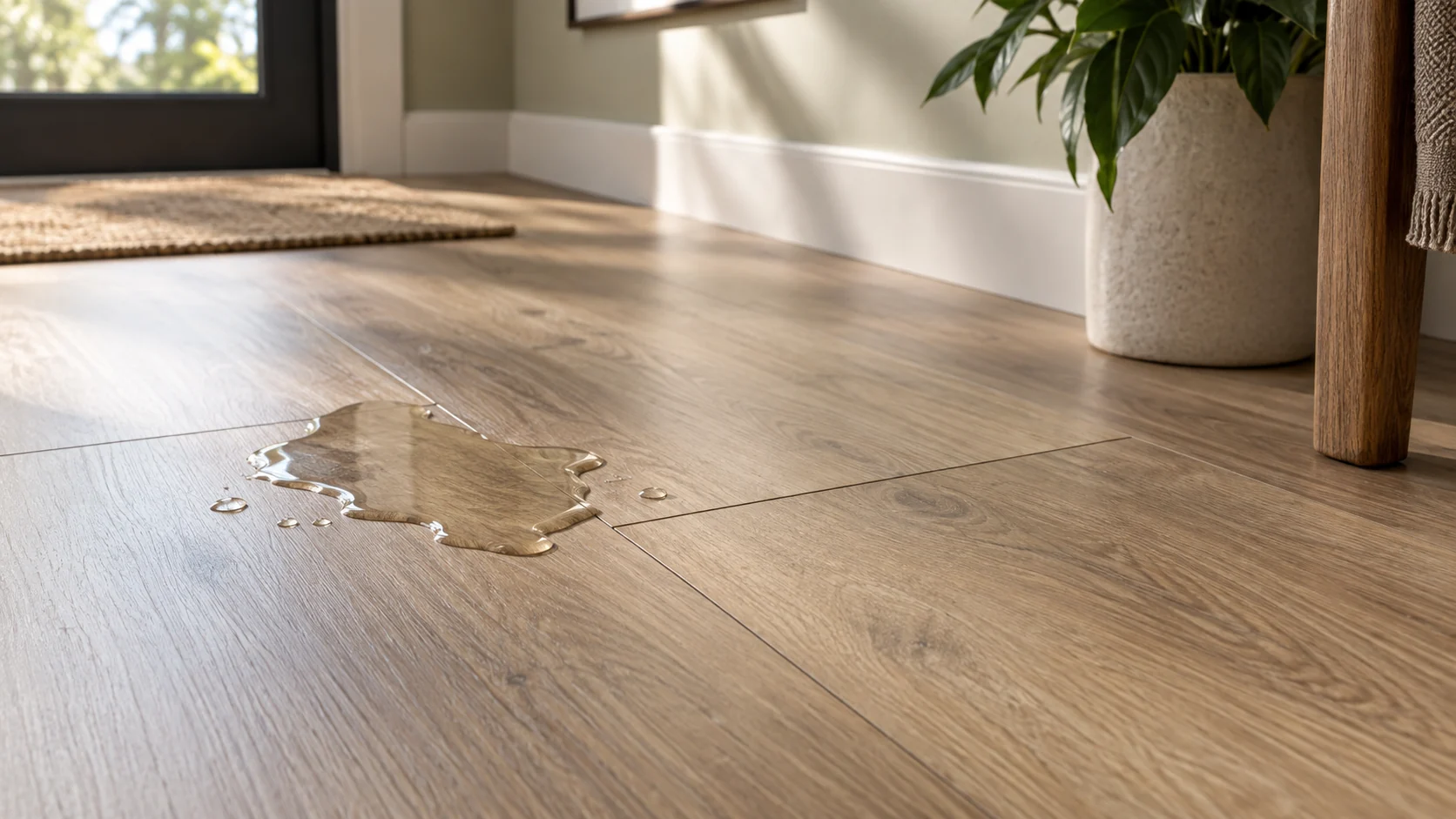
Laminate flooring—is it waterproof, water-resistant, or still vulnerable to a leak? The accurate answer depends on the exact product, its joined seams, perimeter installation, exposure route and written warranty.
Is laminate flooring waterproof?
Some laminate products are sold as waterproof flooring systems, but laminate as a category is not universally waterproof. If you are asking is laminate flooring waterproof, the reliable answer depends on the exact collection, watertight joints, correctly sealed room perimeter, approved installation and the source and duration of the water. A claim about everyday spills on the surface does not automatically promise protection from flooding, an appliance leak or moisture rising from below.
Find the carton, receipt or model number and read that product’s current installation, care and warranty documents before treating “waterproof” as a room- or event-wide guarantee.
First, confirm that the floor is laminate
Wood-look floors can share a similar photograph and plank shape while behaving very differently around water. Laminate usually has a clear wear surface and decorative image over a wood-fiber core. Luxury vinyl plank (LVP) is a resilient plastic-based construction. Engineered hardwood has a real-wood wear layer. Newer hybrid or resilient products may use marketing names that sound like laminate even when their core is different.
Do not identify the material from appearance alone. Check the original box, invoice, product label, installer record or manufacturer model page. If the floor came with the home, ask the seller or installer and inspect spare planks without pulling up an installed board.
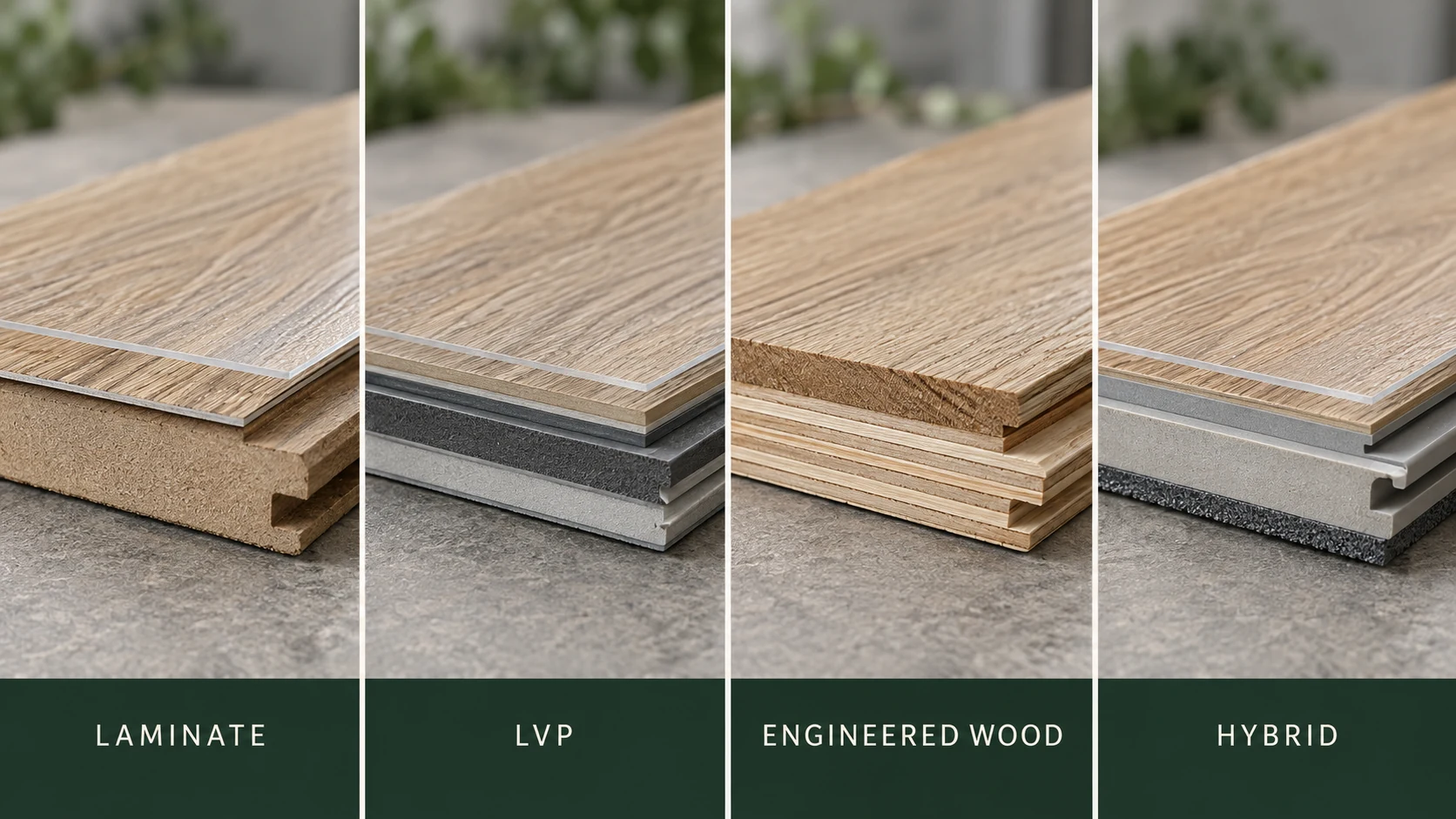
Why identification changes the answer
A “waterproof vinyl” result does not prove that a laminate floor is waterproof. Search and retail pages sometimes place laminate, vinyl and hybrid resilient products close together. The product type on the technical sheet matters more than the wood-look name.
The five-zone test for a waterproof laminate claim
The clearest way to evaluate a claim is to stop asking whether the visible plank face is waterproof and ask what the complete installed system protects.
The North American Laminate Flooring Association (NALFA) describes an optional assembled-joint surface-swell test for prolonged water exposure. That is useful context: water performance can depend on the joined flooring system, not merely the decorative top surface.
Waterproof vs water-resistant laminate flooring
| Label or condition | Reasonable interpretation | What still needs verification |
|---|---|---|
| Water-resistant laminate | Designed to resist limited topical moisture under stated conditions. | Allowed exposure, cleanup window, rooms, seams and exclusions. |
| Waterproof laminate | A specific product or installed system carries a stronger manufacturer claim. | Perimeter steps, penetrations, flood/leak exclusions, underside coverage and warranty term. |
| No water claim found | Do not infer protection from the word “laminate” or a glossy surface. | Current manufacturer documents or written support for the model. |
| Unknown product | Use the conservative path: keep water minimal and remove spills promptly. | Construction, brand, collection, installation and prior damage. |
There is no honest universal number of minutes or hours that applies to every laminate floor. If a brand advertises a spill-duration limit, connect that number to the exact collection, test conditions and current written warranty.
What current manufacturer guidance shows
These examples demonstrate why the model documents control. They are not interchangeable approvals for other laminate floors.
| Product family | Published claim or instruction | CareBySurface reading |
|---|---|---|
| Pergo Outlast+ | Pergo says SpillProtect keeps spills and liquids on the surface and markets the collection as waterproof. | Useful product-level evidence, not permission to ignore installation or warranty conditions. |
| Mohawk RevWood WetProtect | Mohawk describes surface and subfloor warranty protection; some current RevWood product pages also state steam-mop compatibility. | Confirm the exact RevWood collection, current manual and installation before applying either statement. |
| Shaw laminate | Shaw says not to wet mop with soap and water; its laminate overview says steam can damage or warp laminate. | A clear example of conservative brand guidance. Do not override it with advice written for another brand. |
| Quick-Step Studio SpillRepel | The product is sold for everyday spills; its installation instructions call for a watertight perimeter using specified sealing steps. | “Waterproof” is linked to the collection and installed system, not just the loose plank. |
Do not average conflicting brand instructions
If one model permits steam and another prohibits it, the answer is not “steam is probably safe.” Follow the exact floor’s current care guide. For an unknown laminate floor, skip steam and use the lowest-moisture method until the product is identified.
Installation can make or break the water claim
A waterproof-designated plank may still rely on installation details that are invisible after trim is installed. Some systems require compressible backer rod and 100% silicone at expansion spaces, plus sealing around doorframes, pipes or other fixed objects. For example, the Pergo TimberCraft WetProtect instructions specify perimeter sealing steps, and Lowe’s provides a similar wall-to-wall waterproof installation sequence.
That does not mean homeowners should add silicone to an already installed floor without instructions. Floating laminate needs the correct expansion system. Unplanned sealing, fastening or caulking can interfere with movement or warranty requirements. Ask the installer which waterproof detail was used and retain photographs and documents.
Can waterproof laminate go in kitchens, bathrooms or basements?
Often product-dependent
Look for explicit kitchen approval, appliance-leak exclusions, sealed perimeter requirements and instructions at cabinets, islands and transitions.
Never assume from the label
Confirm wet-room approval and details at the tub, toilet, vanity, doorway and pipe penetrations. A bath mat does not replace the required installation system.
Plan for appliance events
Everyday splash resistance is different from a hose or machine failure. Check appliance-related exclusions and access for leak detection.
Check moisture from below
A waterproof surface claim may not solve slab vapor or groundwater problems. Verify subfloor moisture testing, vapor-control and below-grade approval.
A product page may say “ideal for bathrooms” or “whole home,” but the installation guide and warranty define the conditions. Save the documents that applied when the floor was purchased.
A spill, leak and flood are not the same event
| Water event | Primary concern | First decision |
|---|---|---|
| Small topical spill | Liquid remaining at seams or edges. | Blot promptly, dry and inspect under angled light. |
| Pet accident | Time, seam entry, residue and warranty-specific pet coverage. | Remove promptly and use only the exact maker-approved cleanup method. |
| Appliance or plumbing leak | Water may travel under boards beyond the visible wet area. | Stop the source, document the event and assess hidden moisture. |
| Repeated wet mopping | Cumulative seam/perimeter exposure and cleaner residue. | Stop excess moisture and check the product care guide. |
| Moisture from slab or subfloor | Bottom-up exposure outside a top-surface claim. | Investigate the moisture source and installation assembly. |
| Flood or contaminated water | Hidden moisture, contamination and building safety. | Avoid a DIY surface-only response; follow public-health and restoration guidance. |
What to do when laminate flooring gets wet
Stop the source safely
Shut off a controllable leak if you can do so without electrical, contaminated-water or structural risk. For major or unsafe events, contact the appropriate emergency or restoration professional.
Remove surface water promptly
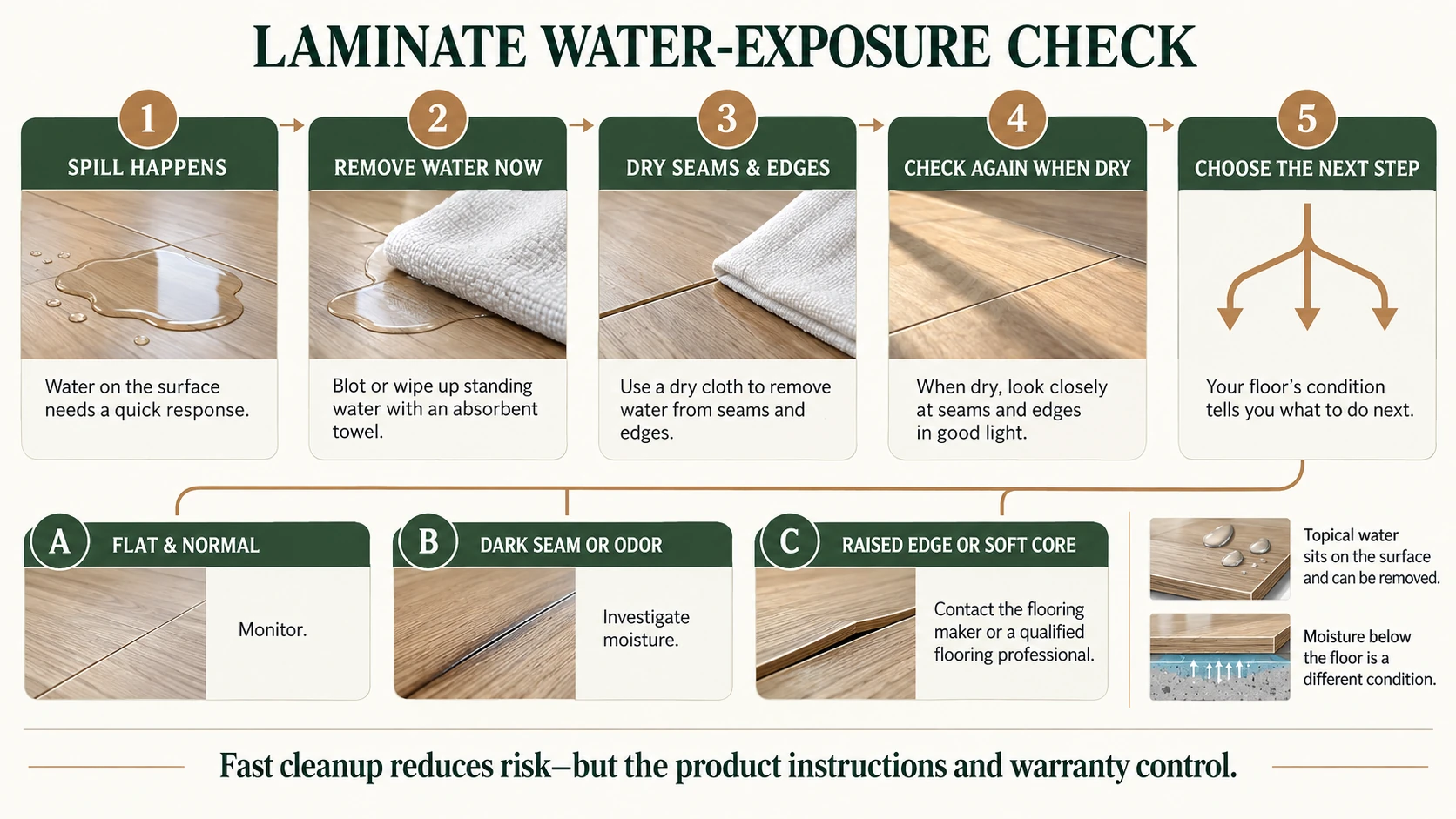
Blot or extract the water without flooding more seams. Do not add cleaner, steam or more water while the exposure path is still unknown.
Photograph before moving anything
Record the source, affected boundaries, seams, transitions and nearby walls. Keep the product label, installation invoice and warranty available.
Check the five zones
Inspect the face, joints, perimeter, penetrations and possible route underneath. A dry-looking face does not confirm a dry underlayment or subfloor.
Dry the building assembly
The EPA advises drying wet materials and areas quickly, generally within 24–48 hours, to reduce mold risk. Its guidance also says to check whether underflooring is wet. See the EPA moisture and mold guide.
Use the warranty route before altering boards
Contact the manufacturer, retailer or installer when coverage may apply. Removing planks, drilling, heating or applying unapproved chemicals can complicate inspection and claims.
-
Recheck after the surface is fully dry
Look and feel for raised seams, swelling, buckling, bubbling, persistent darkening, odor or continuing moisture. These signs need diagnosis, not another cleaning pass.
Stop and seek qualified help
Escalate for standing water, contaminated floodwater, water near electrical systems, a large or unknown leak, wet material that cannot be dried promptly, musty odor, spreading moisture, raised or buckled boards, or suspected wet underflooring. The EPA advises professional help for contaminated water and emphasizes complete drying.
Diagnose what remains after drying
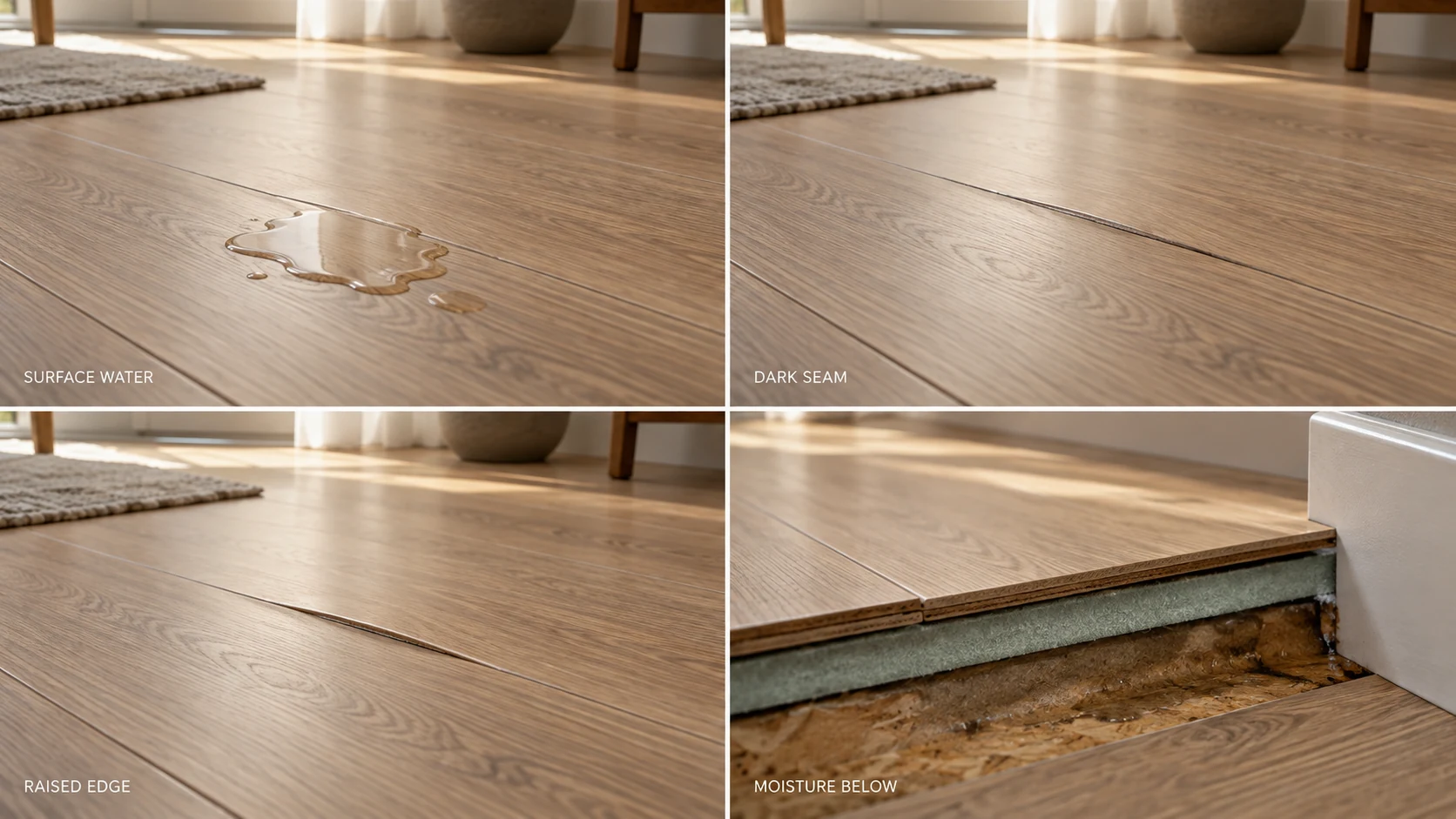
| Observation | Possible meaning | Next action |
|---|---|---|
| Flat, dry, unchanged seams | The visible surface recovered; hidden moisture is less likely but not disproved after a larger leak. | Monitor and retain photographs. |
| Dark line at a seam | Remaining moisture, trapped soil or a visual finish change. | Do not add liquid. Compare after drying and consult the maker if it persists. |
| Raised edge or swollen joint | Core or joint dimensional change may have occurred. | Stop cleaning and request product/installer assessment. |
| Bubbling or layer separation | Possible delamination or irreversible material change. | Document and seek repair or replacement guidance. |
| Musty odor or recurring dampness | A hidden moisture source may remain. | Investigate the assembly and source promptly. |
Diagnostic limitation: A photograph or surface touch cannot prove the condition of the underlayment or subfloor. Moisture investigation may require an installer, flooring inspector or water-restoration professional.
Laminate water-exposure decision map
Start with the exact product, then the water path
Waterproof laminate vs LVP
Waterproof laminate and luxury vinyl plank can compete for the same rooms, but they are not the same material. Laminate typically uses a wood-fiber core and emphasizes a rigid wood-like surface. LVP is resilient flooring built with vinyl or related polymer layers. A water claim still depends on the specific product and installation, but construction changes how the floor reacts when water reaches a cut edge or underside.
If you already have resilient vinyl, use the separate CareBySurface LVP cleaning guide. If records identify real or engineered wood, see the hardwood floor guide. Do not transfer instructions between these surfaces simply because the printed grain looks similar.
Waterproof laminate buyer’s evidence checklist
- Exact manufacturer, collection, style and model number
- Product type stated as laminate—not vinyl, hardwood or an undefined hybrid
- Current downloadable warranty and installation instructions
- Meaning of waterproof: surface only, watertight joints, perimeter and/or subfloor
- Approved rooms and below-grade conditions
- Required perimeter, pipe, doorway and transition details
- Flood, appliance-leak, standing-water and bottom-up moisture exclusions
- Cleaning, wet-mop and steam-mop instructions for that model
- Claim procedure, proof of purchase and installation documentation
The most useful pre-purchase question
Ask the seller to show you where the written warranty covers the water event you are concerned about. “Waterproof” on a shelf label is less useful than a model-specific document that states the protected zones, installation conditions and exclusions.
The final answer: is laminate flooring waterproof?
Is laminate flooring waterproof? Some specifically labeled and correctly installed laminate systems carry meaningful waterproof protection; other laminate is only water-resistant or has no verified water claim. Treat the exact model’s warranty, installation and care documents as the answer—and treat spills, leaks, floods and moisture from below as different events.
Frequently asked questions
Is all laminate flooring waterproof?
No. Water performance varies by product. Some collections carry waterproof system claims, others are water-resistant, and some have no meaningful water claim. Verify the exact model and written warranty.
Is waterproof laminate really waterproof?
It may be waterproof within the manufacturer’s defined test and warranty conditions. Check whether those conditions cover the surface, joined seams, sealed perimeter, penetrations, subfloor, exposure duration and type of water event.
Can waterproof laminate flooring be used in a bathroom?
Only when the exact product permits that room and the installation follows its wet-area details. Pay particular attention to the perimeter, toilet, tub or shower edge, vanity, doorway and pipe penetrations.
What happens if water gets under laminate flooring?
Water beneath the boards can affect the core, underlayment or subfloor even when the face looks dry. Stop the source, document the exposure and arrange appropriate moisture assessment if the event was more than a small surface spill.
Can you steam mop waterproof laminate?
Only if the exact manufacturer and model currently approve it. Shaw advises against steam on its laminate, while some Mohawk RevWood product pages state steam compatibility. For an unknown floor, do not use steam.
Is waterproof laminate the same as vinyl plank?
No. Laminate and LVP are different constructions. Confirm the product type before applying cleaning, installation or damage advice.
Does a waterproof warranty cover flooding?
Not necessarily. “Waterproof,” “spill protection,” “surface and subfloor protection” and “flood coverage” are not automatically equivalent. Read the definitions and exclusions in the exact warranty.
Will swollen laminate flatten after it dries?
Do not assume it will. A raised seam or swollen core may represent a lasting dimensional change. Document it and seek manufacturer, installer or flooring-inspector guidance before attempting a repair.
Editorial method: This guide separates industry test context, manufacturer claims, installation requirements and general public-health guidance. Product examples were checked on September 9, 2026. Manufacturer documents can change; the current instructions for the exact model control. CareBySurface does not promise warranty coverage or diagnose hidden moisture from a photograph.

