Floor & Tile Care · Natural Stone
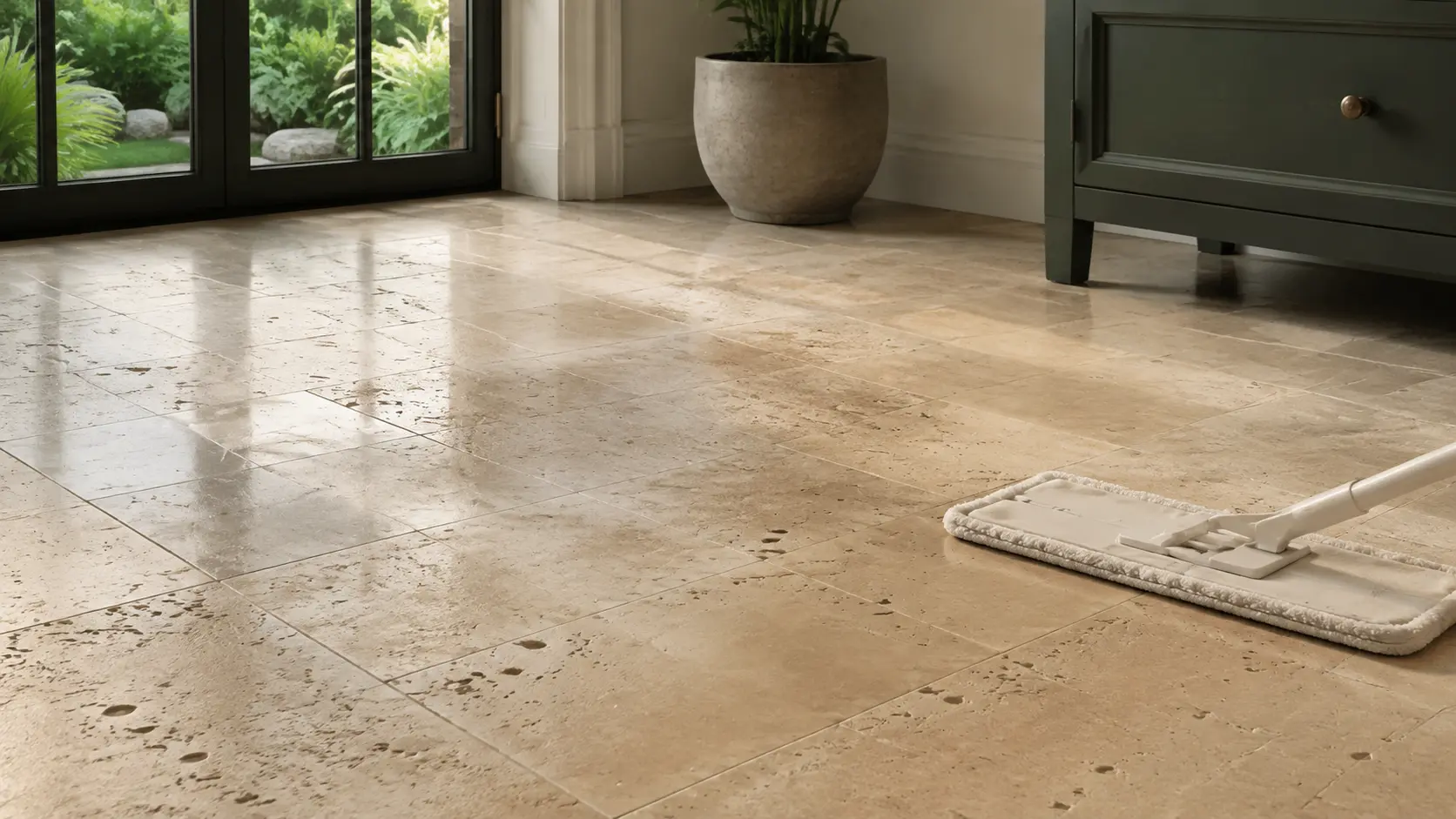
Travertine can hold ordinary soil in its texture, but a cloudy film, pale etch or opening filler needs a different response. This guide helps you identify the installation, clean it gently and judge the fully dry result before escalating.
Quick answer
To understand how to clean travertine tiles safely, first remove loose grit, then damp-clean with a pH-neutral cleaner labeled for natural stone. Follow its label, use a clean microfiber mop or soft cloth, remove the cleaner with frequently changed clean water and dry the tile completely. Do not use vinegar, lemon or an acidic bathroom cleaner. If a pale dull patch remains after drying, it may be etching rather than dirt.
Before cleaning, confirm it is real travertine
A printed porcelain tile can imitate travertine convincingly, while genuine travertine is a calcium-carbonate natural stone with finish- and filler-dependent care. Advice intended for porcelain may include acidic products that can permanently dull genuine stone.
Check the project records
Look for the invoice, tile carton, installer notes, sealer record or care sheet. A product name is more dependable than color or pattern alone.
Inspect repeated patterns
Highly repeated printed veining can suggest a manufactured lookalike, but visual clues alone do not prove the material. Ask the supplier when uncertain.
Identify the finish, filler and location
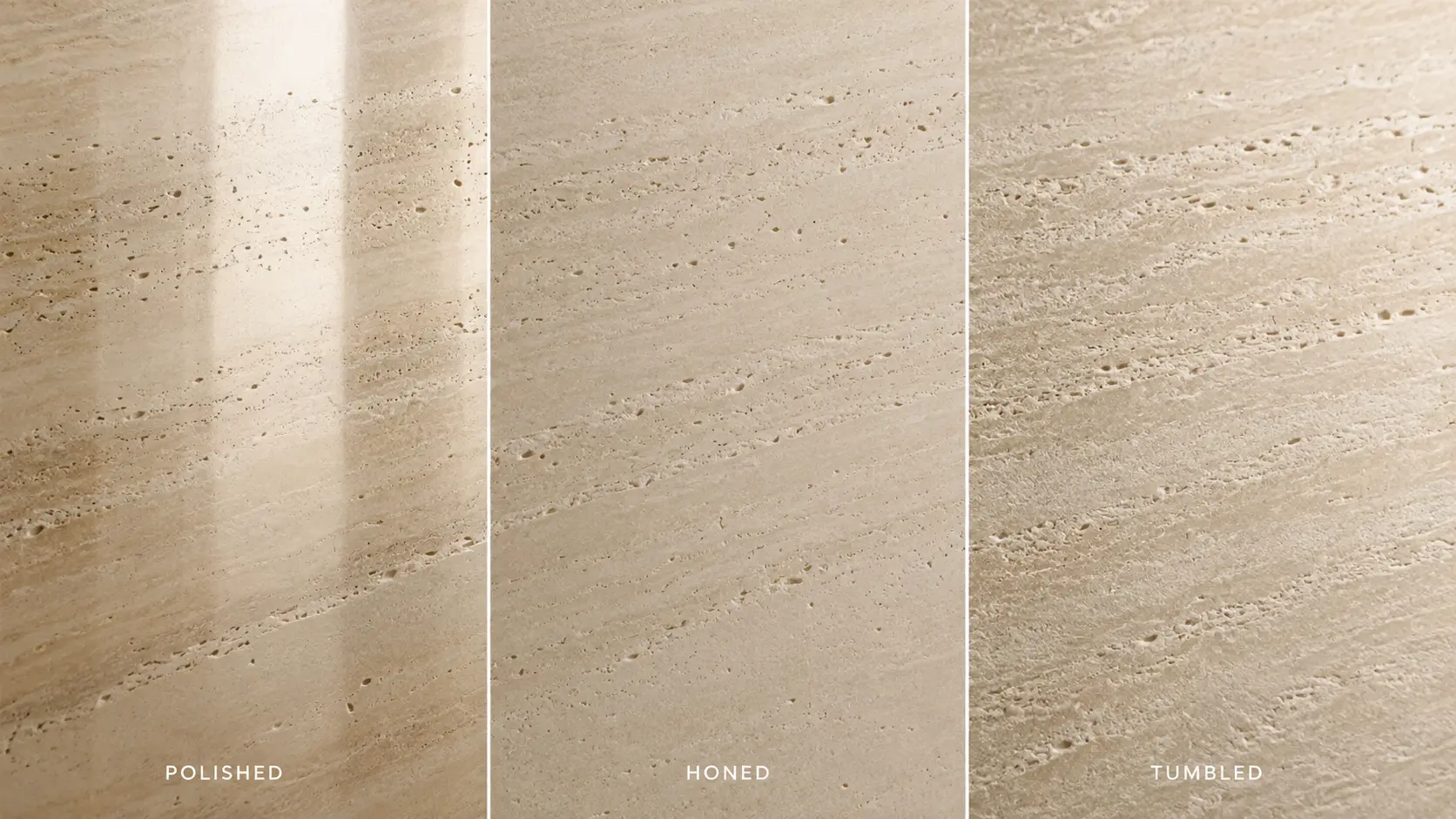
How to clean travertine tiles depends partly on what is installed. Polished travertine has a reflective finish; honed stone is smooth but matte; tumbled or brushed tile is intentionally textured. Many slabs and tiles have natural holes filled with cementitious or resin filler, while other installations intentionally retain an open texture.
Polished
Reflection changes make film, wear and acid etching easier to see. Do not confuse a damaged polish with removable residue.
Honed
The factory finish is matte and smooth. Do not try to make it glossy with household polish or wax.
Tumbled or brushed
Texture can hold more loose soil. Gentle agitation may be needed, but aggressive brushing can affect grout, filler or sealer.
Filled or unfilled
A new crater in previously smooth tile may be failed filler, not dirt that should be scrubbed out.
Diagnose dirt, film, stain, etching or damage
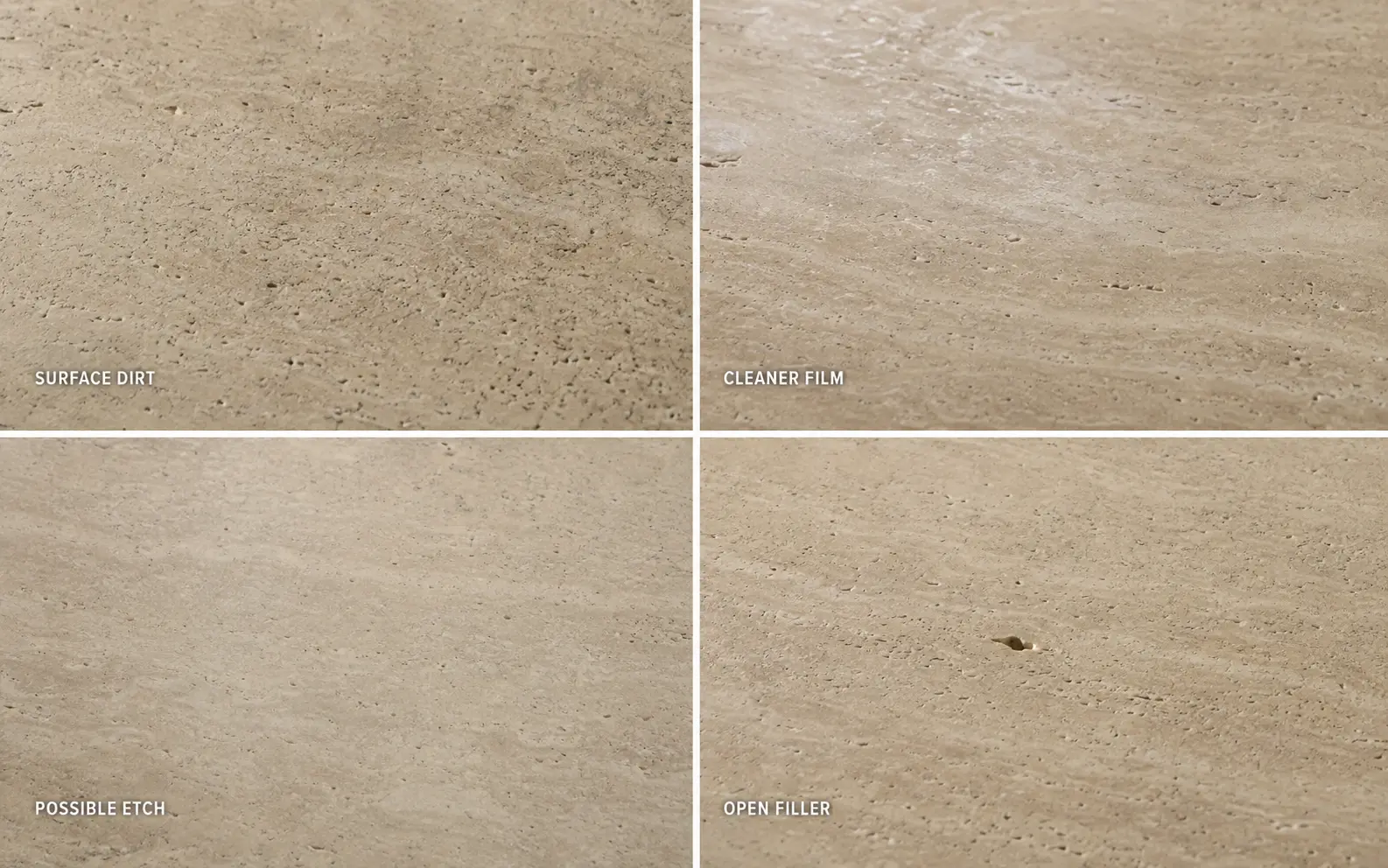
Photograph the dry area in ordinary and angled light before adding water. Cleaning should remove surface soil; it cannot replace stone dissolved by acid or repair loose grout and filler.
| What you see | Likely category | Safest response |
|---|---|---|
| Loose grit or gray soil | Surface debris | Remove dry before damp cleaning |
| Cloudy, sticky or streaky film | Cleaner residue or dirty mop water | Clean-water removal, then dry |
| Dark patch | Moisture or absorbed contamination | Let it dry fully before classifying |
| Flat pale dull area | Possible acid etching or finish wear | Stop stronger cleaning; seek restoration guidance |
| Dirty existing pits | Soil in intentional/open texture | Use only controlled soft agitation |
| New hole or crumbling edge | Failed filler, grout or stone damage | Stop scrubbing and contact a stone professional |
| White raised crust | Mineral deposit or residue | Do not assume an acid remover is safe |
What you need
- A vacuum with a suitable soft floor attachment, soft broom or microfiber dust mop
- A pH-neutral cleaner whose label expressly allows use on natural stone
- A clean microfiber mop, soft cloth or nonabrasive sponge appropriate to the location
- Clean rinse water and a second clean cloth or mop
- Soft absorbent towels
- The installer, tile, sealer and grout care instructions when available
The Natural Stone Institute permits neutral cleaner, stone soap or mild liquid dishwashing detergent for natural stone, but also warns that excessive cleaner can leave film. A labeled neutral stone cleaner is the easiest baseline to control; follow its directions rather than inventing a universal dilution.
How to clean travertine tiles in 7 safe steps
Inspect the dry installation
Look for cracks, loose tiles, crumbling grout, opening filler and active moisture. Photograph questionable areas. If the tile is moving or the filler is failing, routine cleaning is not the first repair.
Remove loose grit
Use the soft attachment, broom or dust mop suited to your installation. Grit dragged beneath a wet mop can abrade polished areas and collect in pits and grout lines.
Prepare the cleaner exactly as labeled
Choose a pH-neutral product approved for natural stone. Follow its dilution, contact and removal instructions. More concentrate is not automatically more effective and can increase film.
Test a small inconspicuous area
Check for an obvious change in color, sheen or texture. A successful spot test reduces uncertainty but cannot prove whole-floor compatibility when finishes, repairs or sealers vary.
Damp-clean manageable sections
Wring the mop or cloth so the surface is cleaned without flooding. Work gently and keep dirty solution from drying on the tile. Use a clean implement rather than redistributing old residue.
Remove cleaner with clean water
Follow the product label. When clean-water removal is called for, use a separate clean damp mop or cloth and change the water frequently. This step is essential when learning how to clean travertine tiles without leaving haze.
Dry and inspect under angled light
Dry the surface with soft towels and allow remaining moisture to disappear. Compare the same area from the side. Judge dirt, streaking, color and reflectivity only when fully dry.
What Should You Do After Cleaning Travertine?
Follow the branch that matches the fully dry result—not how the travertine looks while it is wet.
Verify that the surface is natural travertine rather than travertine-look porcelain or another manufactured tile.
Identify the finish and check whether the filler, grout, tile and existing sealer appear stable.
Use a label-approved pH-neutral natural-stone cleaner, remove the cleaner as directed and let the tile dry completely.
What does the fully dry travertine show?
Stop cleaning
Routine cleaning is complete. Do not add polish, wax, sealer or a stronger cleaner.
Remove residue once
Repeat only the clean-water removal step, change the water frequently and dry the tile again.
Diagnose before treating
Determine whether the mark is remaining moisture, an absorbed stain, mineral buildup or another surface deposit.
Seek professional guidance
Stop DIY escalation for possible acid etching, failed filler, crumbling grout, a crack or a moving tile.
How to clean grout between travertine tiles
Grout may be cementitious, epoxy or previously sealed, and its compatible cleaner can differ from the stone’s. Start with the same stone-safe neutral cleaner and a small soft brush only if the grout and tile manufacturers permit it. Keep pressure controlled and prevent dirty solution from drying in the surrounding texture.
Floors, showers and outdoor pavers need different care
| Location | Main concern | Article-safe direction |
|---|---|---|
| Indoor floor | Grit, mop film and excess moisture | Dry soil removal, damp neutral cleaning, clean-water removal and drying |
| Shower | Soap residue, minerals, caulk, grout and ventilation | Use a non-acidic stone-compatible product; squeegee after use; diagnose deposits separately |
| Outdoor paver | Organic soil, joints, filler and weathering | Clear debris and rinse gently; obtain installer guidance before chemicals or pressure equipment |
| Pool surround | Pool chemicals, slip safety and sealer compatibility | Follow stone, pool and sealer guidance; use a qualified professional for heavy buildup |
Cleaning is not the same as sealing
Cleaning removes soil. An impregnating sealer may improve stain resistance, but it does not make travertine stain-proof and cannot stop acid etching. The Natural Stone Institute recommends consulting the stone supplier because not every stone or installation has the same sealing need. Aqua Mix likewise notes that penetrating sealers do not prevent acidic liquids from etching travertine.
Do not apply sealer over dirty, damp or chemically contaminated tile. Do not adopt a generic yearly schedule. The existing product, finish, location, traffic and installer instructions determine inspection and reapplication.
Can you use vinegar to clean travertine?
No. Vinegar, lemon and acidic bathroom cleaners can react with calcium-carbonate travertine and leave a pale or dull etch. Diluting an acid does not turn it into a neutral stone cleaner. If vinegar has already been used, remove residue with clean water if the manufacturer permits, dry the tile and inspect the reflection. Cleaning cannot restore stone that acid has removed.
Can you steam clean travertine floors?
Do not make steam the default method. The tile is only one part of the installation; heat and moisture also reach grout, filler, sealer, adhesives and existing repairs. Use a steam appliance only when every relevant manufacturer expressly allows it for that installation. Otherwise use the controlled damp-cleaning method.
Products and tools to avoid as a first response
- Vinegar, lemon, citrus cleaner and acidic descaler
- Toilet-bowl cleaner and generic rust remover
- Scouring powder, steel wool, harsh pads and melamine foam
- Unverified baking-soda, bleach, ammonia or peroxide mixtures
- Wax or household polish intended to create shine
- Steam or pressure washing without installation-specific approval
- Rotary machines, honing powder or DIY polishing as routine cleaning
Never mix cleaning chemicals. The Natural Stone Institute specifically warns that mixing ammonia and bleach creates a toxic gas.
When routine cleaning is not enough
Contact the installer, tile supplier or a qualified natural-stone restoration professional when you find expanding cracks, moving tiles, hollow or loose areas, crumbling grout, failed filler, widespread etching, deep staining, flaking coatings or persistent moisture from below.
Send dry photographs under direct and angled light, plus the tile name, finish, location, sealer history and every product already applied. That evidence helps distinguish a cleaning problem from restoration or installation failure.
Simple travertine maintenance
The safest long-term answer to how to clean travertine tiles is consistency: remove grit early, use compatible cleaner sparingly and respond to the dry result instead of reaching for stronger products.
- Remove grit before it is tracked across the surface.
- Blot spills rather than spreading them.
- Use clean mop water and clean tools.
- Remove cleaner residue and judge the tile only when dry.
- Use mats and suitable furniture protection in high-traffic areas.
- Squeegee compatible shower installations to reduce lingering water and soap residue.
- Inspect grout, filler and sealer condition instead of following a fixed calendar.
Frequently asked questions
What is the safest cleaner for travertine tile?
A pH-neutral cleaner whose label specifically allows natural stone is the clearest baseline. Follow its dilution and removal directions. The Natural Stone Institute also permits stone soap or mild liquid dishwashing detergent, but excessive soap can leave film.
Can I clean travertine with dish soap?
A small amount of mild liquid dishwashing detergent may be suitable for routine soil when the installer and existing treatment allow it. Remove it thoroughly with clean water and dry. Do not assume every fragranced, degreasing or acidic formula is equivalent.
Why does travertine look cloudy after mopping?
Common possibilities include too much cleaner, dirty mop water, remaining moisture, worn finish or acid etching. Use clean-water removal once and inspect fully dry. A stable dull patch with changed reflection may need restoration rather than more cleaner.
Can baking soda damage travertine?
Baking soda is not necessary for the routine method and can act as a mild abrasive or collect in textured stone. Do not make a universal paste for tile or grout; use a verified stone-safe method for the specific problem.
Does travertine need to be sealed after cleaning?
Not automatically. Cleaning and sealing are separate jobs. Existing sealer, porosity, finish, location and the product manufacturer determine whether treatment is appropriate. The tile must be clean and dry before any approved application.
Can acid etching be cleaned off travertine?
No. Etching is a physical change caused when acid reacts with the stone. Residue can be removed, but lost finish must be professionally honed or polished to match when restoration is practical.
Care sources
- Natural Stone Institute: Cleaning Products for Natural Stone — neutral cleaning, rinsing, drying, acid and chemical-mixing guidance.
- MSI: Travertine Tile Maintenance — finish, filler, repair and maintenance context.
- The Tile Shop: How to Clean Travertine Tile — basic damp-cleaning and acid-avoidance guidance.
- Aqua Mix: Cleaning and Sealing Travertine — sealing, etching and restoration distinctions.
Source scope: product-specific directions apply only to that product and region. Your tile, sealer, grout and installer instructions take precedence.

