Finish-aware floor care
A natural ingredient is not automatically safe for every floor. Use this surface-by-surface method to remove soil with the least aggressive compatible cleaner—without trading simplicity for haze, sticky residue or moisture damage.
To clean floors naturally, first identify the floor and finish, remove loose grit, then use the least liquid and least aggressive cleaner permitted by the current care guide. A clean microfiber pad and an approved neutral cleaner are a safer cross-surface starting point than a universal vinegar recipe. Dry the floor completely and diagnose any remaining haze before adding another product.
If you searched for how to clean floors naturally, you may want fewer ingredients, less fragrance, lower residue, a simpler routine or a homemade alternative. Those are reasonable goals. The mistake is assuming that vinegar, baking soda, essential oils, soap or steam will behave the same way on coated wood, laminate, vinyl, ceramic tile and natural stone.
First, Identify Your Floor and Its Finish
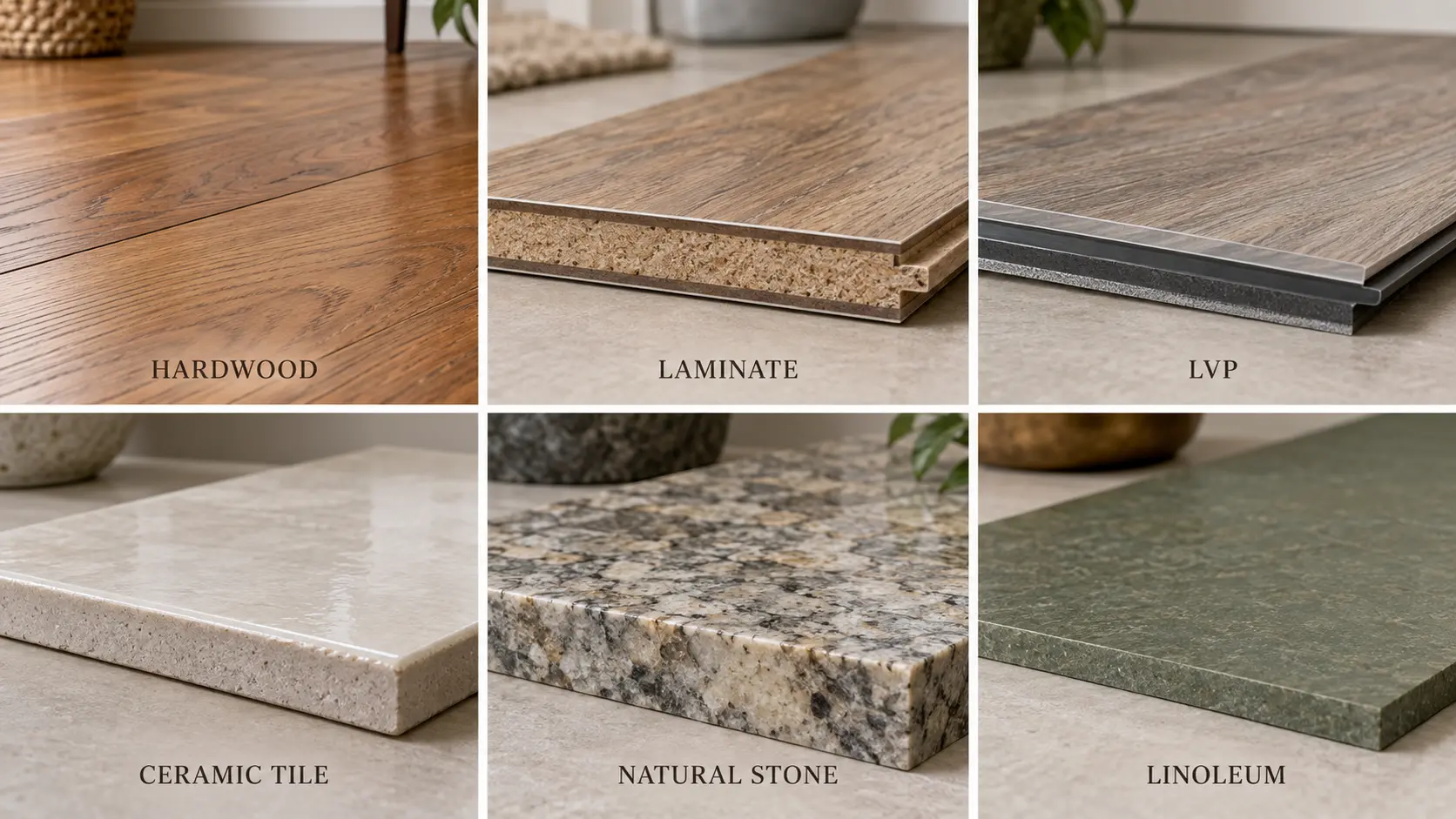
The exposed surface controls routine care. Two floors that look like oak may be polyurethane-coated hardwood, laminate with a wood-fiber core, luxury vinyl plank or a hybrid product. A stone-look tile may be porcelain, marble, travertine or sealed concrete. Appearance alone is not reliable enough.
Look for the purchase invoice, leftover carton, installation records, model number, manufacturer stamp or current warranty. If you rent, ask the owner or property manager. For wood, also determine whether the exposed finish is a surface coating, penetrating oil, wax or hardwax oil.
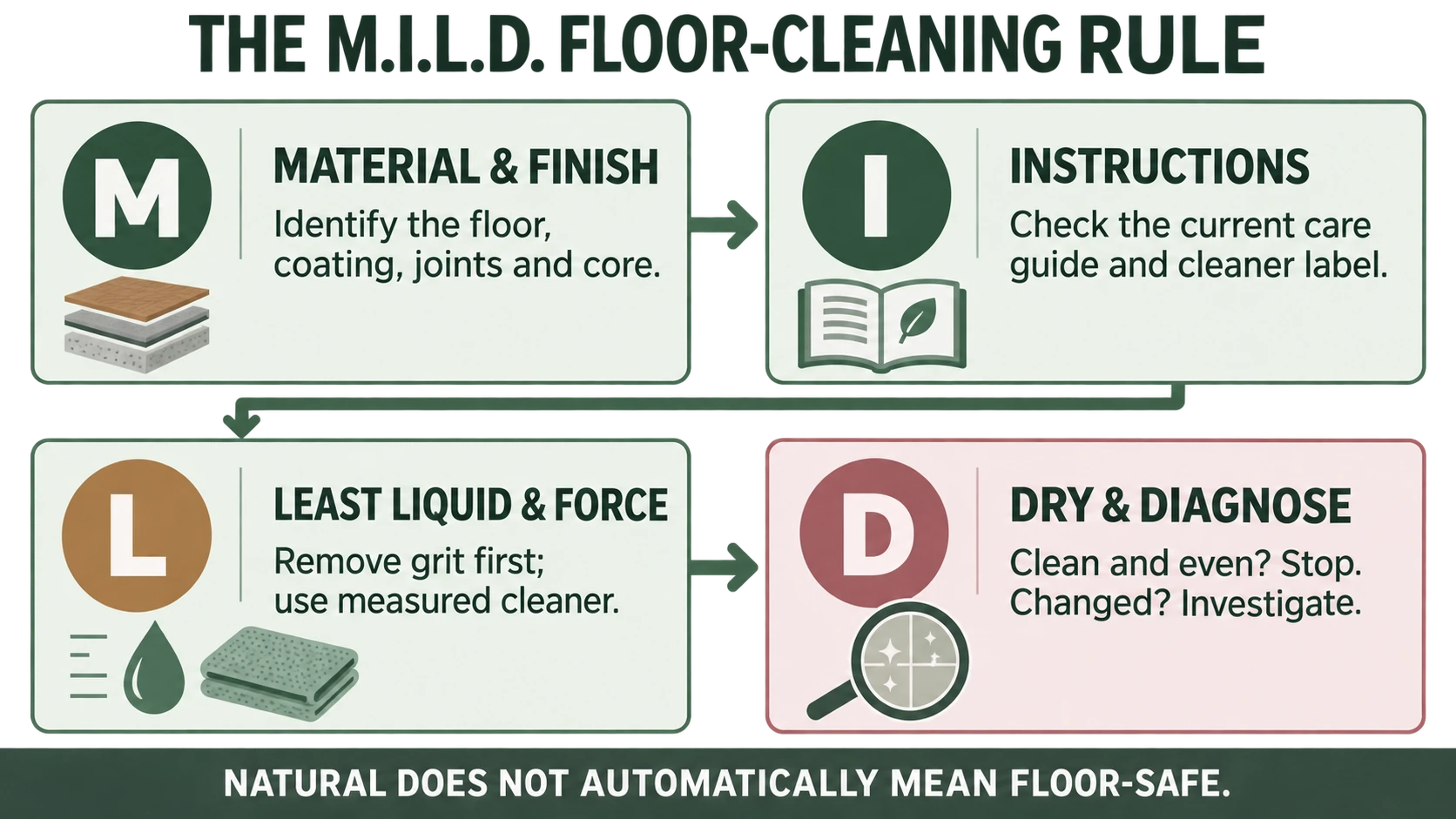
Use the M.I.L.D. Rule
Material and finish
Identify what is exposed and what lies beneath it. Finish, joints, grout, adhesives and wood-based cores all affect risk.
Instructions
Check the installed floor’s current care guide and the cleaner label. Exact product instructions outrank a generic online recipe.
Least liquid and force
Remove dry soil first. Use measured cleaner, a clean pad, minimal moisture and no harder scrubbing than necessary.
Dry and diagnose
Judge the floor only after it dries. A remaining mark may be residue, wear or moisture change—not dirt that needs stronger chemistry.
Natural Floor Cleaner Compatibility Matrix
This is a conservative starting guide, not a substitute for the installed product’s instructions.
| Floor | Lowest-risk starting method | Conditional only | Avoid unless the exact maker permits it | Deep guide |
|---|---|---|---|---|
| Coated hardwood | Remove grit; use the exact maker-approved cleaner and pad. | A barely damp method only when the care guide allows it. | Vinegar, steam, wet mopping, oil soap and unapproved polish. | Clean hardwood floors safely |
| Oil, wax or hardwax-oil wood | Follow the finish maker’s maintenance system. | Product-specific maintenance soap or oil. | Generic recipes, steam and excess water. | Identify the hardwood finish |
| Laminate | Dry clean, then use the maker-specified low-moisture method. | Only the approved cleaner and dosage. | Flooding, universal vinegar recipes and steam without approval. | Laminate water limits |
| LVP, LVT or sheet vinyl | Remove grit; use an approved pH-neutral cleaner. | Spot treatment only when the care guide permits it. | Wax, polish, abrasives, and vinegar or steam where prohibited. | Clean LVP without film |
| Ceramic or porcelain tile | Remove grit; use cleaner approved for the tile-and-grout installation. | Mild detergent if the current instructions allow it. | Dirty mop water, abrasives and unverified acids around grout or sealers. | Understand tile, grout and caulk |
| Natural stone | Use pH-neutral cleaner labeled for natural stone. | Stone-specific stain treatment after diagnosis. | Vinegar, lemon, acid and abrasive powder. | Clean slate tiles safely |
| Linoleum | Use the current manufacturer’s neutral-pH method. | Finish-specific maintenance products. | Treating it as vinyl, excess water and universal recipes. | See manufacturer evidence |
| Bamboo, cork or unknown | Dry clean until construction and finish are confirmed. | Exact maker-approved low-moisture method. | Universal vinegar, steam and soaking. | Clean bamboo flooring safely |
How to Clean Floors Naturally in Seven Finish-Aware Steps
Find the current care instructions
Confirm the material, product line and exposed finish. Read whether the cleaner should be ready-to-use or diluted, applied to the pad or floor, and rinsed or left as a no-rinse product.
Remove loose grit first
Sweep, dust-mop or vacuum using the correct hard-floor attachment. Turn off a rotating beater bar where the flooring manufacturer requires it. Grit dragged beneath a mop can scratch or dull a finish.
Prepare clean tools and a measured solution
Use a clean microfiber flat mop, spare pads and a clean dry towel. Measure concentrate exactly. More cleaner is not stronger cleaning—it often creates a film that attracts soil.
Test a hidden area
Apply the permitted method in an inconspicuous location. Let it dry completely, then compare color, texture, sheen and slipperiness. Stop if anything changes unexpectedly.
Use the least liquid that works
Lightly dampen the pad or apply the cleaner exactly as directed. Never pour a bucket onto a floor. Prevent liquid from collecting at plank seams, perimeter gaps, damaged grout or transitions.
Work in small sections with clean pads
Use overlapping controlled passes. Replace a pad when it turns gray, greasy or begins leaving arcs. On a floor that requires rinsing, use fresh water and change it before it becomes visibly dirty.
Dry, inspect and stop
Pick up visible moisture with a clean towel where appropriate. Let the area dry under normal room conditions and inspect it in angled light. If it is clean and even for its intended finish, stop—do not add polish for unnecessary shine.
Are Popular Natural Cleaning Ingredients Safe?
No pantry ingredient is universally safe for flooring. Use the verdicts below as a screening tool, then check the exact floor and cleaner documentation.
| Option | Verdict | Why | Better decision |
|---|---|---|---|
| Plain water | Conditional | Low chemistry is not low risk when water enters seams or wood-based cores. | Use only the amount and method the floor maker permits. |
| White vinegar | Not universal | Its acidity can etch calcareous stone and conflicts with care guidance from some wood and vinyl manufacturers. | Skip it unless the exact current floor guide expressly permits it. |
| Baking soda | Spot-use only when approved | Particles can act as an abrasive, leave pale residue or lodge in texture and grout. | Diagnose the mark first; use a surface-approved spot method. |
| Dish soap | Conditional, low dose | Formulas differ and excess surfactant can leave sticky or slippery film. | Use only when allowed; measure lightly and follow rinse directions. |
| Castile soap | Conditional | Soap can leave residue, especially in hard water, and is not automatically finish-compatible. | Prefer a labeled, approved neutral cleaner. |
| Essential oils | Usually unnecessary | They add fragrance and oil, not proven cleaning compatibility; they can leave residue. | Choose fragrance-free when scent exposure is a concern. |
| Steam | Exact-product approval only | Heat and moisture can affect finishes, adhesives, joints and wood-based cores. | Do not rely on a machine’s “hard floor” setting as approval. |
| Plant-based cleaner | Verify both labels | Plant-derived ingredients do not prove compatibility or disinfection. | Check the floor guide, cleaner label and a credible certification where relevant. |
Evidence note: Bruce prohibits vinegar and steam on its hardwood floors; Shaw and COREtec warn against vinegar on their vinyl products; Natural Stone Institute warns that acids can dull or etch calcareous stone. These manufacturer examples demonstrate why a universal recipe is unreliable—not that every floor in a broad category has identical instructions.
Choose the Method for Your Floor
Hardwood and engineered wood
First identify the finish. A polyurethane-coated floor and an oil- or wax-finished floor may require different maintenance systems. Remove grit and use the cleaner and applicator named for the installed floor. Bruce, for example, tells owners not to use water or steam, vinegar, oil soap, wax-based cleaners or unapproved polish on its hardwood floors. That product-specific guidance outranks a generic vinegar recipe. For a complete method, use the CareBySurface hardwood-floor guide.
Laminate
Laminate commonly has a wood-fiber core beneath a wear surface. Remove grit, use minimal liquid and protect joints and perimeter gaps. Pergo publishes precise cleaner dosage and warns against excess water for its laminate products; permitted spill exposure varies by collection. Do not translate one collection’s water warranty into permission to wet-mop every laminate floor. Read whether laminate flooring is waterproof before treating seams as watertight.
LVP, LVT and sheet vinyl
Use a compatible pH-neutral cleaner and avoid wax or polish unless the product explicitly calls for it. Shaw says vinegar-based products can damage its luxury-vinyl surface, and COREtec advises against vinegar, citrus, detergent, wax, floor polish and generally steam unless specifically approved. See how to clean LVP flooring without film or seam damage.
Ceramic and porcelain tile
Clean the installation, not only the tile face. Grout, sealer, texture and adjacent movement joints may be less tolerant than a glazed tile. Remove grit, use a clean pad and choose a cleaner labeled safe for both tile and grout. Daltile cautions against mopping with dirty water because it redistributes soil. For wet-area tile, use the tile, grout and caulk diagnostic guide.
Natural stone
Do not use vinegar, lemon or another acid as a universal natural cleaner. The Natural Stone Institute recommends a neutral cleaner, stone soap or a mild liquid dishwashing detergent with warm water, followed by thorough rinsing where the method requires it and drying. Calcareous stones such as marble, limestone and travertine can etch. Textured slate may trap soil and require a soft brush. Start with the slate cleaning guide or travertine cleaning guide.
Linoleum
Linoleum and sheet vinyl are not interchangeable. Forbo’s current guidance for its protected Marmoleum products calls for a neutral-pH cleaning solution and publishes exact product dilution. Use the documents for your specific linoleum and finish rather than copying a vinegar formula intended for vinyl.
Bamboo, cork, sealed concrete and unknown floors
These categories vary significantly by construction, factory finish, sealer and installation. Use dry cleaning until the product and finish are known. For bamboo, follow the finish-aware bamboo cleaning method. For sealed concrete, the coating or sealer instructions—not the concrete alone—control cleaner compatibility.
Why Does the Floor Look Hazy, Sticky or Dull After Mopping?
Wait until the floor is completely dry, then inspect it under low angled light. Repeatedly adding cleaner can make the result worse.
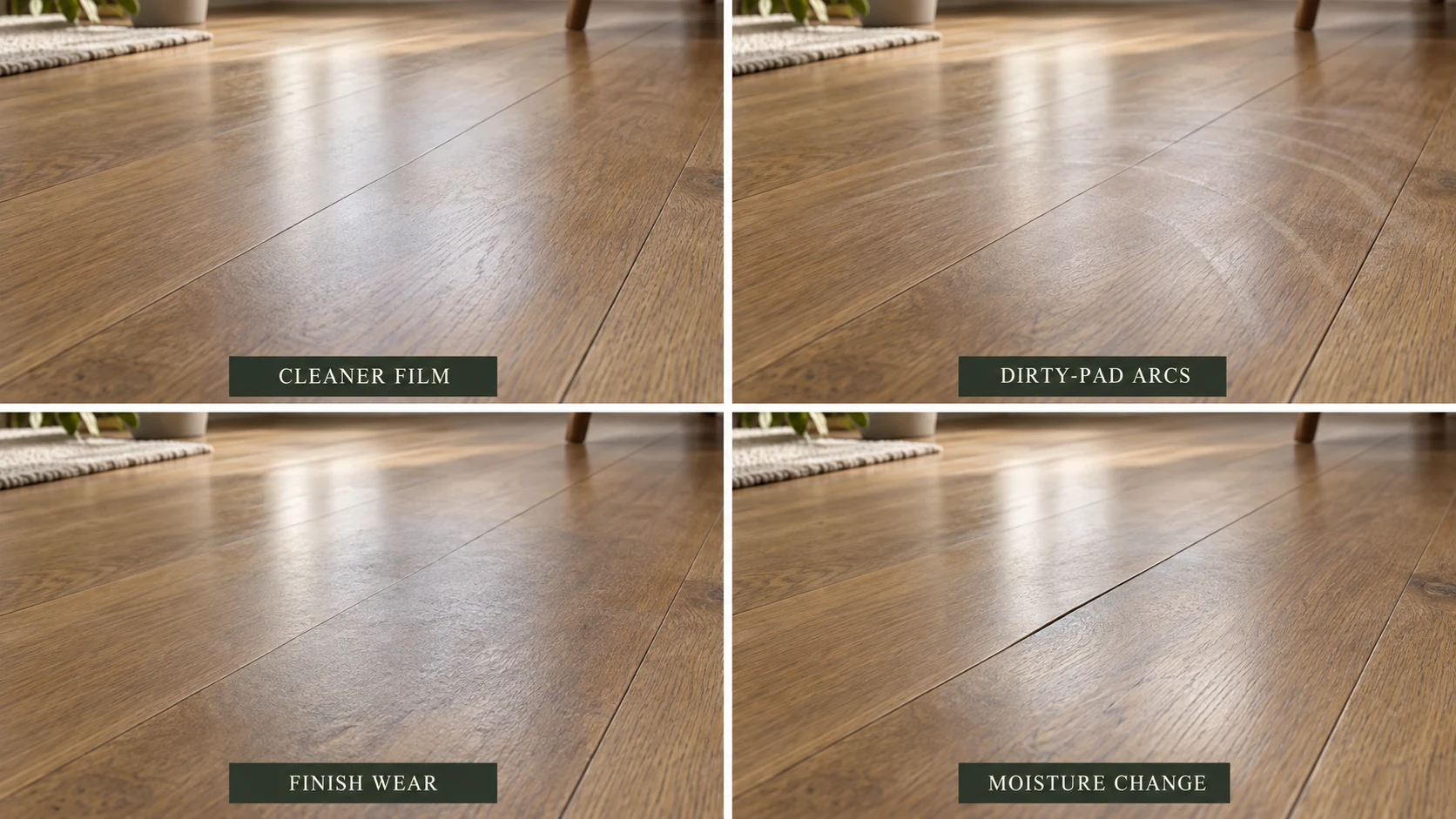
Uniform film
Haze that improves with the cleaner label’s approved residue-removal or rinse method may be excess product. Do not invent a rinse step for a floor or cleaner that forbids it.
Dirty-pad arcs
Curved tracks often follow a saturated or contaminated pad. Replace the pad and clean only as the floor guide directs.
Wear or finish change
A dull traffic lane, whitening, color change or altered reflection that does not move may be coating wear or chemical damage, not removable soil.
Moisture change
Raised seams, dark edges, cupping, swelling or persistent odor require moisture investigation. Stop wet cleaning and document the condition.
Cleaning Is Not the Same as Disinfecting
The CDC distinguishes cleaning from disinfecting. Cleaning uses water, soap or detergent and physical action to remove dirt and many germs. Disinfecting uses an appropriate product to kill specified germs and generally follows cleaning.
Routine cleaning is usually enough in a home unless someone is sick or another situation calls for disinfection. If disinfection is needed, use an applicable EPA-registered product exactly as labeled—including surface suitability, precleaning, wet contact time, ventilation and safety directions—and confirm that the floor manufacturer allows it. Vinegar and essential oils should not be presented as registered disinfectants.
What “safer” product selection can mean
Instead of relying on vague “natural” or “chemical-free” marketing, consider independently verifiable information. The EPA Safer Choice product search can help identify cleaners that meet its ingredient standard. That certification does not replace the floor manufacturer’s compatibility instructions. EPA’s DfE label applies to qualifying antimicrobial products; it is not interchangeable with an ordinary cleaner.
Children, pets and fragrance
Do not assume homemade means harmless. Store every ingredient and mixed solution securely, follow label precautions, ventilate as directed and keep people and animals away until the floor is dry where the label requires it. Avoid unsupported “pet-safe,” “baby-safe,” “non-toxic” or allergy claims. If fragrance is the concern, look for a compatible fragrance-free option rather than adding essential oils.
Natural Floor Cleaning Decision Map
Follow the branches in order. This text-based map remains usable with a keyboard or screen reader and contains the complete decision logic.
No: use dry cleaning only and find the invoice, carton, installer or care guide. Yes: continue.
Confirm dilution, application, rinse rule and tool. Test a hidden area.
Do not use it. Choose the exact documented method or contact the manufacturer.
Use a clean pad, small sections and no pooled liquid.
Stop. More product or polish is unnecessary.
Check for excess product or dirty-pad transfer; follow the cleaner’s approved removal instructions.
Stop wet cleaning. Document the change and investigate finish or moisture damage.
Natural Floor Cleaning FAQ
What is the safest natural way to clean floors?
Identify the floor and finish, remove loose grit, and use the least liquid and least aggressive cleaner allowed by the current care guide. For many floors, a clean microfiber tool and an approved neutral cleaner are a safer starting point than a universal pantry recipe.
Can I use vinegar to mop every type of floor?
No. Vinegar can etch calcareous natural stone and conflicts with the care instructions for some hardwood, laminate and vinyl products. Use it only if the exact current floor guide permits it; a generic online dilution is not universal approval.
What can I use instead of vinegar?
Use the cleaner named in the installed floor’s care guide. If the manufacturer allows a cleaner category rather than a brand, choose a correctly diluted pH-neutral product labeled for that exact surface and finish.
Is dish soap safe for floors?
Sometimes, but not universally. Dish-soap formulas vary, excess soap can leave a sticky film, and some manufacturers prohibit detergents. Use a very small measured amount only when the floor guidance allows it, and follow the stated rinse rule.
Are essential oils safe in floor cleaner around pets?
Do not assume so. Essential oils are unnecessary for routine soil removal, can leave oily or fragranced residue, and broad pet-safety claims require substance- and exposure-specific evidence. Choose a compatible fragrance-free cleaner when scent is the concern.
Can a natural cleaner disinfect floors?
Cleaning and disinfecting are different. If disinfection is actually needed, use a product registered for the intended organism and surface, follow its label and wet contact time, and confirm the floor manufacturer permits it. Do not imply that vinegar or essential oils provide registered disinfection.
Why is my floor sticky or cloudy after mopping?
Common causes include too much cleaner, a formula that requires rinsing, dirty water, a contaminated pad, polish buildup or incompatibility. Let the floor dry, inspect the pattern and follow the approved residue-removal method. Fixed dullness or color change may be finish damage rather than dirt.
What if I do not know my floor type or finish?
Use dry methods only until you can identify it from records, spare planks, the installer, retailer or manufacturer. Avoid vinegar, steam, polish and wet mopping while compatibility is unknown.
Evidence and Methodology
Care instructions can change by product line and finish. The examples below were reviewed on September 9, 2026. Recheck the exact installed product’s current documentation before acting.
- Bruce: hardwood floor-care dos and don’ts.
- Shaw Floors: vinyl care and maintenance.
- COREtec: LVP cleaning guidance.
- Pergo: laminate maintenance and water guidance.
- Natural Stone Institute: care and cleaning.
- Daltile: ceramic and porcelain tile care.
- Daltile: natural-stone care.
- Forbo: Marmoleum floor care.
- CDC: when and how to clean and disinfect a home.
- U.S. EPA: Safer Choice.

